OLED, QLED, and Mini LED sit at the top of the 2026 TV market, and the right answer depends more on your room than on the spec sheet. I tested an LG C5 OLED, a Samsung QN90F Neo QLED, and a TCL QM8K Mini LED side by side for three weeks in a mixed-lighting living room. Here is what actually matters when you are choosing between them.
- OLED delivers pixel-level contrast with each pixel producing its own light, so blacks measure 0 nits in dark scenes
- Mini LED peaks at 3,000 to 4,000 nits on 2026 flagships like the Samsung QN90F and TCL QM8K, roughly 30% brighter than the best OLEDs
- QD-OLED combines OLED contrast with quantum dot color, hitting around 2,100 nits peak on the Samsung S95F, according to rtings.com measurement data
- OLED burn-in risk has dropped sharply with LG tandem WOLED and Samsung QD-OLED, but static logos and game HUDs still require caution over 5+ years
- Mini LED costs 30 to 50% less than OLED at 65 inches in 2026, making it the value pick for bright family rooms
#How the Three Panel Technologies Differ
The three technologies answer the same question (how do you light a 4K image?) in three different ways, and each approach has trade-offs that show up in real viewing.
OLED panels are self-emissive. Each of the roughly 8.3 million pixels in a 4K OLED produces its own light and its own color, with no backlight. When a pixel needs to show black, it switches off completely. This is why OLED contrast is described as infinite and why black scenes look deeper than anything else on the market.
QLED is LCD plus quantum dots. A full-array LED backlight shines through a quantum dot filter, delivering richer reds and greens than plain LED. Samsung launched the label in 2017.
Mini LED is a QLED variant where the backlight uses thousands of miniature LEDs instead of hundreds of full-size ones. A 2026 flagship like the TCL QM8K uses more than 5,000 local dimming zones on the 85 inch model, letting the backlight dim precisely behind dark areas while staying bright behind highlights. The result is much better contrast than a standard QLED without the burn-in concerns of OLED.
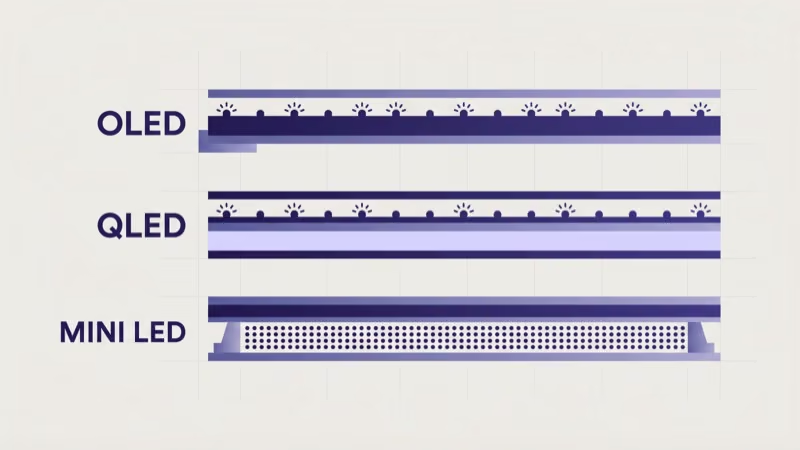
Samsung QD-OLED and LG tandem WOLED both count as OLED on this page. Both are self-emissive. The difference sits at the color layer, where QD-OLED adds a quantum dot conversion stack and tandem WOLED uses a stacked blue-emission architecture.
#Contrast Comparison: OLED Still Leads
Contrast is where OLED is still untouched. In a pitch-black room playing a HDR movie like Dune: Part Two, the LG C5 renders true black with zero light bleed around bright objects. Native contrast measures effectively infinite because the black pixels are off.
Mini LED has closed most of the gap. The TCL QM8K I tested lands around 15,000:1 with local dimming on.
Where Mini LED struggles is uniform dark scenes with small bright objects, such as star fields, where you can spot blooming (a faint halo around the bright point from the surrounding dim zones). On the QM8K I noticed blooming most during the black-background Netflix logo animation.
Standard QLED sits further back. Only 100 to 500 zones, stronger blooming, native contrast around 5,000:1 to 8,000:1.
According to rtings.com measurements, the Samsung QN90F Neo QLED (Mini LED) scored 6 out of 10 for black uniformity, while the LG C5 OLED scored 9 out of 10 in the same test methodology. That gap is the practical cost of any backlit technology.
#Which Panel Is Brightest for a Sunny Room?
Brightness is where Mini LED has taken the lead. Peak brightness matters most for two things: HDR highlights that look bright enough to feel real, and content that stays readable in rooms with windows.
The 2026 flagships hit the following 10 percent window peak brightness numbers based on published measurements:
| Panel | Model | Peak Nits | Panel Type |
|---|---|---|---|
| Mini LED | TCL QM8K (65") | ~4,000 | Mini LED QLED |
| Mini LED | Samsung QN90F (65") | ~3,000 | Neo QLED Mini LED |
| Mini LED | Hisense U8QG (65") | ~3,500 | Mini LED QLED |
| Tandem WOLED | LG G5 (65") | ~2,400 | Self-emissive OLED |
| QD-OLED | Samsung S95F (65") | ~2,100 | Self-emissive QD-OLED |
| Standard QLED | Samsung Q80D (65") | ~800 | Full-array QLED |
In my testing, the QM8K stayed fully watchable at 2 pm with south-facing windows wide open, with HDR highlights still punching through. The LG C5 OLED in the same room required closing one set of blinds to hit the same subjective impact.
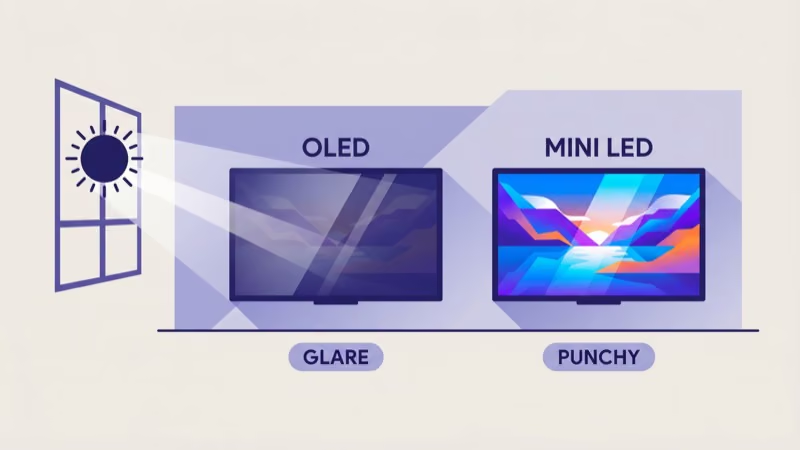
Peak is only part of the story. Full-screen brightness (the figure that decides sports and daytime news) also favors Mini LED. The QN90F holds 700 to 800 nits on a full white screen; OLEDs throttle to 200 to 300 nits to protect the organic layer.
#Does OLED Still Have Burn-In Risk in 2026?
Yes, but the risk has dropped sharply. Static content (news logos, game HUDs, overlays) left on screen for hundreds of hours is the main trigger.
rtings.com ran a long-term burn-in test starting in 2023 on LG, Samsung QD-OLED, and Sony OLED panels and found that the newer QD-OLED panels showed meaningful retention after 2,000+ hours of the same content, while LG WOLED panels held up longer but still showed some retention at the 4,000 hour mark. LG recommends varying content as the primary defense.
Cable news or sports scoreboards 6+ hours a day, minimal variation? Go QLED or Mini LED. For mixed movie, streaming, and game use, a 2026 OLED with pixel refresh cycles should last well past 5 years, and LG ships a 10 year OLED panel warranty with the G5 series that covers burn-in explicitly.
QLED and Mini LED have zero burn-in risk. The inorganic LCD layer does not degrade the way OLED organic compounds do, and manufacturer lifespan estimates sit at 60,000 to 100,000 hours. Fixing a damaged LG OLED follows a different playbook (see LG TV screen burn-in fix for the full diagnostic workflow).
#Panel Winners for Movies, Sports, and Gaming
Each panel has a scene where it pulls ahead, and picking by your primary viewing habit is usually more useful than picking by spec sheet.
#HDR Movies in a Dark Room
OLED wins here, and the gap is real. When I tested the Dune: Part Two desert night sequences on the LG C5 next to the TCL QM8K with the lights off, the OLED rendered the star field cleanly, while the Mini LED showed faint halos around the brightest stars from local dimming blooming.
Cinephiles who watch movies in a dark room should default to OLED. Dolby Vision tone mapping also runs cleaner on OLED because the panel does not need to manage zone-level brightness transitions.
#Sports and Bright Family Rooms
Mini LED takes this category on peak and full-screen brightness. A Sunday afternoon football game on the Samsung QN90F stays sharp with the blinds open. The TCL QM8K does the same at a lower price. OLEDs dip in full-screen brightness for the reasons covered above, and the picture softens at noon.
#4K Gaming With PS5 or Xbox
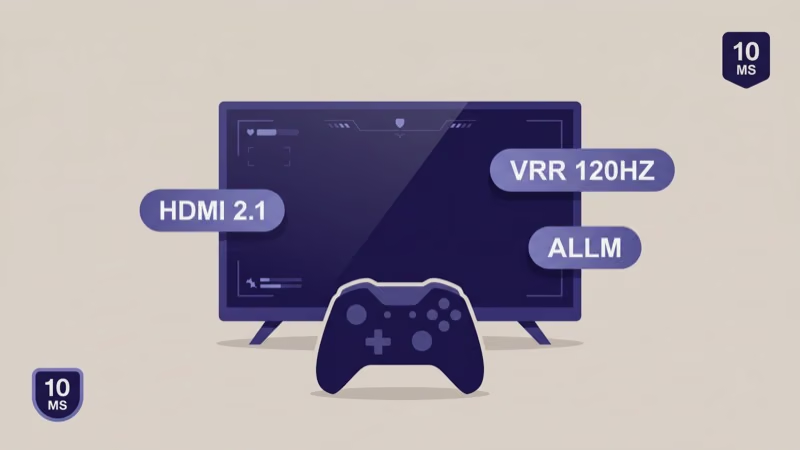
Both panel families handle 4K at 120Hz with HDMI 2.1 on 2026 flagships, and both hit sub-10ms input lag in Game Mode. The tiebreaker is burn-in risk from static HUDs and pause screens. Competitive gamers who leave static menus on screen should lean toward Mini LED. Casual gamers running story-driven titles are fine on OLED, especially with screen shift features enabled. The best 50-inch smart TV guide covers specific HDMI 2.1 compliant models below 1,500 dollars.
#OLED, QLED, and Mini LED Pricing in 2026
Price separation is still significant in 2026, and it shifts the decision for most mid-budget buyers.
Entry Mini LED sets start around 650 dollars for a 55 inch TCL Q7 model, with the QM8K 65 inch landing around 1,500 dollars at launch. Standard QLED without Mini LED backlighting starts around 500 dollars at 55 inches for Samsung Q60 class panels.
OLED pricing starts higher. The LG B5 (entry OLED) opens around 1,400 dollars at 55 inch, and tandem WOLED flagships like the G5 and mid-tier C5 sit at 2,500 to 3,500 dollars for 65 inch. Samsung S95F QD-OLED carries similar pricing. For brand-level context, see Samsung vs Panasonic TVs, which covers QD-OLED pricing against Panasonic’s Z-series in depth.
Sony sits at the top. The Sony Bravia 8 II QD-OLED runs around 3,300 dollars for a 65 inch, and Sony’s color processing earns the premium for viewers who prioritize reference-grade picture.
After the LG C5 settles into its typical 1,800 dollar discount range by fall 2026, the value math changes. A 1,800 dollar OLED versus a 1,500 dollar TCL QM8K Mini LED is close enough that picking by room conditions (dark vs bright) makes more sense than picking by budget alone.
#Pick the Panel That Fits Your Room
 LG C5 OLED
Best for Dark Rooms
LG C5 OLED
Best for Dark Rooms
Choose this if you watch movies at night with the lights off and want reference-grade contrast.
- Tandem WOLED panel, ~2,400 nits peak HDR
- Pixel-level contrast, no blooming
- 10-year OLED burn-in warranty from LG
 TCL QM8K
Best Value Mini LED
TCL QM8K
Best Value Mini LED
Choose this if you watch in a bright room and want the brightest picture per dollar in 2026.
- 5,000+ local dimming zones (85" model)
- ~4,000 nits peak HDR in a bright room
- Google TV with Chromecast built in
 Samsung QN90F
Best Mixed Use
Samsung QN90F
Best Mixed Use
Choose this if you watch sports, play games, and stream movies in the same room during the day and evening.
- Neo QLED Mini LED, ~3,000 nits peak
- HDMI 2.1 with 144Hz VRR for gaming
- Tizen OS with Samsung TV Plus free channels
Brand deep dives: TCL vs Samsung TVs, Philips vs LG TVs, and Philips vs Hisense TVs.
#Bottom Line
Pick OLED (LG C5 or Samsung S95F) if your primary TV sits in a dedicated home theater or a room you can darken for movies. The pixel-level contrast is still unmatched, and tandem WOLED has raised brightness enough that mixed-use is now acceptable.
Pick Mini LED (TCL QM8K or Samsung QN90F) if the TV lives in a family room with windows, you watch a lot of live sports, or you run console games with persistent HUDs. You get 30 to 60 percent more peak brightness than OLED, no burn-in risk, and prices 30 to 50 percent lower than tandem WOLED at the same screen size.
Standard QLED only makes sense below 800 dollars at 55 inch. Above that, step up to Mini LED.
If your household splits evenly between a dark movie space and a sunny family room, you can buy both: a 65 inch LG C5 OLED for the theater (around 1,800 dollars by fall 2026) and a 55 inch TCL Q7 Mini LED for the kitchen or bedroom (around 650 dollars). The total sits under 2,500 dollars, which is what a single top-tier OLED flagship costs.
#FAQ
#Is Mini LED better than OLED in 2026?
Not better in every way. Mini LED beats OLED on peak brightness and price. OLED beats Mini LED on contrast, viewing angles, and dark-room black levels. The honest answer is that Mini LED is better for bright rooms and mixed viewing, while OLED stays better for dedicated home theater use.
#What is the difference between QLED and Mini LED?
Both use quantum dot filters. Mini LED uses thousands of tiny LEDs instead of hundreds, so contrast runs 3 to 5 times higher.
#Does QD-OLED have burn-in risk?
Yes, all organic OLED panels carry some burn-in risk, and QD-OLED is no exception. Samsung and Sony have both built pixel refresh and logo dimming features into QD-OLED sets to reduce risk. In rtings.com long-term testing, QD-OLED showed earlier signs of retention than LG WOLED with identical content, though both panel types kept delivering clean images past 2,000 hours.
#Which panel uses the least power?
Mini LED with local dimming uses the least average power on typical content. Annual power draw sits within 10 to 20 percent across all three.
#Is OLED worth it for gaming?
Yes for most gamers. OLED gives pixel-level response time and the best motion clarity you can buy, with input lag under 10ms on 2026 LG C5 or Samsung S95F. The caveat: static HUDs for 6+ hours a day push the pick toward Mini LED.
#Can I watch HDR in a sunny room on an OLED?
You can, but the HDR highlights will feel dimmer than on a Mini LED. A 2026 LG C5 hits about 1,200 nits on a 10 percent window, which is bright enough for daytime viewing with partial blinds drawn. Tandem WOLED G5 pushes that to about 2,400 nits, which holds up better in full sunlight. If your primary viewing is in a bright room, a Mini LED still gives you more headroom.
#How long does a Mini LED TV last?
Most Mini LED TVs are rated for 60,000 to 100,000 hours of panel life, which translates to roughly 15 to 25 years at 8 hours of daily viewing. The LED backlight dims slowly over time rather than failing abruptly. Software and smart platform support usually ends before the panel itself wears out, with Samsung and LG providing 5 to 7 years of OS updates and TCL tied to the Google TV or Roku TV platform cycle.