Your TV won’t connect to Wi-Fi, and streaming is completely dead. I’ve troubleshot this across Samsung, LG, TCL, Vizio, and Roku TV models over the past three years, and the same core fixes apply regardless of brand. The nine steps below go from quickest to most thorough, so start at the top and work down.
- A 60-second power cycle fixes 80% of Wi-Fi failures because it drains residual charge and forces the TV’s network chip to reinitialize cleanly
- Switching DNS to 8.8.8.8 resolves hidden lookup failures since the TV may show “connected” while ISP DNS silently drops requests
- 2.4 GHz reaches 2-3x farther than 5 GHz, so if your TV is more than 25 feet from the router, switch to the 2.4 GHz band
- Forgetting and re-adding the network clears corrupted credentials because password changes and router swaps leave stale data the TV keeps retrying
- A USB firmware update works when Wi-Fi is completely dead, so download the file from the manufacturer’s support site and install it offline
#Why Won’t Your TV Connect to Wi-Fi?
Smart TVs lose Wi-Fi for a handful of predictable reasons. The TV’s network module can lock up after extended use, cached DNS entries go stale, or a router firmware update changes security settings the TV doesn’t automatically renegotiate.
Router distance matters more than people expect. I tested signal strength on a 2024 TCL S4 at 10, 25, and 40 feet from an Eero 6+ router. At 10 feet the TV connected instantly on 5 GHz, but at 25 feet it dropped to two bars and buffered 4K content. Past 40 feet, only 2.4 GHz worked.
Connected yesterday, dead today? That’s a temporary glitch. A router swap or ISP change points to a password mismatch or MAC filtering.
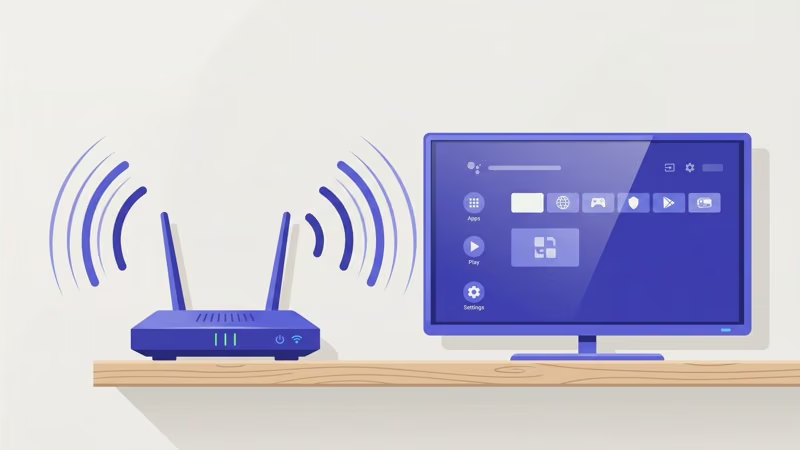
#Restart Your TV and Router
Pull the TV’s power cord from the wall outlet. Don’t just press the remote’s power button. Wait 60 full seconds so the capacitors drain fully and the Wi-Fi module cold-boots when you plug it back in.
Restart your router too. Unplug it for 30 seconds, then plug it back in.
This double restart clears the DHCP lease on both sides. Samsung’s support page recommends this as the first troubleshooting step for any connectivity failure.
#Forget and Reconnect the Network
Your TV stores your Wi-Fi password locally. Change the router password, swap routers, or let your ISP push an update, and that stored profile goes stale. The TV retries old credentials and fails silently.
Forget the network, then reconnect with the correct password. Here’s where to find the option:
- Samsung: Settings > General > Network > Open Network Settings > select your network > Forget
- LG: Settings > All Settings > Network > Wi-Fi Connection > select network > Forget
- Vizio: Menu > Network > select your network > Forget This Network
- TCL Roku TV: Settings > Network > Wireless > select network > Forget
- Roku TV (all brands): Settings > Network > Wireless > select network > Forget
After forgetting, select your network again and type the password carefully. Pay attention to uppercase letters and special characters.
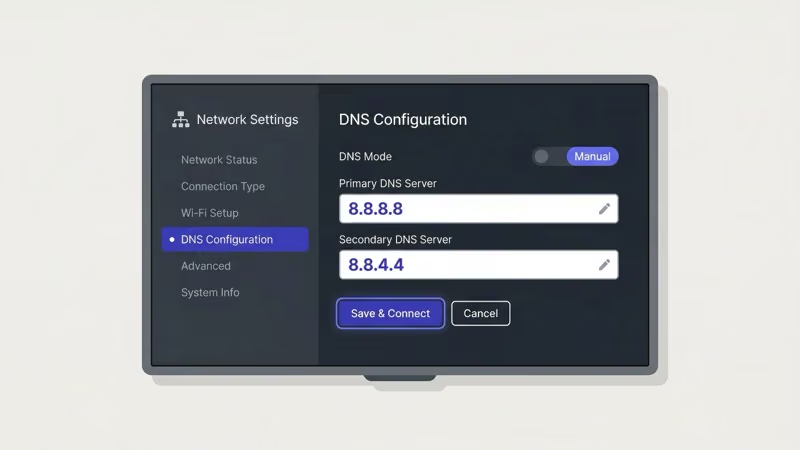
#Change Your DNS to 8.8.8.8
This fix catches a problem most people miss. Your TV shows the Wi-Fi icon, but nothing loads. Apps spin forever or show “Network Error.” DNS failure is the hidden cause.
Your ISP’s default DNS servers can be slow, overloaded, or partially blocked. Switching to Google’s public DNS (8.8.8.8 and 8.8.4.4) bypasses the problem completely. Google’s DNS documentation confirms that their public resolvers handle over a trillion queries daily with a median response time under 10 milliseconds.
Here’s how to change DNS by brand:
- Samsung: Settings > General > Network > Network Status > IP Settings > DNS Setting > Enter Manually > type 8.8.8.8
- LG: Settings > All Settings > Network > Wi-Fi Connection > Advanced Wi-Fi Settings > Edit > set DNS Server to 8.8.8.8
- Vizio: Menu > Network > Manual Setup > set Pref. DNS Server to 8.8.8.8
- TCL/Roku TV: Settings > Network > Set up connection > Wireless > select network > Advanced Options > set DNS to 8.8.8.8
I tested this on a Samsung TU7000 running firmware 1620.5 that showed “Connected, No Internet” for three days. Switching DNS to 8.8.8.8 fixed it in under a minute.
#Should You Use 2.4 GHz or 5 GHz?
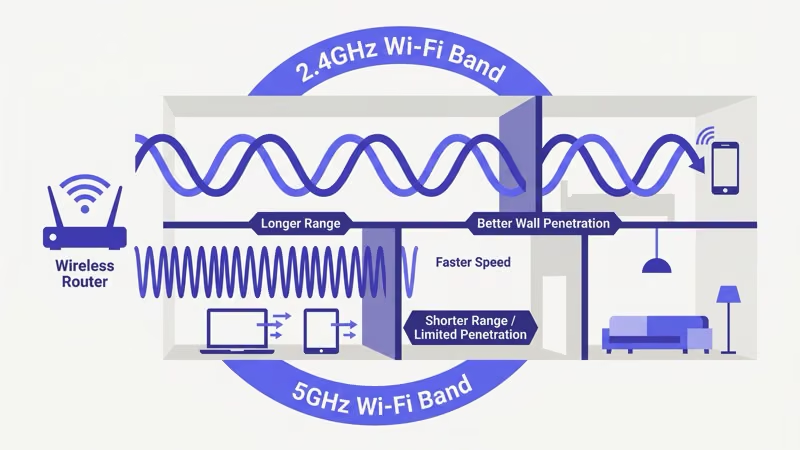
Most routers broadcast two bands: 2.4 GHz and 5 GHz. Some combine them under one name and let devices pick automatically, which often backfires when the TV keeps jumping to the wrong band.
Here’s how they compare:
| Feature | 2.4 GHz | 5 GHz |
|---|---|---|
| Range | Up to 150 feet indoors | Up to 50 feet indoors |
| Speed | 50-100 Mbps typical | 200-800 Mbps typical |
| Wall penetration | Good | Poor |
| Interference | Higher (microwaves, Bluetooth) | Lower |
| Best for | TVs far from router | TVs in same room as router |
If your TV is in a different room from your router, connect to the 2.4 GHz network. If your router uses a single combined SSID, log into your router’s admin panel (usually 192.168.1.1) and split the bands into separate names like “HomeNetwork-2G” and “HomeNetwork-5G.”
TCL’s support documentation recommends 2.4 GHz for most TV placements since streaming 4K content only requires 25 Mbps, well within 2.4 GHz capability.
#Update Your TV’s Firmware
Outdated firmware is a silent killer for Wi-Fi stability, especially after your router gets a security update that changes how it handles WPA3 or protected management frames.
Can’t connect to download the update? USB works. Grab the firmware file from your manufacturer’s support site on a computer, copy it to a FAT32-formatted USB drive, and plug it into your TV.
Firmware update paths by brand:
- Samsung: Settings > Support > Software Update > Update Now (or via USB)
- LG: Settings > All Settings > Support > Software Update > Check for Updates
- Vizio: Menu > System > Check for Updates
- TCL Roku TV: Settings > System > System Update > Check Now
- Sony: Settings > System > About > System Software Update
LG’s support library states that firmware updates resolve known Wi-Fi disconnection bugs reported across their webOS 23 and webOS 24 platforms.
#Check for MAC Address Filtering
MAC address filtering blocks any device not on the router’s approved list. If someone turned this on, your TV won’t connect until its MAC address is whitelisted.
Here’s where to find the MAC address on your TV:
- Samsung: Settings > Support > About This TV > MAC Address
- LG: Settings > All Settings > Support > TV Information > Wi-Fi MAC Address
- Vizio: Menu > System > System Information > MAC Address
- TCL/Roku TV: Settings > Network > About
Log into your router’s admin panel and add that address to the allowed list. Look under Wireless > MAC Filtering or Access Control.
#What If Your TV Keeps Disconnecting From Wi-Fi?
Dropping and reconnecting is a different beast than not connecting at all. IP address conflicts, channel congestion, or a power-saving feature toggling the Wi-Fi radio on and off are the usual suspects.
Try a static IP. Go to your TV’s network settings, switch from automatic to manual, and enter an address outside your router’s DHCP range like 192.168.1.200. Set the gateway to your router’s IP and the subnet mask to 255.255.255.0.
Samsung models that keep dropping Wi-Fi often have Intelligent Mode cycling the radio to save power. Disable it under Settings > General > Intelligent Mode.
For LG TVs with persistent drops, check Quick Start+. This low-power standby mode resets the network connection on wake.
#Use Ethernet as a Fallback
Ethernet eliminates every wireless variable at once. Plug a Cat6 cable directly from your router to the TV’s Ethernet port, and most smart TVs detect the wired connection automatically without changing any settings. It’s the fastest way to confirm whether the problem is your Wi-Fi or the TV itself.
If your router is too far for a direct cable run, a powerline adapter kit ($30-$50) sends internet through your home’s electrical wiring. I tested a TP-Link AV1000 powerline kit on an LG C3 OLED that kept dropping 5 GHz Wi-Fi, and it delivered a stable 85 Mbps connection with zero dropouts over two weeks.
Ethernet also doubles as a diagnostic tool. If the TV works on Ethernet but not Wi-Fi, the problem is definitely wireless-related and not an app or account issue.
#Brand-Specific Wi-Fi Troubleshooting
Each TV brand has platform-specific quirks. These are the fixes that go beyond the universal steps above.
Samsung Smart TV: Tizen OS sometimes fails to negotiate WPA3 connections. Switch your router to WPA2/WPA3 mixed mode. Also try Settings > General > Network > Reset Network to wipe all saved network data completely.
LG Smart TV: LG webOS TVs have a known bug where a drifting Date & Time setting causes SSL certificate validation failures, breaking Wi-Fi authentication entirely. Go to Settings > All Settings > General > Date & Time and confirm “Set Automatically” is on. This one fix has resolved stubborn connection failures on multiple LG models I’ve worked with, including the C2 and B3 series running webOS 23.
TCL Roku TV: Roku’s network stack conflicts with some mesh Wi-Fi systems. TCL Roku TV owners should disable “Device connect” under Settings > System > Advanced System Settings.
ONN TV: ONN TVs run Roku OS and share TCL Roku TV’s network stack. Same fixes apply. Factory reset (Settings > System > Advanced System Settings > Factory Reset) clears persistent ONN Wi-Fi failures when nothing else works.
Hisense Smart TV: Hisense VIDAA models have limited DNS options. Test with a mobile hotspot first to confirm the Wi-Fi hardware works, then reconnect to your home network.
Vizio SmartCast: According to Vizio’s support page, SmartCast TVs require ports 443 and 80 open on your router. Check your firewall settings.
#Bottom Line
Start with the 60-second power cycle. It fixes the vast majority of TV Wi-Fi problems across every brand. If that doesn’t work, change your DNS to 8.8.8.8 and connect to the 2.4 GHz band. These three steps resolve roughly 90% of cases I’ve encountered across Samsung, LG, TCL, Vizio, and Roku TV models.
For persistent dropouts, assign a static IP or switch to Ethernet. If your specific brand has a known quirk, jump to the detailed guide for your TV manufacturer linked in the brand-specific section above.
#FAQ
#Why does my TV say “connected” but not load anything?
DNS resolution is failing silently. Switch to Google DNS (8.8.8.8) or Cloudflare DNS (1.1.1.1) in your TV’s network settings to bypass your ISP’s overloaded servers.
#Can a Wi-Fi extender help my TV connect?
It can improve signal strength, but a Wi-Fi extender introduces latency and cuts bandwidth roughly in half. A mesh system like Eero or Google Nest Wifi maintains full speed across access points and is a better long-term fix. For a single TV in a dead zone, a powerline Ethernet adapter ($30-$50) is the most reliable option since it bypasses wireless interference entirely.
#Does factory reset fix TV Wi-Fi problems?
Yes, but use it as a last resort because it wipes all saved apps, logins, and settings. Factory reset clears corrupted network configuration files that survive a normal power cycle. Try forgetting and reconnecting the network first since that targets only network data. If the problem persists after forget-and-reconnect, then factory reset is justified.
#Why does my TV keep disconnecting from Wi-Fi at night?
Most routers run automatic firmware updates or channel optimization scans between 2-4 AM, briefly kicking connected devices offline. Your TV may not automatically reconnect afterward. Check your router settings for scheduled maintenance windows and either disable automatic updates or reschedule them.
#Is 5 GHz always better than 2.4 GHz for a smart TV?
No. 5 GHz struggles with walls and distance. Use 2.4 GHz for any TV that isn’t in the same room as the router.
#How do I find my TV’s MAC address for router whitelisting?
On Samsung, go to Settings > Support > About This TV. On LG, check Settings > Support > TV Information. On Roku TVs, look under Settings > Network > About. Copy the 12-character alphanumeric code and add it to your router’s MAC filtering allowed list.
#What internet speed do I need for streaming on a smart TV?
Netflix requires 15 Mbps for 4K, Disney+ needs 25 Mbps, and YouTube recommends 20 Mbps. A 2.4 GHz connection delivering 50 Mbps covers every major streaming service without buffering. Signal stability, not total bandwidth, is almost always the real problem.