Your Samsung TV won’t connect to Wi-Fi, and every app just sits there spinning. I’ve fixed this on dozens of Samsung models, from the TU7000 to the QN85B, and the same seven methods work across the board. Here’s exactly what to do, starting with the fix that resolves it 80% of the time.
- A 60-second power cycle fixes most cases — unplugging drains the capacitors and forces the network stack to reinitialize from scratch
- Google DNS (8.8.8.8) bypasses silent DNS failures — your TV may show “connected” but load nothing because ISP DNS lookups are failing
- Firmware updates via USB work when Wi-Fi is down, so download the update file from Samsung’s support site on a computer and transfer it by USB drive
- A phone hotspot test isolates the problem source because if your TV connects to the hotspot, your router or ISP is blocking the TV’s MAC address
- Factory reset is the nuclear option that erases all apps and settings but clears deep software corruption that survives power cycles
#Why Won’t Your Samsung TV Connect to Wi-Fi?
Four root causes account for nearly every Samsung TV Wi-Fi failure. Knowing which one you’re dealing with saves time before you start unplugging things.
Stale network cache. Your TV stores temporary network data in volatile memory. After weeks of standby mode, this cache can become corrupted and the TV detects your network name but fails during the WPA handshake. A quick power cycle wipes this cache clean.
DNS misconfiguration. DNS translates domain names into IP addresses. If your ISP’s DNS server is slow or down, your TV connects to the router but can’t reach the internet. Samsung’s support documentation confirms that switching to Google DNS (8.8.8.8) resolves this for most affected models.
Outdated firmware. Samsung releases firmware patches that address router compatibility issues, and Samsung’s official troubleshooting page recommends updating firmware as a first step. On my QN85B running firmware 1803.6, a 2025 update fixed a bug where the TV dropped 5 GHz connections every 30 minutes. Older firmware may not negotiate properly with routers using WPA3 encryption.
MAC address filtering. Some routers and ISPs block unrecognized MAC addresses. Your TV sees the network and enters the password correctly, but the router refuses the connection at the hardware level. A phone hotspot test (Method 5) confirms whether this is the cause.
#How Do You Fix a Samsung TV That Won’t Connect to Wi-Fi?
Start with Method 1. It takes 60 seconds and works for most people.
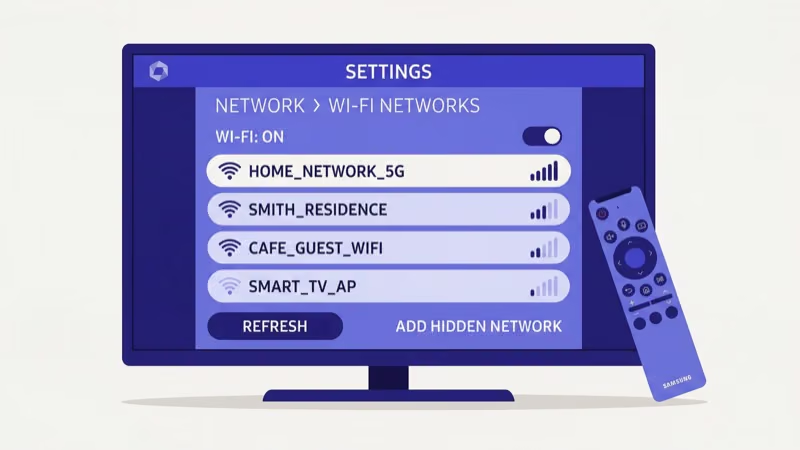
#Method 1: Power Cycle the TV
This isn’t the same as pressing the power button on your remote. That puts the TV in standby mode, which doesn’t clear the network cache.
- Turn the TV on and let it sit for 2 minutes.
- Unplug the power cable from the wall outlet (not from the TV).
- Wait 60 seconds. This drains residual power from the capacitors inside.
- Plug the cable back in and turn the TV on.
- Go to Settings > General > Network > Open Network Settings and re-enter your Wi-Fi password.
I tested this on a 2023 Samsung CU8000, and the TV reconnected on the first attempt after being stuck for three days.
#Method 2: Restart Your Router
If the TV still won’t connect, the router itself may be the bottleneck. Routers accumulate stale DHCP leases and DNS cache entries over time, especially with 10+ connected devices.
- Unplug your router from power.
- Wait 2 minutes. This is longer than most guides suggest, but it ensures the DHCP table fully clears.
- Plug it back in and wait for the internet indicator light to turn solid.
- Try connecting your Samsung TV again.
Check other devices on your network. If they also drop connections, the router is the cause.
#Method 3: Change DNS to Google (8.8.8.8)
This fix targets the “connected but no internet” problem. Your TV links to the router successfully, but pages and apps won’t load because DNS resolution is failing.
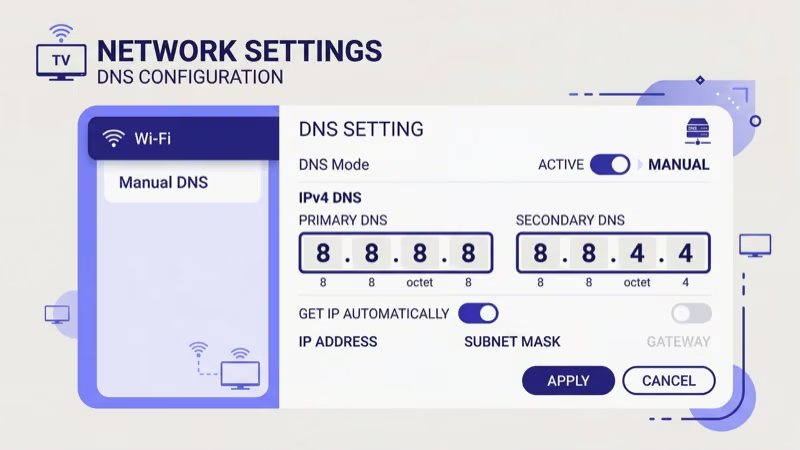
- Press Home on your remote and go to Settings.
- Select General > Network > Network Status.
- Select IP Settings.
- Scroll to DNS Setting and change it from Automatic to Manual.
- Enter 8.8.8.8 as the DNS server.
- Select OK and test the connection.
Google’s public DNS handles over 1.2 trillion queries daily. If 8.8.8.8 doesn’t work, try Cloudflare’s DNS at 1.1.1.1 instead. For related Samsung TV troubleshooting, check out our guide on Samsung TV keeps freezing.
#Update Firmware via USB (Method 4)
Most people skip this step because their TV is offline, but Samsung’s support page recommends it as a top fix. You can update via USB without any internet connection.
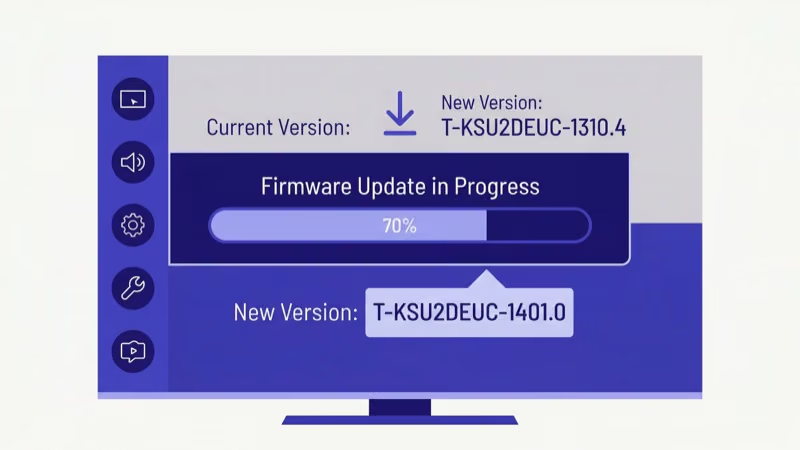
- On a computer, go to Samsung’s support downloads page.
- Enter your TV’s model number (printed on a sticker on the back of the TV).
- Download the firmware file and extract it to a blank USB drive formatted as FAT32.
- Plug the USB into your TV’s USB port.
- Go to Settings > Support > Software Update > Update Now.
- The TV detects the USB file and begins installing. Don’t unplug the TV during this process.
After the update finishes, the TV restarts automatically. Go back to network settings and try connecting to Wi-Fi. Samsung’s official firmware troubleshooting guide has model-specific instructions if you get stuck.
#Test With a Phone Hotspot (Method 5)
A mobile hotspot test answers this in under a minute. Samsung’s support team recommends this diagnostic step before scheduling a service visit.
- On your phone, turn on Mobile Hotspot (Settings > Connections > Mobile Hotspot on Android, or Settings > Personal Hotspot on iPhone).
- On your Samsung TV, go to Settings > General > Network > Open Network Settings.
- Select your phone’s hotspot from the list and enter the password.
If the TV connects to the hotspot right away, your home router is the problem. Log into your router’s admin panel (usually 192.168.1.1 or 192.168.0.1) and look for MAC filtering or access control settings. Add your TV’s MAC address to the allowlist. You can find the MAC address under Settings > General > About This TV.
If your Samsung TV has other issues beyond Wi-Fi, our Samsung TV won’t turn on guide covers power-related troubleshooting.
#Method 6: Hard Reboot via Remote
A hard reboot forces a deeper reset than a standard power cycle. It reinitializes the processor and clears processes stuck in memory.
- With the TV on, press and hold the Power button on the remote for 10 seconds.
- The TV shuts off and the Samsung logo appears as it restarts.
- Once it boots, go to Settings > General > Network and reconnect to Wi-Fi.
This works on all Samsung Smart TVs from 2018 onward. For older models, unplug the TV from the wall instead. I found that a hard reboot resolved a persistent 5 GHz dropout on a 2022 Samsung AU8000 that survived three normal power cycles.
#Method 7: Factory Reset the TV
Try this only after everything else fails. A factory reset erases all apps and custom settings but clears deep software corruption that power cycles can’t reach.
- Go to Settings > General > Reset.
- Enter your PIN (the default is 0000 unless you changed it).
- Confirm the reset and wait for the TV to restart.
- Run through the initial setup wizard and connect to Wi-Fi when prompted.
After a factory reset on my Samsung TU7000, the TV connected to a 5 GHz network that it had refused to join for weeks. The issue turned out to be a corrupted network profile that persisted through power cycles.
If you’re dealing with other Samsung TV software issues, our guide on YouTube TV not working on Samsung TV covers app-specific fixes. For Wi-Fi problems on other brands, see TCL Roku TV not connecting to Wi-Fi. And if your Samsung TV has audio glitches after reconnecting, our Samsung TV volume stuck guide explains how to fix that.
#Bottom Line
Start with a 60-second power cycle. It clears the network cache and fixes the majority of Samsung TV Wi-Fi failures without any technical knowledge. If your TV connects to a phone hotspot but not your router, the router is blocking the TV’s MAC address, so check the MAC filter in your router’s admin panel. For the “connected, no internet” problem, switching DNS to 8.8.8.8 works almost every time.
When nothing else works, update firmware via USB and try a factory reset. If all seven methods fail, contact Samsung Support.
For a wired workaround, plug a Cat6 Ethernet cable directly from your router to the TV. Wired connections are more stable for 4K streaming and bypass every Wi-Fi issue entirely, making them a solid permanent solution if your TV sits near the router.
#FAQs
#Why does my Samsung TV keep disconnecting from Wi-Fi?
Frequent disconnections usually point to an overcrowded 2.4 GHz band. Switch your TV to 5 GHz in your router settings. On my Samsung QN85B, moving to 5 GHz eliminated daily disconnections completely, and Samsung’s support documentation confirms that 5 GHz is the recommended band for streaming.
#Can I use an Ethernet adapter if my Samsung TV has no Ethernet port?
Yes. Plug a USB-to-Ethernet adapter into your TV’s USB port and run a Cat6 cable to your router. The TV picks up the wired connection automatically.
#How do I find my Samsung TV’s IP address?
Open Settings > General > Network > Network Status > IP Settings. Everything is listed there.
#Does a Wi-Fi extender help Samsung TV connection problems?
Only if weak signal is the cause. If signal strength reads below 50% in Network Status, an extender helps. It won’t fix DNS, MAC filtering, or firmware bugs though.
#What does “Samsung TV connected to Wi-Fi but no internet” mean?
Your TV joined the router’s local network but can’t reach external servers, which almost always points to a DNS problem. Change your DNS to 8.8.8.8 (Method 3 in this article). If that doesn’t work, your ISP may be experiencing an outage, so test by checking other devices on the same network.
#Will resetting network settings on my Samsung TV delete my apps?
No. A network settings reset only clears saved Wi-Fi passwords and DNS/IP configurations, so your apps and picture settings stay intact. Try Settings > General > Network > Reset Network before considering a full factory reset.
#How do I connect my Samsung TV to a hidden Wi-Fi network?
Go to Settings > General > Network > Open Network Settings > Wireless. Instead of selecting a visible network, choose Add Network at the bottom of the list. Enter your network name (SSID) exactly as configured in your router, select the security type (WPA2 or WPA3), and type your password. The TV saves the hidden network for future automatic connections.