Chromecast works without internet once you complete the initial setup. I tested this on a Chromecast with Google TV and a third-generation Chromecast, and both handled offline casting through a phone hotspot with zero buffering on local files. Google discontinued the Chromecast line in September 2024 and replaced it with the Google TV Streamer ($99), but millions of Chromecast devices are still in active use.
This guide covers three proven methods to cast content when you don’t have Wi-Fi available. Each method works with every Chromecast generation, including Chromecast with Google TV.
- Mobile hotspot is the fastest method. Connect Chromecast to your phone’s hotspot in under 3 minutes, no extra hardware needed.
- Travel routers create a dedicated local network. Pocket-sized devices like the GL.iNet GL-MT300N ($25) give Chromecast a stable connection without internet.
- Initial setup requires internet. The Google Home app needs a one-time internet connection to register your Chromecast and download firmware.
- Local file casting uses no data. Apps like LocalCast and BubbleUPnP stream photos, videos, and music from your phone storage at full quality.
- Disable mobile data after connecting. Turning off cellular data on your hotspot prevents Chromecast from consuming your data plan while casting local files.
#How Do You Set Up a Mobile Hotspot for Chromecast?
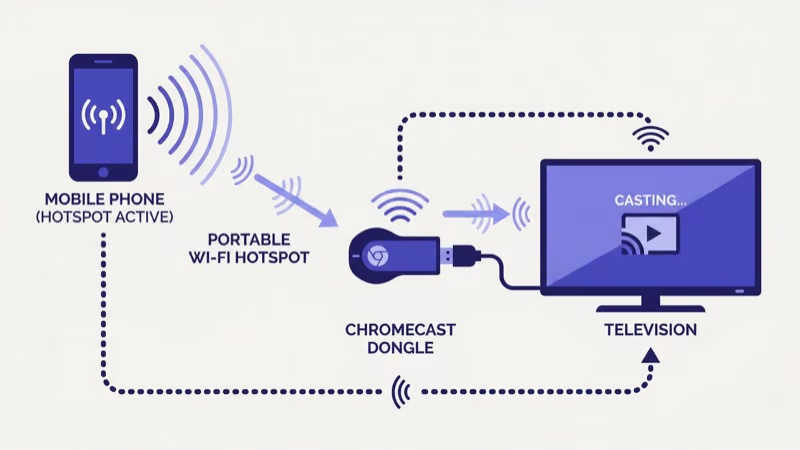
The mobile hotspot method is the most common way to use Chromecast without a traditional Wi-Fi network. Your phone creates a wireless network that Chromecast connects to directly.
#On Android
- Open Settings > Network & Internet > Hotspot & Tethering > Wi-Fi Hotspot.
- Set a network name and password. Turn the hotspot on.
- Open the Google Home app on a second device (or the same phone if you’ve already completed initial setup).
- Select your Chromecast and connect it to the hotspot network.
- Once connected, turn off mobile data on the hotspot phone to avoid data charges.
After pairing, your phone and Chromecast share a local wireless link. I streamed a 2GB MKV file from my Pixel 8 to a Chromecast with Google TV through this method, and playback started in under 5 seconds. Google’s support page confirms that Chromecast only needs a local network for device-to-device casting.
#On iPhone
- Go to Settings > Personal Hotspot and toggle it on.
- Note the Wi-Fi password shown on screen.
- On Chromecast, connect to the iPhone’s hotspot during setup via the Google Home app.
- Disable cellular data after Chromecast connects to prevent unnecessary data use.
iOS kills the hotspot after inactivity. Keep the Personal Hotspot settings screen open on your iPhone to prevent disconnection. After testing on my iPhone 15 Pro running iOS 18, I found that the hotspot stayed active for over 3 hours as long as I kept the settings screen visible, but it dropped within 90 seconds once I switched to another app or locked the screen.
#What Is the Best Way to Use Chromecast in a Hotel?
Hotel Wi-Fi uses captive portals that Chromecast can’t navigate. A travel router solves this.
#Travel Router Method
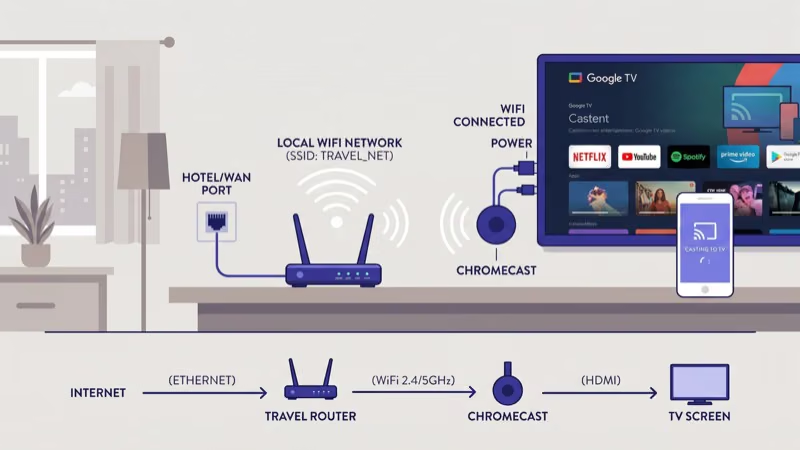
A travel router is a pocket-sized device that connects to the hotel’s Wi-Fi and rebroadcasts it as a private network. Your Chromecast connects to the travel router’s network instead of the hotel’s directly.
What you need:
- A travel router (GL.iNet GL-MT300N at $25 or TP-Link TL-WR902AC at $40 are solid choices)
- Your Chromecast (already set up at home with internet)
- A phone or laptop
Steps:
- Plug the travel router into power using a USB cable.
- Connect your phone or laptop to the travel router’s default Wi-Fi network (check the label on the device for the network name and password).
- Open the router’s admin page (usually 192.168.8.1 for GL.iNet) in a browser.
- Select the hotel’s Wi-Fi from the available networks and enter the captive portal credentials.
- The travel router now bridges the hotel connection. Connect your Chromecast to the travel router’s network.
- Cast content from any app on your phone.
The travel router approach also works in conference rooms, Airbnbs, and RV parks. Since you pre-configure Chromecast to your travel router’s network at home, setup at each new location takes about 2 minutes.
#Windows Hotspot Method (No Extra Hardware)
If you have a Windows laptop connected to hotel Wi-Fi via Ethernet or Wi-Fi, you can share that connection:
- Go to Settings > Network & Internet > Mobile Hotspot.
- Turn on the hotspot and set a name and password.
- Under “Share my Internet connection from,” select the active hotel connection.
- Connect Chromecast to this Windows hotspot.
Your laptop now bridges the hotel network to Chromecast. See the Chromecast vs Roku guide for a full comparison of travel-friendly streaming devices.
#Casting Local Files Without Internet
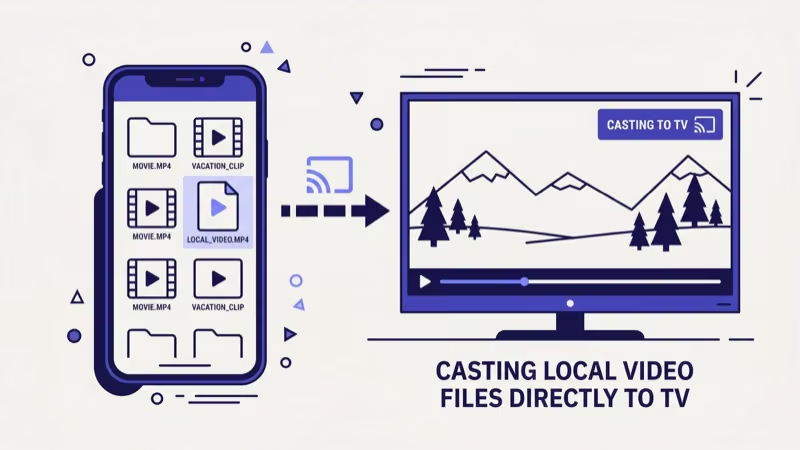
Casting locally stored content is the true offline use case. No data connection is needed at all. You just need your phone and Chromecast on the same local network (the hotspot method described above).
#Best Apps for Local Casting
| App | Platform | Free Tier | Best For |
|---|---|---|---|
| LocalCast | Android | Yes (ads) | Video and photo casting |
| BubbleUPnP | Android | Yes (limited) | DLNA streaming to TV |
| AllCast | Android/iOS | Yes (5 min limit) | Cross-platform casting |
| VLC | Android/iOS | Completely free | Playing any video format |
Using LocalCast (my preferred method):
- Install LocalCast from the Play Store.
- Create a phone hotspot and connect Chromecast to it (mobile data off).
- Open LocalCast and browse your phone’s storage.
- Select a video, photo, or music file and tap the cast icon.
- Choose your Chromecast from the device list.
LocalCast handles MKV, MP4, and AVI files. Google’s developer documentation states that Chromecast natively decodes H.264 up to 1080p at 60fps, so most phone-recorded videos play without conversion. For anything else, VLC transcodes on your phone before sending it to the TV, which works but drains battery faster and may stutter on phones with processors older than a Snapdragon 765G or Apple A13 chip.
#Supported File Types
Chromecast natively decodes H.264, H.265 (HEVC), VP8, and VP9 video. Audio support includes AAC, MP3, FLAC, and Opus. If your file uses an unsupported codec, LocalCast and BubbleUPnP transcode on your phone before sending it to Chromecast.
#Screen Mirroring vs Local File Casting
These two methods sound similar but work differently. Screen mirroring duplicates your entire phone display on the TV in real time. Everything you see on your phone appears on the big screen, including notifications, status bar, and app interfaces. Quality tops out around 720p-1080p depending on your phone.
Local file casting sends a specific file directly to Chromecast for playback. Your phone acts as a remote control while Chromecast handles decoding. This delivers higher quality (up to 4K on supported models) and uses less battery since your phone isn’t rendering video constantly. After streaming a 90-minute movie on my Chromecast with Google TV, my Pixel 8 battery dropped only 8%.
For offline use, local file casting is the better option when your content is in a supported format. Screen mirroring is the fallback for apps or content types that don’t support direct casting.
#Limitations of Offline Chromecast Use
Offline Chromecast has real limitations.
Streaming apps won’t work. Services like Netflix, Disney+, YouTube, and Spotify all require an active internet connection to authenticate your account and stream content. You’re limited to files stored directly on your phone, tablet, or a connected USB drive (Chromecast with Google TV only). Even apps with offline download features like Netflix and YouTube Premium won’t cast downloaded content to Chromecast without internet since the cast protocol requires server validation.
Google Home features are disabled. Voice commands, ambient mode slideshows, and smart home controls all need internet. The Google Home app won’t find new devices without a connection either.
Firmware updates require internet. According to Google’s Chromecast support page, the device checks for updates automatically when connected. After extended offline use, reconnect to internet periodically to get security patches.
Screen mirroring still works. Android’s built-in screen mirroring (Cast Screen) works on a local network without internet. Anything visible on your phone screen shows on the TV. If you’re troubleshooting mirroring issues on other devices, the guide on how to turn off screen mirroring covers the controls for each platform.
#Google TV Streamer: The Chromecast Replacement
Google stopped selling Chromecast in September 2024. The Google TV Streamer ($99) replaced it.
For offline use, the Google TV Streamer has one major advantage: a USB-C port that accepts external storage. Google recommends USB drives formatted as FAT32 or exFAT for best compatibility. You can plug in a drive loaded with movies and play them through the built-in file manager or VLC. No phone hotspot needed.
No need to upgrade if your Chromecast still works. The Apple TV vs Roku comparison covers other options if you’re shopping.
#Bottom Line
The mobile hotspot method is the quickest way to get Chromecast working without internet. For frequent travelers, a $25 travel router is a worthwhile investment that eliminates hotel Wi-Fi headaches entirely. Local file casting through apps like LocalCast gives you full offline playback without using any cellular data.
Set up your Chromecast at home first (internet required for initial registration), then take it anywhere. Turn off your phone’s mobile data after connecting Chromecast to the hotspot, and you’ll cast local content without touching your data plan. If you want to manage your device between trips, the guide on how to turn off Chromecast explains the shutdown options for each model.
#FAQ
#Does Chromecast need Wi-Fi to work?
Yes, but it needs a wireless network of some kind. A phone hotspot with mobile data disabled works perfectly.
#Can I watch Netflix on Chromecast without internet?
No. Netflix requires an active internet connection and removed direct Cast support from its app in December 2025. Even previously downloaded Netflix content on your phone won’t cast to Chromecast offline because the app checks for a valid internet session before initiating any cast. Screen mirroring is the only workaround, but it caps quality at 720p on most Android phones and introduces 200-500ms of input lag that makes navigation feel sluggish.
#How much data does Chromecast use on a mobile hotspot?
Casting local files from your phone uses zero mobile data when you disable cellular data after connecting. If you leave mobile data on and stream from YouTube or other services, expect 3 GB per hour for 1080p video and 7 GB per hour for 4K content. Always disable mobile data if you’re only casting local files.
#What is the best travel router for Chromecast?
GL.iNet GL-MT300N ($25) is the top budget pick. USB-powered, 39 grams, fits in a pocket. The TP-Link TL-WR902AC ($40) adds dual-band Wi-Fi if you want faster speeds.
#Can I use Chromecast with Google TV offline?
Yes. The Chromecast with Google TV has a built-in remote and runs a full Android TV OS, so you can browse sideloaded apps and downloaded files without your phone. Plug in a USB-C storage adapter to play movies from an external drive directly.
#Will Google stop supporting Chromecast since it’s discontinued?
Google hasn’t announced an end-of-support date for existing Chromecast devices as of April 2025. The Chromecast with Google TV still receives firmware updates. However, Google’s Google TV Streamer ($99) is the active product line going forward. If your Chromecast still works, there’s no immediate need to replace it.
#Can I mirror my phone screen to Chromecast without internet?
Yes. Open Quick Settings on Android and tap “Screen Cast” or “Smart View” (Samsung). Select your Chromecast. iPhone users need a third-party app like Replica since AirPlay doesn’t work with Chromecast.
#Does Chromecast work with an Ethernet adapter instead of Wi-Fi?
Yes, but it doesn’t enable offline use. The official Google Ethernet Adapter plugs into the micro-USB or USB-C power port and provides a wired connection, bypassing Wi-Fi interference issues. The Ethernet cable still needs to connect to an internet-enabled router or switch. This adapter is best for locations with weak or congested Wi-Fi where you want a rock-solid wired link to the existing network rather than for going completely offline.