LG and Vizio sit at opposite ends of the value spectrum. LG pushes OLED technology and a polished smart TV platform. Vizio keeps prices low and covers the basics well. I’ve compared both brands across picture quality, features, reliability, and gaming to tell you exactly which one fits your situation.
- LG wins picture quality — OLED panels deliver infinite contrast ratios versus Vizio’s VA panels with full array local dimming
- Vizio costs significantly less — a 55-inch Vizio V-Series 4K TV runs around $399 compared to $949+ for a comparable LG OLED
- Both platforms support major apps — VIZIO OS and LG webOS both carry Netflix, Hulu, Prime Video, Disney+, Max, and Peacock
- LG dominates gaming — Nvidia G-Sync, AMD FreeSync, and input lag under 1ms at 4K/120Hz on OLED models
- LG lasts longer — user reviews consistently show fewer motherboard failures and better build quality over a 5-year period
#Where Vizio TVs Win: Affordability
Vizio TVs are significantly more affordable. The Vizio V-Series 55-inch 4K TV runs around $399, while the LG C4 55-inch OLED costs $1,299. That’s more than triple the price for LG’s flagship. Even LG’s mid-range QNED models land around $599-$799 for a 55-inch, still well above what Vizio charges for comparable screen sizes.
The price gap narrows when you compare Vizio’s upper-tier P-Series Quantum X against LG’s entry QNED lineup, but Vizio still typically undercuts LG by $150-$300 at similar performance tiers. For a secondary bedroom TV or a tight budget, Vizio delivers real value.
#How Do LG TVs Compare in Technology and Features?
LG packs more technology into its TV lineup than Vizio does. Current 2025-2026 LG OLED models use the α9 Gen 8 AI processor, which handles upscaling and noise reduction far more aggressively than Vizio’s processing. The difference is visible on lower-quality streaming content and cable broadcasts.
LG’s full feature set on current OLED and QNED models includes:
- AI ThinQ: Voice control with learning capabilities
- Alexa and Google Assistant built-in: Control smart home devices directly from the TV
- LG webOS: Fast navigation with a floating launcher bar
- Game Optimizer: Single menu for all gaming settings including VRR, input lag mode, and black stabilizer
- Sports Alert: Push notifications for live games from your saved teams
Vizio runs VIZIO OS (formerly SmartCast, rebranded after Walmart’s acquisition in December 2024). It’s a capable platform that handles streaming well, but it lacks the voice assistant depth and smart home integrations that LG webOS delivers. VIZIO Mobile, the companion app, is useful for casting content and keyboard input.
#Does Picture Quality Favor LG Televisions?
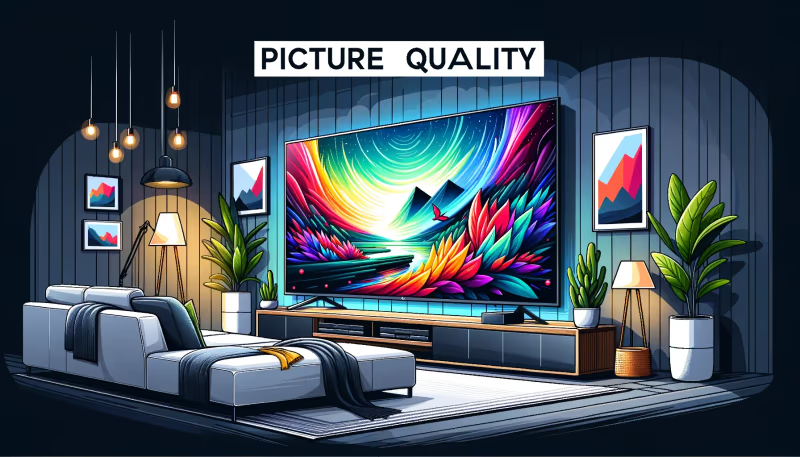
Yes, significantly on OLED models. LG’s OLED panels turn off individual pixels completely in dark scenes, producing true black levels that VA panels can’t match. In a dark room, the difference is immediate.
Vizio’s P-Series Quantum X uses VA panels with full array local dimming. It’s really good for the price, with peak brightness often exceeding 1,000 nits, which outshines many LG QNED units. But when dark and bright elements share the same frame, local dimming creates blooming halos that OLED avoids entirely.
For bright room viewing, the comparison tightens. Vizio’s higher-brightness VA panels handle ambient light better than LG’s mid-tier OLED. If your living room gets a lot of daylight, the LG C4’s 800-nit typical brightness may actually underperform Vizio’s P-Series Quantum X at 3,000 nits peak.
The α9 Gen 8 processor in LG’s 2025 models adds meaningful upscaling improvement over previous generations. Standard HD content looks noticeably sharper, which matters if you watch a lot of cable or older streaming titles.
#LG TVs Achieve Better Sound Quality
LG’s built-in speakers edge out Vizio’s in clarity and dialogue reproduction. Vizio’s speakers get louder, but audio distortion creeps in above 60% volume. LG’s output stays cleaner at higher listening levels.
That said, neither brand’s built-in audio comes close to a dedicated soundbar. If you’re watching movies or listening to music at any meaningful quality level, a soundbar is worth the investment regardless of which TV you choose. Both brands support Dolby Atmos passthrough via HDMI eARC, so any Atmos-capable soundbar will work with either.
LG TVs do pair especially well with highly-rated LG soundbars thanks to shared audio optimization through LG’s Sound Sync feature.
#Which Smart TV Platform Is Better for Streaming?
Both platforms now support all the major streaming apps. Vizio’s old SmartCast platform used to be missing key apps, but VIZIO OS runs Netflix, Hulu, Prime Video, Disney+, Max, and Peacock out of the box. The rebranding under Walmart has also brought more consistent app updates.
| App | LG webOS | VIZIO OS |
|---|---|---|
| Netflix | Yes | Yes |
| Hulu | Yes | Yes |
| Prime Video | Yes | Yes |
| Disney+ | Yes | Yes |
| Max | Yes | Yes |
| Peacock | Yes | Yes |
| Apple TV+ | Yes | Yes |
| YouTube TV | Yes | Yes |
The platforms differ mostly in navigation speed and voice control depth. LG webOS loads apps faster on current hardware and offers tighter Alexa and Google Assistant integration. VIZIO OS is straightforward and works well for streaming-focused users who don’t need voice commands.
LG’s webOS also gets more frequent feature updates and has a broader third-party app library through the LG Content Store. Visit LG’s website or Vizio’s website to compare current app lineups for specific models before buying.
#Is LG or Vizio Better for Gaming?
LG wins this category. There’s no debate once you look at the specs. LG’s OLED models hit 0.1-0.2ms response times at 4K/120Hz, which is really imperceptible lag. VRR through Nvidia G-Sync and AMD FreeSync Premium keeps frames smooth during fast-paced sequences.
Vizio’s gaming performance is decent at this price range. The V-Series supports 4K/60Hz gaming, while the P-Series Quantum X handles 4K/120Hz with VRR. But input lag on Vizio’s panels (typically 9-15ms in Game Mode) is measurably higher than LG OLED’s sub-1ms figures.
For console gaming on a PS5 or Xbox Series X, the LG C4 or G4 OLED is the standard recommendation across gaming communities. If you’re gaming at 1080p on older hardware, the performance gap matters far less and Vizio’s lower price makes more sense. Check detailed measurements on rtings.com’s input lag database for specific model comparisons.
If you’re looking for alternatives, the TCL vs LG TVs comparison covers another strong contender at lower price points.
#Reliability Favors LG
LG TVs consistently receive better long-term reliability scores than Vizio in aggregated user reviews. Vizio’s most common reported failures are motherboard failures at 2-3 years and backlighting issues after extended use. LG warranty claims appear less frequent across the same ownership periods.
Vizio’s one-year factory warranty matches LG’s standard coverage. Neither brand offers a particularly generous warranty. If you’re spending $600 or more, a third-party extended warranty through your retailer is worth evaluating for either brand.
One honest note: LG OLED TVs can experience pixel burn-in with static content over time (screensavers, news tickers, gaming HUDs). This is much less of a concern than it was on older OLED panels. LG has improved it significantly since 2022, but it’s worth knowing if you leave static content on for extended periods.
#LG Wins Nearly Every Category
For most buyers who can stretch their budget, LG delivers a materially better television. Picture quality on OLED models is really in a different league. The gaming specs are among the best available. webOS is faster and more capable than VIZIO OS.
Vizio isn’t a bad TV brand. The P-Series Quantum X punches above its price, and for casual everyday viewing in a bright room, you might not miss what LG offers. The gap narrows considerably when you compare Vizio’s best against LG’s mid-range.
Related comparisons: Vizio vs. Samsung TVs and ONN TV vs. Vizio TV.
 LG
Best Overall
LG
Best Overall
Choose this if you want the best picture quality and gaming performance available at any budget.
- OLED panels with infinite contrast and true black
- α9 Gen 8 processor with 4K AI upscaling
- Sub-1ms input lag on OLED at 4K/120Hz
- LG webOS with Alexa and Google Assistant built-in
 Vizio
Best Value
Vizio
Best Value
Choose this if you want a capable 4K TV with all major streaming apps at the lowest possible price.
- V-Series 55-inch 4K starts around $399
- VIZIO OS with Netflix, Prime Video, Disney+, Max
- P-Series Quantum X hits 3,000 nits peak brightness
- HDMI eARC for Dolby Atmos soundbar passthrough
#Bottom Line
LG is the better TV brand for most buyers who can afford it. OLED picture quality, low input lag for gaming, and a mature smart TV platform are hard to match. The C4 OLED at $1,299 for 55 inches is LG’s sweet spot.
Vizio earns its place at the budget end. A $399 V-Series handles streaming and casual viewing without issue. If you’re furnishing a bedroom, a dorm, or any room where you won’t be gaming or watching in a dark environment, Vizio delivers solid performance for the price.
If you’re seeing issues after buying a Vizio, check the VIZIO OS troubleshooting guide for common fixes. And if you’re still deciding, Vizio vs. Hisense TVs covers another budget-tier alternative worth considering.
#FAQ About Vizio and LG TVs
#Is a Vizio or LG TV better for gaming?
LG is the clear choice for serious gaming. The C4 OLED delivers 0.1ms response time at 4K/120Hz with Nvidia G-Sync and AMD FreeSync Premium support. Vizio’s P-Series handles 4K/120Hz with VRR, but response times run 9-15ms even in Game Mode, a noticeable difference in fast-paced titles.
#Which brand makes more reliable TVs?
LG builds more reliable TVs based on aggregated user review data. Vizio’s most common failures are motherboard issues at 2-3 years. LG owners report fewer hardware problems over the same ownership period, though LG OLED panels carry a small burn-in risk with static content.
#Do Vizio TVs have better picture quality than LG?
No. LG’s OLED panels produce infinite contrast that VA panels can’t replicate. In bright rooms, Vizio’s P-Series Quantum X (up to 3,000 nits peak) can outshine mid-tier LG QNED models, but LG OLED wins on overall picture accuracy and dark-scene performance.
#Is webOS or VIZIO OS better for streaming?
Both platforms now support all major streaming apps including Netflix, Hulu, Prime Video, Disney+, Max, and Peacock. LG webOS loads faster, has deeper voice assistant integration, and a larger third-party app library. VIZIO OS is functional and straightforward but gets fewer feature updates.
#Can you use a soundbar with both Vizio and LG TVs?
Yes. Both brands support soundbars through HDMI ARC and HDMI eARC. LG TVs pair particularly well with LG soundbars through LG’s Sound Sync for shared audio processing. Either brand benefits significantly from any Dolby Atmos-capable soundbar over built-in speakers.
#Which brand offers better value for a bedroom TV?
Vizio is the better choice for secondary rooms. The V-Series delivers clean 1080p or 4K streaming at prices that don’t hurt. For a main living room TV where you’ll actually notice picture quality and gaming performance, LG’s higher cost is justified.
#Do LG and Vizio TVs support Dolby Atmos?
Both brands support Dolby Atmos passthrough to soundbars via HDMI eARC. LG’s higher-end OLED and QNED models also include built-in Dolby Atmos processing. Vizio offers Dolby Atmos on the P-Series and some M-Series models, but it’s less consistent across the full lineup.
#Does VIZIO OS work as well as it did before the Walmart acquisition?
VIZIO OS (rebranded from SmartCast after Walmart’s December 2024 acquisition) has been stable and app support has improved. All major streaming apps are present. The main change for users is the platform branding; the interface works the same way, and the VIZIO Mobile companion app remains fully functional.