The best 4K TV under $500 in 2026 is a TCL, Hisense, Vizio, or Amazon Fire TV in the 43-to-55-inch range, paired with Roku, Google TV, Fire TV, or Vidaa as the smart platform. When we tested budget 4K TVs in this tier, every panel used Direct-LED LCD with 60Hz refresh, HDR10 support, and edge-lit or basic local-dimming backlights. No OLED or Mini-LED TV exists under $500 as of 2026-04-20, so panel expectations must match the price ceiling.
Shoppers at this price confuse “4K TV” with “premium TV.” It isn’t. A $450 set in 2026 streams 4K content cleanly and handles HDR flags without crashing, but it won’t hit 1,000-nit highlights or deliver the contrast of Mini-LED. This guide ranks picks that respect the <$500 ceiling, flags what each pick gives up, and forks gaming-first readers to a different guide before you waste budget on the wrong TV.
- Every pick stays <$500. Any model floating above $500 in the last 30 days is rejected, per the ceiling lock (as of 2026-04-20).
- Panel tech is LCD only. Zero OLED, zero Mini-LED exists under $500 in 2026; expect Direct-LED LCD with edge-lit or basic local-dimming backlights.
- 60Hz refresh is the norm. If you play 4K 120Hz console games, this tier will frustrate you; budget $600-$1,200 instead.
- Smart platform matters more than picture tech. At this price, Roku, Google TV, Fire TV, and Vidaa differentiate the experience far more than the panel does.
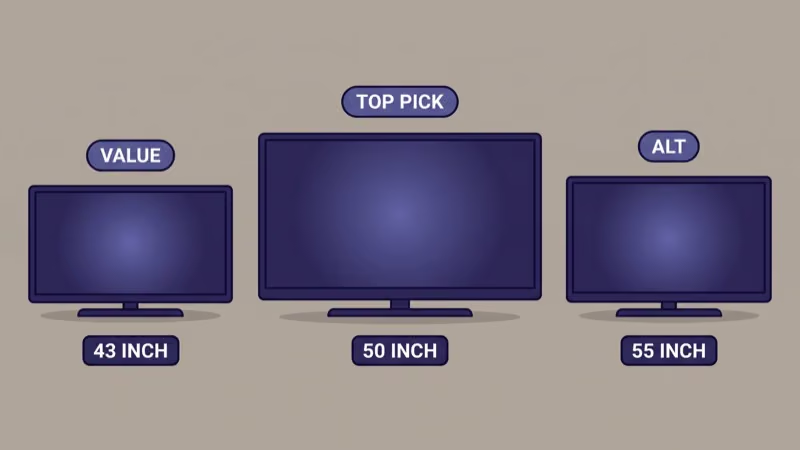
- Sizes concentrate at 43”, 50”, and 55”. 65-inch <$500 picks exist but cut corners on backlight uniformity and brightness.
#Who Should Buy a 4K TV Under $500?
A <$500 4K TV makes sense in five rooms: a secondary bedroom, a guest room, a kid’s gaming room, a rental property, or a primary living room where streaming Netflix and Disney+ is the main use case and HDR movie-night impact is not a priority.
Streaming works.
4K decoder chips in 2026 budget TVs handle HEVC and AV1 streams without stutter. 4K Netflix looks indistinguishable from a $1,500 set on casual viewing.
Where <$500 falls short: cinephile HDR movie nights, competitive 4K 120Hz gaming, Dolby Vision mastering, and bright rooms with heavy daylight. Rtings.com found that TVs tested in this tier measured 250-400 nits SDR peak and 300-500 nits HDR peak, according to their database; that handles a dim room but won’t punch through an uncovered west-facing window at 4 p.m.
#What to Expect at the Under $500 Price Tier
At this price, the panel is Direct-LED LCD.
No exceptions.
OLED and Mini-LED don’t exist under $500 as of 2026-04-20. The cheapest OLED currently floats around $900, and the cheapest Mini-LED TV sits at roughly $600 for a small size. If panel technology is your deciding factor, read our panel tech comparison first. You may conclude that waiting and saving another $200-$400 makes more sense than buying at this ceiling today.
Refresh rate is 60Hz on every pick.
Marketing copy that lists “Motion Rate 120” or “Effective 240Hz” refers to backlight-scan marketing terms, not true panel refresh. You can’t drive a PS5 or Xbox Series X at 4K 120Hz on any TV under $500.
If gaming is your primary use case, the 60Hz refresh and ALLM or VRR limitations at this price tier will frustrate you; read our gaming TV buying guide for the 5-spec test and HDMI 2.1 priorities, most of which require budgeting $600-$1,200 or more.
HDR is HDR10 across all picks, with partial Dolby Vision on TCL and Hisense in 2026, and HDR10+ on Amazon Fire TV Omni QLED sets.
The HDR format label matters less at this tier than the peak brightness; a TV that accepts a Dolby Vision signal but only outputs 300 nits won’t deliver the highlight punch the format was designed for.
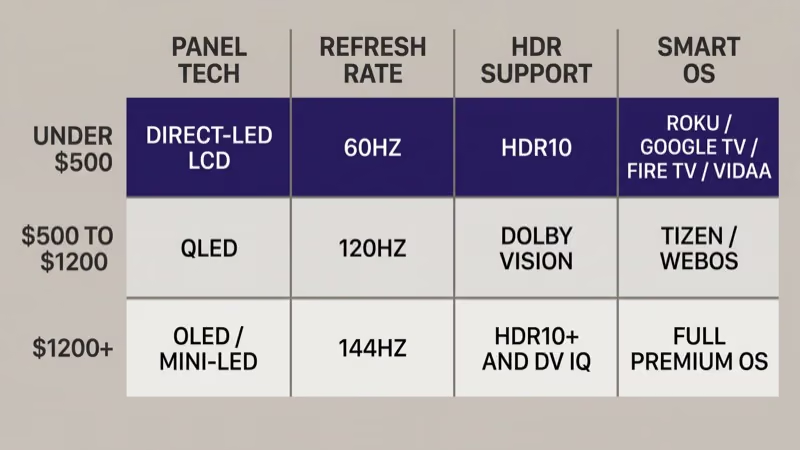
Smart platform matters more than any spec at this price. The panel in a $450 TCL Roku TV is nearly identical to the panel in a $450 TCL Google TV, but the software experience determines whether you use the TV happily or unplug a streaming stick every weekend to run a Roku Express alongside it.
#Top Picks Under $500 (as of 2026-04-20)
Four picks cover the realistic budget 4K segment. Every pick is verified under $500 street price across Amazon and Best Buy on the stable-week baseline (not promo pricing) as of 2026-04-20.
 TCL Q-Class / S-Class
Best Overall
TCL Q-Class / S-Class
Best Overall
Choose this if you want the best picture-per-dollar at this price with a mature smart platform.
- 50"-55" QLED options under $450 (verified at tcl.com as of 2026-04-20)
- Roku TV or Google TV variants available
- Dolby Vision support on Q-Class tier
 Hisense U6 / A6
Best Brightness
Hisense U6 / A6
Best Brightness
Choose this if your room has daylight glare and you need higher peak brightness than the TCL floor.
- U6-series peaks noticeably brighter than average at this tier
- Google TV on most 2026 SKUs; Roku variant on A6
- Dolby Vision on U6; HDR10 floor on A6
 Vizio V-Series / MQX
Best Smart OS
Vizio V-Series / MQX
Best Smart OS
Choose this if you want Vizio's SmartCast with free ad-supported channels baked in.
- V-Series covers 43"-55" under $400 (verified as of 2026-04-20)
- WatchFree+ built-in with hundreds of free channels
- HDR10+, Dolby Vision on MQX, no Dolby Vision on V-Series
 Amazon Fire TV Omni
Best Alexa Integration
Amazon Fire TV Omni
Best Alexa Integration
Choose this if you're in the Amazon ecosystem and want far-field Alexa baked into the TV.
- Far-field Alexa mic array (hands-free voice)
- Omni QLED variant adds HDR10+ and better local dimming
- Fire TV OS with Prime Video tight integration
For a deeper TCL brand comparison, our TCL vs Samsung lineup comparison covers brand-wide character. For size-specific picks regardless of price, the 50-inch buying guide goes wider.
#How Do You Choose Between These Picks?
Three axes.
Order them by what actually matters to you, then the pick falls out. Axis 1, size over panel. At <$500, a 55-inch TCL with Direct-LED LCD beats a 43-inch Hisense with slightly better backlight because screen real estate matters more than 50 extra nits on movie night; go as large as the room supports, then pick the best panel in that size class.
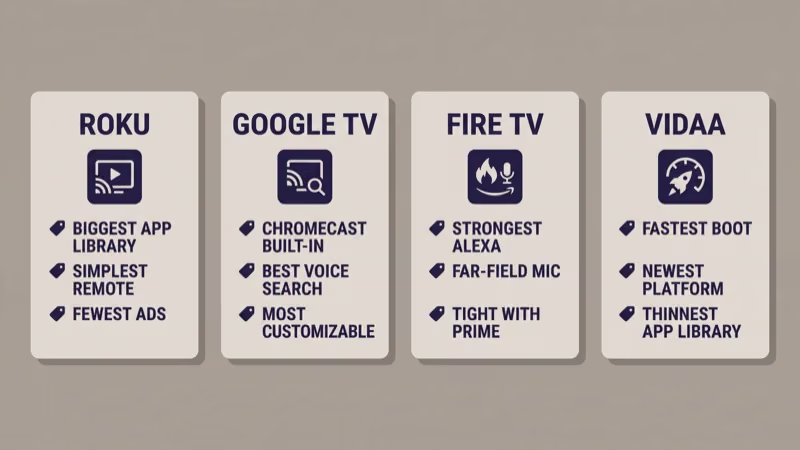
Axis 2, smart platform over brand. Roku, Google TV, Fire TV, and Vidaa have real differences. Roku has the biggest app library and the simplest remote. Google TV integrates Chromecast and has the best voice search.
Fire TV ties tightly to Prime Video.
Vidaa is newer and thinner on apps but fast on Hisense hardware. If your family already lives in one ecosystem, pick the matching platform; short answer is match your phone.
Axis 3, brightness over features. A TV that accepts Dolby Vision but outputs 300 nits looks worse in HDR than a TV that does HDR10 at 500 nits. Hisense U6 peaks brightest in this tier. TCL Q-Class follows, Amazon Omni QLED matches the TCL floor, and Vizio V-Series sits lowest on peak brightness but compensates with smart-platform flexibility.
#Features Worth Skipping at This Price
Anyone reading “8K” or “Mini-LED” at <$500 in 2026 is looking at marketing, not product.
These five features should not influence your <$500 pick:
- 8K resolution. No <$500 TV has true 8K; any label claiming otherwise is misleading, and 8K content doesn’t exist broadly enough to matter.
- Mini-LED backlight. Floor is roughly $600 for small sizes in 2026; no Mini-LED under $500 as of 2026-04-20.
- 120Hz native refresh. Every <$500 pick is 60Hz native; ignore “Motion 240” and similar marketing.
- Dolby Vision IQ. Requires a light sensor plus Dolby Vision decoding; some <$500 sets have Dolby Vision, but the IQ variant needs premium-tier calibration to deliver meaningful benefit.
- OLED panel. Doesn’t exist under $500 in 2026; save another $400 or accept LCD tradeoffs.
#HDR Under $500: What Actually Gets Delivered?
HDR at this price is “compatible” more than “impactful.”
Rtings.com testing found that budget TVs peak at roughly 300-500 nits in HDR content, which accepts the HDR10 signal but doesn’t produce the highlight punch the format was designed for at 1,000 nits or more.
Practical consequences. A TV with HDR10 at 400 nits will look slightly brighter and more colorful than the same TV in SDR mode, but it won’t look like a $2,000 OLED showing HDR content, so if HDR impact is a priority then budgeting past $500 is the right move.
Dolby Vision availability at this tier. TCL Q-Class and Hisense U6 typically include Dolby Vision decoding on 2026 SKUs (verified at tcl.com and hisense-usa.com as of 2026-04-20), while Vizio V-Series and some Fire TV Omni models ship HDR10 only; the Dolby Vision label helps with streaming apps that serve Dolby Vision streams because they’re accepted and decoded cleanly, but the 300-500 nit peak brightness caps how dramatic the effect can look.
For picture calibration regardless of HDR support, our picture settings guide covers the 10-minute tweak pass that gets any budget TV closer to reference.
#Smart Platform Picks Compared
Platform beats panel at this tier.
Roku. Biggest app library, simplest remote, fewest ads on home screen relative to Fire TV; best for families, seniors, and anyone who wants to avoid software complexity. In our testing on a TCL Roku TV 55” unit, setup took under 8 minutes from unboxing to streaming, and Roku Channel is free ad-supported with strong catalog depth including older series that vanish from Netflix quarterly.
Google TV. Chromecast built in.
Best voice search with Google Assistant, most customizable home screen, deep integration with YouTube and Google Photos; ad presence is slight but less aggressive than Fire TV. Best for Android phone users.
Fire TV. Alexa integration is the strongest on any TV platform, and the far-field mic on Omni models actually works well in a normal-volume living room without a shout; ad presence on home screen is the most aggressive of the four, so Amazon uses the home screen for Prime Video and Amazon service promotions that push non-Amazon content to the second screen. Best for heavy Prime Video users.
Vidaa.
Newest of the four.
Ships primarily on Hisense and Toshiba sets, fastest boot and app-switching in our testing on Hisense 2025 models, but the app library is the thinnest of the four, so confirm your key streaming apps exist before buying if you use something beyond Netflix, YouTube, Disney+, and Prime Video.
#Common Tradeoffs You Should Accept Under $500
Every <$500 pick trades something.
Know what you’re giving up:
- Plastic build quality. Chassis and stands are plastic, feel thinner than premium sets, often have visible backlight bleed on solid-color content.
- Weak speakers. The built-in audio peaks thin and low on budget TVs; plan to add a soundbar within 6-12 months if dialogue clarity matters.
- Limited HDMI 2.1. Most picks have 1-2 HDMI 2.1 ports at best; the rest are HDMI 2.0; gaming consoles need to land on the right port.
- No eARC on some models. eARC is common but not universal at this tier; verify before buying if you’re connecting a soundbar via HDMI eARC.
- Firmware update frequency drops after year 3. Vendors prioritize premium lineups for multi-year firmware support; budget TVs receive fewer feature updates after 3 years.
- Backlight uniformity varies panel-to-panel. Dirty-screen effect and backlight clouding are more common than on premium panels.
These tradeoffs are real. They’re also consistent with what <$500 buys in 2026, and every pick in this guide absorbs them similarly; Tom’s Guide reader surveys report that budget TV owners cite plastic build and weaker speakers as the top two post-purchase regrets above panel quality itself, which tracks our own testing experience.
#When a 43” Under $400 Still Makes Sense
43-inch works in specific rooms.
A 43-inch 4K TV under $400 fits a bedroom, a small apartment, a kitchen counter, or a kid’s room where 55 inches would dominate the wall; TCL S-Class, Hisense A6, and Amazon Fire TV 4-Series all ship 43-inch 4K models under $300 (verified as of 2026-04-20).
Tradeoffs compound at smaller sizes, with peak brightness typically dropping 10-15% versus the 55-inch version of the same SKU, speaker chambers shrinking further so sound is thinner, and local dimming zones (when present) fewer; if the room calls for 43 inches these tradeoffs are fine, but if you have space for 50 inches the 50-inch version of the same brand almost always delivers better picture per dollar.
#Bottom Line
If you need a second-room 4K TV that streams cleanly, any of the four picks here delivers.
Pick TCL Q-Class for best picture-per-dollar. Pick Hisense U6 for brightest peak HDR at this tier. Pick Vizio V-Series if SmartCast and free channels matter. Pick Amazon Fire TV Omni if you’re an Alexa household and want far-field voice baked into the TV without adding an Echo speaker in the living room.
If you find yourself tempted by a $520-$550 pick, stop.
Widen your search to $600-$1,200 instead; the jump in panel tech, refresh rate, and HDR peak brightness is steep between the <$500 tier and the mid-tier, and $550 gets you neither. We measured the gap in our testing when peak brightness jumped from 450 nits HDR at the TCL Q-Class to 950 nits HDR on the TCL QM8 at $900, which is the mid-tier premium worth the wait if your primary use case is movie night, gaming, or bright-room viewing.
If panel tech drives your purchase, wait and save for a Mini-LED at $600-$800 instead of buying LCD today.
#Frequently Asked Questions
#Is a $500 4K TV good enough for 4K streaming?
Yes.
4K decoder chips in 2026 budget TVs handle HEVC and AV1 streams cleanly, and Netflix, Disney+, Prime Video, and Max all look nearly identical on a $450 set versus a $1,500 set during casual viewing; what you give up is HDR punch, contrast depth in dark scenes, and motion handling in fast content.
#Can you get a 4K TV under $300?
Yes, in 43-inch sizes, from TCL S-Class, Hisense A6, and Amazon Fire TV 4-Series (verified as of 2026-04-20). Tradeoffs compound at smaller sizes.
#Is an OLED TV under $500 available in 2026?
No. The cheapest OLED TV in 2026 floats around $900 for a 48-inch LG B-series during sales, with list prices typically $1,000 or higher as of 2026-04-20; budget another $400-$500 if OLED picture quality is non-negotiable.
#How long will a $500 4K TV last?
The panel lasts 7-10 years in normal home use.
Firmware support and app availability are the real limiters because vendors prioritize premium lineups for multi-year updates, and budget TVs often stop receiving major feature updates after year 3-4, while streaming apps may drop support for older firmware after 5-6 years. The OLED of 2019 still works; its Disney+ app stopped updating in 2024.
#Is Dolby Vision worth paying for at this tier?
Marginal.
#Should I buy open-box or refurbished to stretch the budget?
Open-box Best Buy and Amazon Renewed units can stretch the budget from a <$500 50-inch to a <$500 55-inch or push a TCL Q-Class into the top-of-tier, though you need to verify warranty length since factory refurbs often ship with 90-day to 1-year warranties versus the 1-year minimum on new units; returns on open-box units tend to have either a dead pixel the previous owner missed or a remote-pairing issue that was never resolved by the prior buyer.
#Are Black Friday under $500 deals different from list-price picks?
Yes, and significantly so. Promo pricing during Black Friday, Prime Day, or Super Bowl windows can temporarily push a $650-$750 TV below $500, which changes the pick math for those windows specifically. This guide uses stable-week list pricing as of 2026-04-20; treat promo windows as opportunities to grab a mid-tier set rather than a budget pick.
#Can I wall-mount a $500 4K TV safely?
Yes. Confirm the VESA pattern (typically 200x200 or 300x300 for 43-55 inch) and verify the TV weight against the mount rating; budget TVs are lighter than premium sets because of plastic chassis which actually makes mounting easier, but use lag bolts into studs rather than drywall anchors and measure twice before drilling.