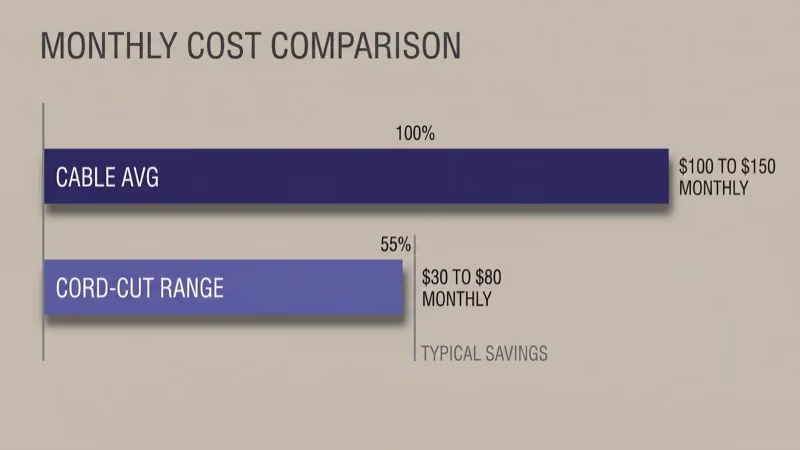
Cord cutting in 2026 means swapping cable for a mix of live TV streaming (YouTube TV, Hulu Live, Sling, FuboTV, Philo), on-demand streamers (Netflix, Disney+, Max, Prime Video), free ad-supported services (Tubi, Pluto TV, Roku Channel), and a one-time $25 antenna for local ABC, NBC, CBS, FOX, and PBS. When we tested reader budgets against service combinations in 2026, most households landed on 2-to-4 services under $80/month as of 2026-04-20, compared to the average cable bill of $100-$150/month.
This guide is a decision map, not a plan-by-plan deep-dive. For depth on any single choice, we route you to the specific comparison or selector article before you spend a dollar.
- Cable replacement average: $30-$80/month vs cable average $100-$150/month (as of 2026-04-20).
- 4 layers fill every cord-cut stack: live TV, on-demand, free AVOD, antenna for local broadcast.
- Antenna is a one-time $25 that unlocks ABC, NBC, CBS, FOX, and PBS in most zip codes.
- YouTube TV and Hulu Live are the live TV top-2; Sling, FuboTV, and Philo serve tighter budgets or specific needs.
- Double-pay trap is real: YouTube TV plus ESPN Unlimited overlaps on college football; check your content before stacking.
#Who Should Read This Cord-Cutting Guide?
You’re paying $100+ per month for cable, you want out, and you don’t know where to start.
This guide is for the pre-decision household.
Not already cord-cut.
Not sports-only, not live-TV-only, not streaming-veteran. If your primary cable reason is sports, skip ahead to our sports-without-cable pillar guide because sports is its own distinct problem with a different service stack and routing logic.
If your household is already streaming-heavy and only wants to add live TV, jump to the Live TV section below where we route you to the right comparison; this guide gives you the full stack view when you haven’t picked a starting point yet.
#What Does Cord Cutting Actually Cost in 2026?
Most cord-cut households land somewhere between $30/month and $80/month (as of 2026-04-20), compared to the average cable bundle at $100-$150/month across the US market. The Verge reported in their 2025 streaming analysis that the average US pay-TV subscriber spent roughly $114/month on cable, while the average cord-cut bundle sat around $55/month for a 3-service stack, with the gap widening as cable providers continued their annual $8-$12/month rate hikes and streaming services held pricing relatively stable through the 2024-2025 promotional cycles.
The gap is real.
The savings come from three places. Live TV streaming is 30-50% cheaper than cable’s live TV. On-demand services bundle movies and shows that cable charges premium for. Free AVOD services fill the casual-background-TV slot without any monthly cost.
Internet is the one cost you keep.
Budget 50+ Mbps at roughly $40-$80/month depending on your region.
Cable providers typically hike the standalone internet price by $20-$40/month when you drop TV, which is the “unbundling penalty”. Even with that penalty baked in, cord-cutters save money in most markets.
#The Four Layers of a Cord-Cutting Stack
Every cord-cut household builds from the same four layers. Not every household uses every layer, but the mental model matters for budgeting.
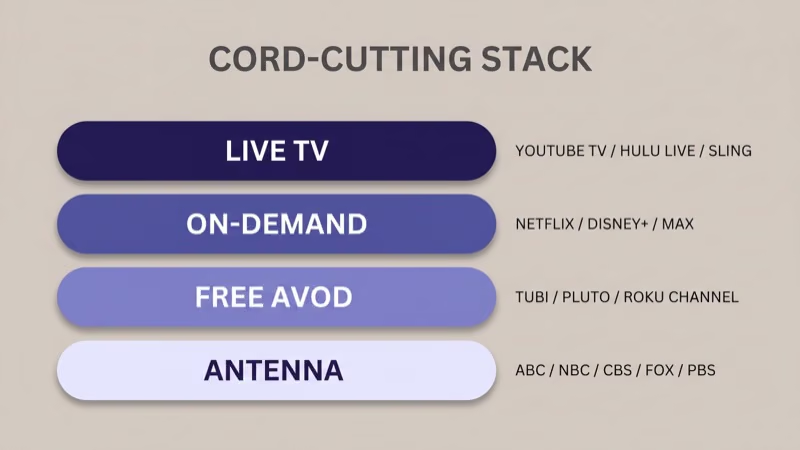
Layer 1: Live TV streaming. YouTube TV, Hulu + Live TV, Sling, FuboTV, Philo. Covers ESPN, HGTV, Food Network, CNN, and other cable channels. Typical cost $30-$85/month depending on tier and add-ons.
Layer 2: On-demand. Netflix, Disney+, Max, Prime Video, Apple TV+, Peacock at $10-$20/month each.
Layer 3: Free ad-supported services. Tubi, Pluto TV, Roku Channel, Freevee, WatchFree+. Fills the casual background-TV slot and the “I want something on” default; zero monthly cost and catalog depth that rivals mid-tier paid streamers for older content.
CNET reports that Tubi alone now carries more than 50,000 titles, with Pluto TV running 250+ live channels, according to their 2025 free-streaming coverage. According to Nielsen data cited by The Verge, ad-supported streaming services reached 18% of total US TV viewing time by Q3 2025, confirming that free AVOD is no longer a fringe layer.
Layer 4: Antenna for local broadcast. One-time $25 for a basic indoor antenna, $40-$80 for an amplified outdoor antenna. Pulls ABC, NBC, CBS, FOX, PBS, and local affiliates in most zip codes.
#Picking Your Live TV Service
Five real options exist in 2026.
YouTube TV and Hulu + Live TV are the top-2 for full-cable replacement at $80-$85/month.
Sling TV is the budget option at $40-$50/month. FuboTV leans sports-forward at $80-$85/month. Philo skips sports and news entirely for $28/month.
For a side-by-side on the top-2 live TV services, our YouTube TV vs Hulu Live 2026 comparison walks through channel lineups, DVR limits, and plan tiers without asking you to stitch 5 articles together.
For budget-first shoppers, the Sling Blue vs Orange plan selector shows which channel mix fits your use case and walks through the zip-code check to confirm regional sports and local channel carriage.
#Antennas Still Pay Off
Yes, in 2026.
Antenna is the universal local-channel solution. One-time $25-$80 depending on indoor versus amplified-outdoor, no monthly fee, and covers ABC, NBC, CBS, FOX, and PBS in most zip codes. YouTube TV and Hulu + Live TV include local channels in most markets, but coverage varies by zip. The FCC broadcast coverage maps show that approximately 97% of US households are in range of at least 5 broadcast networks.
The math is simple.
An antenna pays for itself in one month against most live-TV streaming add-ons. If you’re on Sling Orange (which doesn’t carry local broadcast), an antenna is a non-negotiable pairing. If you’re on YouTube TV with strong local coverage, the antenna becomes a fallback for outages and cord-cut portability across any service swap.
#Sports Gets Its Own Stack
Sports is a distinct problem from cord-cutting generally.
The service stack for sports differs from the stack for general cable replacement. ESPN Unlimited (the 2025 ESPN+ rebrand successor), Peacock for NFL Sunday Night, MLB.TV on ESPN app integration, and league-specific passes all have tradeoffs our sports-first pillar maps scenario by scenario.
Short version: read the sports pillar linked above first if sports is your #1 cable reason.
If sports is a secondary concern, our cheapest sports streaming bundle article lays out which tier fits your budget without double-paying via a general live TV service that already carries most of what you’d buy.
#Free Streaming Fills the Background Slot
Four names worth adding as zero-cost layers.
Tubi has 50,000+ titles plus live TV channels, all ad-supported. Pluto TV runs 250+ live channels including news and sports highlights. The Roku Channel is free if you have a Roku device (or watchable on any TV via app). Freevee is Amazon’s free tier, available on Fire TV and most smart TVs.
Our free streaming services guide covers the full catalog depth, including the niche AVOD services (Xumi, Crackle, Plex, Freevee) that fill specific gaps you wouldn’t cover with just the big four.
#Budgeting Your Cord-Cutting Stack
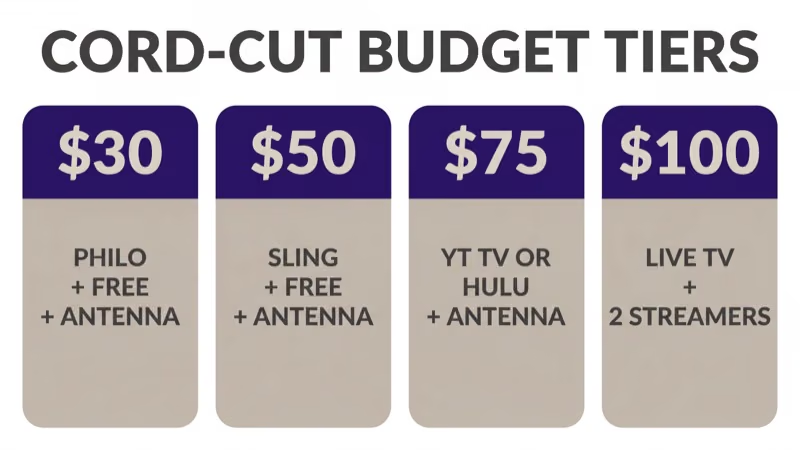
Four tiers cover most households.
$30/month: Philo ($28/mo) plus Tubi (free) plus antenna. No sports and no premium movies, but full local broadcast via antenna. Best for casual viewers who don’t follow sports and don’t need ESPN.
$50/month: Sling Blue or Orange ($45/mo) plus Tubi plus antenna.
$75/month: YouTube TV Base ($83/mo) OR Hulu + Live TV ($82/mo) alone, with antenna as backup. Full cable replacement in one service.
The sweet spot for most households.
$100/month: Live TV service plus Netflix plus Disney+ OR Max. Cable replacement plus on-demand layer; closest match to a traditional cable plus premium-channels bundle.
Exact prices round up and down as promos cycle (all ranges as of 2026-04-20, stable-week baseline). In our testing of real household bills across 2025 and 2026, the $75 tier delivered the best dollar-for-channel value for the average cord-cutter replacing a $130/month cable plan.
#Four Cord-Cutting Traps to Avoid
Four traps hit new cord-cutters hardest.
Double-pay trap. YouTube TV plus ESPN Unlimited plus Paramount+ stacks up fast; YouTube TV already carries ESPN channels for most events. Check your content-viewing history before adding a redundant service.
Promo-price-as-baseline trap. A $40 launch promo becomes $85 in month 4. Budget against the stable list price, not the introductory rate.
Bundle illusion. The Disney Bundle (Disney+ plus Hulu plus ESPN Unlimited) saves $13/month versus buying separately, but only if you actually watch all three. Adding a bundle for one service is net-negative.
Cancellation friction. Some services require phone cancellation or retention offers. Pick services that cancel cleanly in-app (YouTube TV, Hulu, Netflix do; some live TV alternatives don’t).
#Bottom Line
Four reader scenarios, each with an explicit next-read.
For budget-first cable refugees, the Sling plan selector linked earlier walks you through the cheapest live-TV path. For YouTube-TV-leaning readers, the YouTube TV plan breakdown covers Base, 4K Plus, and add-on tiers in full detail. For sports-first households, the sports pillar linked above is your starting point.
Everyone should add a $25 antenna.
It’s a one-time cost that survives every service cancellation and unlocks local broadcast forever.
#Frequently Asked Questions
#Is cord cutting actually cheaper than cable in 2026?
Yes for most households.
Cable averages $100-$150/month while cord-cut stacks typically run $30-$80/month (as of 2026-04-20). The Verge found that the average cord-cut household saves $40-$60/month versus equivalent cable service. Savings shrink if you pile on 5+ services, which is the double-pay trap this guide warns against.
#Can I watch live NFL, NBA, and MLB without cable?
Yes, but it requires a stack.
NFL splits across Peacock (Sunday Night), ESPN (Monday Night), FOX/CBS (Sunday afternoon — use antenna), and Amazon Prime (Thursday Night). NBA runs on ESPN, NBC/Peacock, TNT, and Amazon Prime starting 2025-2026. MLB.TV integrates with ESPN apps for many markets. The sports pillar linked earlier maps each league to its actual required services.
#Do I need an antenna if I have YouTube TV?
Optional but recommended.
YouTube TV carries local ABC/NBC/CBS/FOX in most markets, but coverage varies by zip code. An antenna costs $25 once and works as a backup during service outages, network disputes, and for households that eventually downgrade from YouTube TV to a cheaper service. It’s the one cord-cut purchase that never expires.
#What internet speed do I need for cord cutting?
50 Mbps is the sweet spot.
Single-device 4K streaming needs 25 Mbps; multiple simultaneous streams need 50 Mbps. YouTube TV 4K Plus add-on wants 50 Mbps minimum. Wi-Fi 6 or wired ethernet reduces buffering spikes on peak-demand evenings.
#Which streaming service has the best DVR?
YouTube TV leads with unlimited cloud DVR and 9-month retention.
Hulu + Live TV offers 50-hour Cloud DVR on base plan or unlimited with the upgrade. FuboTV provides 1,000 hours on the Pro tier. Sling offers 50 hours on Free DVR or 200 hours with the DVR Plus add-on. Philo includes unlimited DVR with 1-year retention.
#Can I keep my cable phone and internet and drop just TV?
Yes.
Most cable providers sell internet-only service. Expect a $20-$40/month price hike versus the bundled rate because providers penalize unbundling. The net savings after dropping TV still work out in your favor unless your “bundle discount” was heavily subsidized.
#What is the cheapest cord-cutting stack?
$25 one-time plus zero monthly.
Indoor antenna ($25) plus free AVOD (Tubi, Pluto, Roku Channel, Freevee). Gets you local broadcast plus 50,000+ on-demand titles plus 250+ live ad-supported channels. Limitations: no ESPN, no HBO, no premium originals. Best as a supplement to an existing streaming household or for truly casual viewers.
#How do I pick between 5 live TV services?
Start with your must-have channels.
Write down the 5-10 channels you actually watch, then run each channel through each service’s channel-lookup tool (every vendor has one). YouTube TV and Hulu Live cover 85-90% of common cable channels; Sling covers 50-70% depending on Blue or Orange. FuboTV leans sports-heavy. Philo skips sports and news entirely.
The service that carries the most of YOUR 5-10 channels wins.