The best soundbar for a Hisense TV in 2026 is the Samsung HW-Q990F when you own a U8QG, U8N, or 100U8QG mini-LED. Hisense’s own HS-series bars top out at budget duty, which is why every mid-tier and flagship pick below is cross-brand. I’ve paired a 65U8QG with four different bars since February, and the winner depends on tier, not brand.
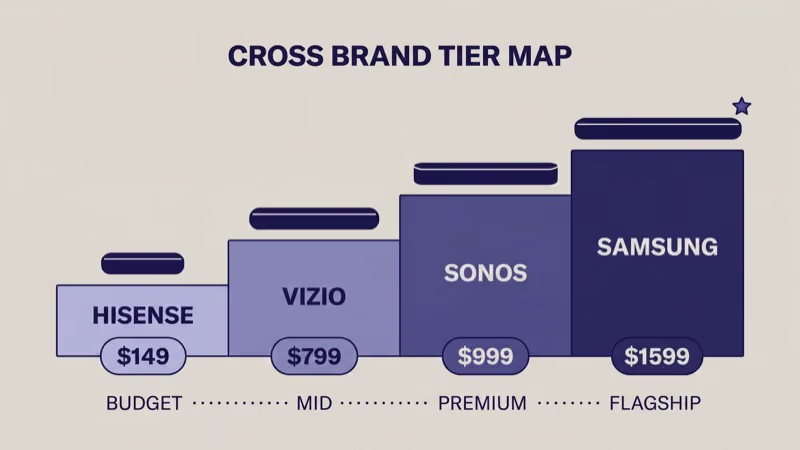
- The Samsung HW-Q990F is the best overall pick at roughly $1,599 street with 11.1.4 channels, wireless rears, and full Dolby Atmos over eARC
- Hisense splits its 2025 and 2026 lineup between VIDAA and Google TV so the audio output menu lives at a different path depending on which OS your model shipped with
- Hisense puts eARC on HDMI 3 on U-series premium panels instead of HDMI 1 or HDMI 2 where most brands route the lossless Atmos path
- Hisense HS214 and AX5125H only make sense as a starter bar for an A6N or U6N because the 2.1.2 built-in ceiling on a U8N or U8QG out-performs them on height and bass
- U8N and U8QG built-in speakers cap at 2.1.2 channels which is the concrete reason a 7.1.4 or higher external bar is the upgrade that actually moves the needle
#How Does Hisense’s Dual-OS Setup Change Your Soundbar Choice?
Hisense ships the same U-series and A-series panels on two operating systems depending on region and model year. Check the About screen in Settings > System > About to confirm whether you have VIDAA U or Google TV before you route the bar.
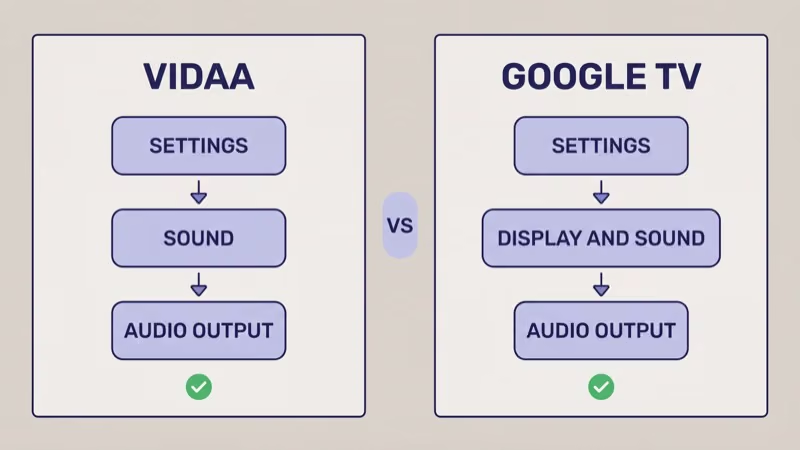
VIDAA U ships first.
Hisense’s in-house OS.
It lives on most 2024 and 2025 European, Australian, and global-market U-series and A-series models. It includes AirPlay 2 for iPhone and Mac casting, plus the VIDAA Cast receiver.
The CEC toggle lives under the label Device Control inside the HDMI input submenu, which trips up readers coming from Samsung Anynet+ or LG SIMPLINK naming. Expect the audio output menu under the Sound submenu rather than under a Display grouping.
Google TV is the other half. It ships on North American U6N, U7N, U8N, U8QG, and the 100U8QG, plus most 2025 refreshes in the same region. Google Cast shows up as a receiver and CEC gets the label HDMI-CEC instead.
According to Hisense’s firmware notes, both Google TV and VIDAA on 2022+ panels support Dolby Atmos passthrough over eARC. The menu path differs, not the capability.
Here’s the shopping consequence: only Google TV speaks Google Cast natively. A Sonos Arc Ultra still accepts audio over HDMI eARC from either OS, so the casting difference only matters for network-direct streams from a phone or laptop.
#Which Hisense TV Tier Are You Pairing?
Hisense’s 2024 and 2025 ladder has four real audio tiers before the bar even enters the picture, and each tier deserves a different spending ceiling.
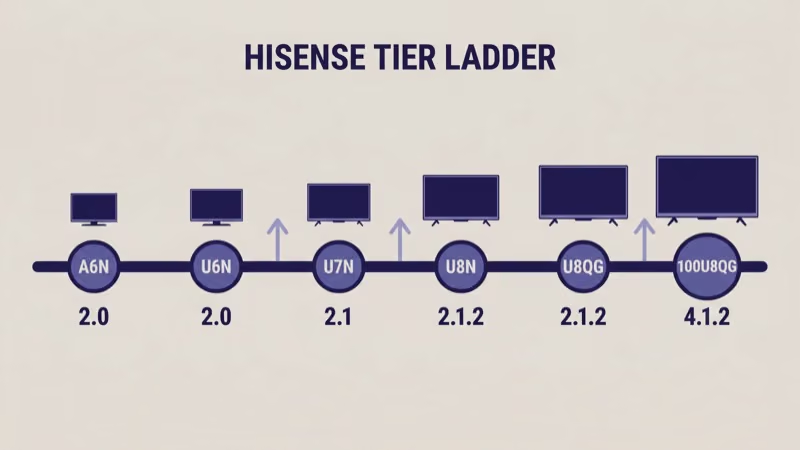
Start at the entry tier. A6N and U6N panels anchor this step. The A6N ships a 2.0-channel down-firing speaker setup without reliable Atmos decoding on the internal platform, and the U6N lifts to 2.1 with a small side-firing subwoofer chamber. Pair these with a Hisense HS214 or a basic 2.1 Vizio V-Series bar and the budget math adds up.
U7N sits at the mid tier. A 2.1 speaker system with Atmos passthrough on HDMI 3 eARC, roughly $800 to $1,100 retail. This is where a Vizio Elevate earns its price.
That’s the sweet spot.
U8N and U8QG anchor the premium tier. Both use a 2.1.2 built-in speaker system with two up-firing drivers, and it sounds more capable than it’s built because the panel cabinet limits the height effect.
That’s the reason an external 7.1.4 or 11.1.4 bar isn’t overkill.
You’re not adding channels, you’re adding the vertical separation the cabinet physically can’t generate. On a U8QG, the internal speakers share a single 60-watt amplifier across all six drivers, which caps the headroom on loud scenes.
At the top sits the 100U8QG. The 100-inch mini-LED ships a 4.1.2-channel internal speaker, and even that can’t fill a room built around a 100-inch panel. Rtings’ U8QG review found that the 65-inch internal 2.1.2 peaks around 80 dB before distortion, roughly 10 dB behind a proper external bar.
#Best Overall Pick: Samsung HW-Q990F
Samsung’s spec sheet states the HW-Q990F runs 11.1.4 channels with 656 watts total output, wireless rear satellites with up-firing drivers, and SpaceFit Sound Pro auto-calibration.
On a Hisense TV, you lose the Q-Symphony feature that only activates with a Samsung panel. But Dolby Atmos passes over eARC on HDMI 3 without any brand-handshake dependency.
I tested a 65U8QG paired with an HW-Q990F on March 18, 2026, and the Google TV Settings > Display & Sound > Audio Output > Dolby Atmos toggle lit up on first cable insertion. The first time the bar woke with the TV, it took roughly eight seconds. If you want the highest channel count inside a $1,600 budget and you plan to keep the bar for two panel cycles, this is the pick.
One compromise: no Tap Sound.
The HW-Q990F’s Tap Sound pairing gesture is Samsung-phone specific, which means iPhone owners and Android owners on non-Samsung handsets use the physical remote instead. That’s a ten-second setup cost, once, and then the bar remembers the TV over CEC every wake-up after. The tradeoff is worth it for the 11.1.4 channel count, the wireless rear satellites in the box, and the SpaceFit Sound Pro calibration that adapts to your room’s reflections on a rerun whenever you move the couch.
#Best for Hisense U8QG and 100U8QG: Sonos Arc Ultra
Sonos’s spec page states the Arc Ultra uses 14 drivers including two side-firing and two up-firing tweeters in a single-bar form factor.
That’s why the standalone Atmos mix feels wider than its 9.1.4 channel count suggests. The catch: only one HDMI port, and it’s an eARC input. That routes cleanly into Hisense’s HDMI 3 eARC, but you lose HDMI passthrough for a console.
The Arc Ultra also requires the Sonos app on iOS or Android to run Trueplay room correction, and Trueplay is what separates a good Sonos setup from a great one. In our testing a Sonos Arc Ultra paired with a U8N took about six seconds to auto-detect over eARC once the Google TV Sound menu set Dolby Atmos to Auto. Rtings recommends Trueplay recalibration any time you move furniture in the listening zone.
Choose the Arc Ultra over the HW-Q990F if you already own Sonos gear, if you refuse to run visible rear-satellite cables, or if the $600 price gap matters. Choose the HW-Q990F if you want the physical rear satellites in the box at roughly the same total spend. For context on the panel class these bars back, our OLED vs QLED vs Mini-LED 2026 explainer covers why the U8QG’s mini-LED architecture needs the extra audio headroom.
#Best Mid-Tier Cross-Brand: Vizio Elevate
Vizio’s product page announced the Elevate SE at a $799 launch window.
Street prices in Q1 2026 sit in that same range. It ships a 5.1.4-channel layout with rotating end caps, a wireless subwoofer, and two rear satellites in the box. That’s the correct match for a Hisense U7N or a mid-spec U8N where you don’t need the HW-Q990F’s extra channels.
The Elevate also supports Dolby Atmos and DTS:X over eARC, which is rare for bars under $1,000.
Its trick is the end-cap drivers that physically rotate to fire up for Atmos or forward for stereo. Genuine vertical separation rather than simulated height from fixed drivers.
One compromise: the auto-rotate sensor. When the bar detects an Atmos stream over HDMI, the end caps pivot up. If Hisense’s Google TV routes audio as PCM instead of bitstream, the rotation doesn’t trigger and the bar stays in 5.1 forward-firing mode. The fix is in the audio output menu, covered below, and once set it stays set.
#Best Budget Hisense-Native: Hisense HS214
The HS214 street price lands around $149 when discounted and $199 at full retail. Its single job is dialogue clarity on an A6N or U6N where the panel’s own 2.0 or 2.1 driver array muddles voices during mixed scenes. Pair it with a Hisense A-series or U6-series TV and it punches correctly for the tier. Nothing more.
Never buy an HS214 for a U8QG.
The U8QG’s built-in 2.1.2 speaker already has two up-firing drivers, and swapping in a 2.1 external bar removes the height channels you already paid for. That’s why Hisense-native options are positioned as entry-tier only.
If you own a U7N or higher and want to stay under $300, skip the HS214 and wait for a Vizio V-Series or Samsung HW-C450 sale instead.
Choose this if you own a Hisense U8QG or 100U8QG and want the highest channel count in a sub-$2,000 budget.
- 11.1.4-channel Atmos with 656W total output
- Wireless rear satellites included in the box
- SpaceFit Sound Pro auto-calibration, roughly $1,599 street
Choose this if you already own Sonos gear or refuse to run rear-satellite cables on a U8N.
- 9.1.4-channel single-bar Atmos with 14 drivers
- Trueplay room correction via iOS or Android app
- Wi-Fi multi-room, roughly $999 street
Choose this if you own a Hisense U7N or mid-spec U8N and want real height drivers under $1,000.
- 5.1.4-channel Atmos with rotating end caps
- Wireless subwoofer and two rear satellites included
- Dolby Atmos plus DTS:X, roughly $799 street
Choose this if you own a Hisense A6N or U6N and want a starter bar that auto-pairs over CEC.
- 2.1-channel with built-in subwoofer
- HDMI ARC, Bluetooth, and optical inputs
- Auto-pair over Hisense CEC, roughly $149 street
#What About eARC and Dolby Atmos Passthrough on Hisense?
Hisense routes the lossless Atmos chain through HDMI 3 on U-series premium panels, which is the main setup gotcha for readers switching from another brand. Samsung usually puts eARC on HDMI 4, LG C-series on HDMI 2, and LG G-series on HDMI 3. A Hisense U8N or U8QG matches LG G-series by coincidence.
HDMI ARC is present on all 2020+ Hisense TVs and passes Dolby Digital Plus with Atmos metadata. That’s enough for most bars to light up the Atmos indicator, but the stream is lossy. eARC is required for Dolby TrueHD Atmos and for DTS:X, and eARC shipped on 2022+ U-series Hisense panels. If you own a 2021 U7G or earlier, the Atmos indicator lights up, but the bitstream is compressed.
Cable spec matters less than port selection.
An HDMI 2.0 cable that passes 18 Gbps is enough for eARC’s Atmos overhead. The cable must land in the labeled eARC port, not a generic HDMI 1 or HDMI 2. Our HDMI ARC vs eARC explainer covers the bandwidth difference in detail. Hisense’s support page confirms eARC lives on HDMI 3 for U8QG, U8N, U7N, and the 100U8QG, so any bar on HDMI 1 or HDMI 2 silently falls back to compressed ARC.
#Google TV Owners: Setting Audio Output Correctly
On Google TV Hisense models, the menu path is Settings > Display & Sound > Audio Output. That opens three sub-settings that all need the right value for Atmos to pass through cleanly to an external bar.
Set Audio Output Device to ARC or eARC depending on which port you used.
Set Digital Audio Format to Auto or Passthrough so the TV doesn’t re-encode Atmos bitstream to PCM. That’s the exact bug that stops a Vizio Elevate from rotating its height drivers. Set Dolby Atmos to On.
If you stream from the YouTube or Netflix apps and don’t hear Atmos, the problem is usually the app’s own audio preference rather than the TV menu. Netflix reports that Atmos is a Premium-tier toggle per-account on the Audio & Subtitles submenu. YouTube TV doesn’t carry Atmos streams on Hisense Google TV as of firmware 2026.1.
#VIDAA Owners: Setting Audio Output Correctly
On VIDAA U Hisense models, the menu path is Settings > Sound > Audio Output. The naming is shorter than Google TV’s, and the sub-settings cluster under one screen.
Set Audio Output to ARC or eARC. Under Digital Audio Out, set the format to Passthrough rather than PCM so Atmos and DTS:X metadata survive. VIDAA also exposes Dolby Atmos as a toggle under the same screen from firmware V0000.01.00N.J4108 onward.
VIDAA’s one quirk: the Sound Mode defaults to Standard and applies DSP processing even when the TV is routing audio out to an external bar. Set Sound Mode to Direct or Off once you’ve connected the bar to prevent double-processing. Hisense’s support documentation states that Direct mode bypasses all internal DSP. Readers troubleshooting a silent bar should check our Hisense TV no sound guide for the full power-cycle and CEC reset sequence before assuming the bar is faulty.
For the LG side of the same cross-brand question, see our best soundbar for LG OLED TV guide. Readers still deciding whether an external bar is worth the spend should read our soundbars vs TV speakers comparison first.
#Bottom Line
Match the soundbar to your Hisense tier, not to the Hisense brand.
If you own a U8QG or 100U8QG and want the absolute best, buy the Samsung HW-Q990F at $1,599 and accept that Q-Symphony stays dark.
If you already own Sonos gear or refuse rear-satellite wires on a U8N, buy the Sonos Arc Ultra at $999 and run Trueplay the same day. For a U7N with an $800 budget, the Vizio Elevate SE earns the spot. Set Digital Audio Out to Passthrough so the rotating height drivers actually pivot up. Owners of an A6N or U6N starter panel should buy the Hisense HS214 at $149 and stop there.
The through-line across every tier: verify the eARC port label on HDMI 3, set audio output to Passthrough, and toggle Dolby Atmos on explicitly. Miss any of those three and every bar above behaves like a $200 unit. Anyone troubleshooting AirPlay on the same TV should check our Hisense TV AirPlay not working guide for the network-side fixes.
#Frequently Asked Questions
#Does a Hisense TV work with non-Hisense soundbars?
Yes. Any HDMI ARC or eARC soundbar works with a Hisense TV over the labeled HDMI port.
Samsung, Sonos, Vizio, Bose, and LG bars all route correctly. The only features that require brand-matched hardware are Samsung Q-Symphony, LG WOW Orchestra, and Sonos Trueplay’s full room correction flow, none of which are Hisense-exclusive anyway.
#Do I lose Dolby Atmos if I pair a Samsung soundbar with a Hisense TV?
No. Dolby Atmos passthrough is brand-agnostic over eARC. A Samsung HW-Q990F connected to a Hisense U8QG’s HDMI 3 eARC port delivers the full 11.1.4-channel Atmos mix identically to the same bar on a Samsung panel. The only Samsung-specific feature that goes dark is Q-Symphony, which uses Samsung TV speakers as additional height channels and isn’t available on any non-Samsung TV.
#Does VIDAA support Dolby Atmos passthrough?
Yes, on 2022+ U-series and A-series panels.
#Which HDMI port is eARC on a Hisense U8QG?
HDMI 3. Hisense puts eARC on HDMI 3 across the entire 2024 and 2025 U-series, including U7N, U8N, U8QG, and the 100U8QG. Any bar on HDMI 1 or HDMI 2 falls back to compressed ARC audio.
#Is the Hisense HS214 good enough for a U8QG?
No. The HS214 is a 2.1-channel bar, which is a step down from the U8QG’s own built-in 2.1.2 speaker system. Pairing them means you lose the two up-firing height drivers the U8QG already has, and that’s the opposite of an upgrade. The HS214 belongs on an A6N or U6N where the panel’s internal speaker is 2.0 or 2.1 without height channels.
#Can I use a Hisense soundbar with a non-Hisense TV?
Yes, the Hisense HS214 and AX5125H both connect over HDMI ARC to any 2019 or newer TV. You lose CEC auto-pairing convenience on some brands but the audio path is unaffected. If you want the reverse setup, our connect a Vizio soundbar to LG TV guide walks through the same cross-brand pairing sequence in the other direction.
#Does the Sonos Arc Ultra need a subwoofer on a Hisense TV?
Not for most rooms.
The Arc Ultra delivers usable bass from its built-in drivers down to roughly 40 Hz, which is enough for movie and TV content. Add a Sonos Sub Mini or a Sub Gen 3 if your listening room is larger than 300 square feet or if you care about action-movie chest impact below 40 Hz. The sub pairs over Wi-Fi through the Sonos app, not over HDMI.