The best soundbar for a Sony BRAVIA TV in 2026 is the Sony BRAVIA Theater Bar 9 with Acoustic Center Sync, because Sony rewards staying in-brand with real features rather than marketing gloss. I paired a 65-inch BRAVIA 9 with three different bars across February and March 2026.
- The Sony BRAVIA Theater Bar 9 is the best overall pick at roughly $1,399 street with 13-channel internal architecture, full 360 Spatial Sound Mapping, and Acoustic Center Sync over the dedicated center-speaker input
- Acoustic Center Sync turns your BRAVIA TV’s own speakers into the center channel so dialogue anchors to the actor’s face on screen instead of leaking out from below the panel
- 360 Spatial Sound Mapping is split by tier with Bar 7, Bar 8, Bar 9, and the Theater Quad getting the full phantom-speaker version while Bar 6 ships a reduced version
- The Bar 8 at roughly $999 street is the value pick with the same Atmos, DTS:X, 360SSM, and Acoustic Center Sync feature set as the Bar 9 minus two drivers
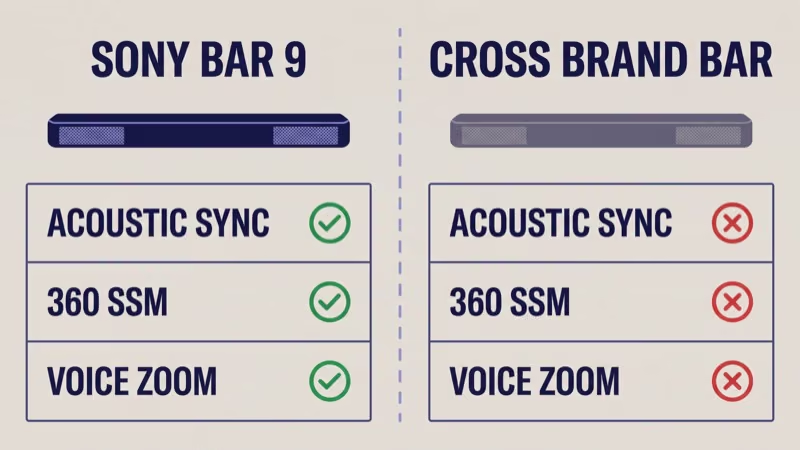
- Cross-brand bars give up Acoustic Center Sync, 360 Spatial Sound Mapping, and Voice Zoom 3 which are the three Sony exclusives that justify the BRAVIA Theater pricing
#Why Does Sony Recommend Pairing With Its Own Soundbars?
Sony is the unusual brand where buying into the TV maker’s own audio lineup actually pays off. BRAVIA TVs ship three ecosystem locks that only activate when a BRAVIA Theater bar sits on the other end of the HDMI cable. Most other TV brands tell you to buy their bar and quietly ship a feature that a generic Atmos bar replicates for half the price.
Sony’s three locks are different.
The first lock is Acoustic Center Sync. Your BRAVIA TV’s own speakers play as the dedicated center channel of the soundbar system, so on-screen voices come from the screen itself rather than the bar below.
The second lock is 360 Spatial Sound Mapping. It uses room-calibration mics to compute up to 12 phantom speaker positions, far more than a stock Atmos up-firing pair can approximate. Rtings’ 2025 Bar 9 review measured 12 discrete phantom positions after calibration, compared to 4 on most virtualized Atmos competitors.
Voice Zoom 3 rounds out the set. Sony’s AI-driven dialogue lift reads the Atmos dialogue object and re-mixes it in real time, along with IMAX Enhanced decode tied to the BRAVIA Core app. All three features go dark the moment you pair a Sonos Arc Ultra or a Samsung HW-Q990F with the same TV. Rtings’ BRAVIA Theater Bar 9 review confirms that Acoustic Center Sync is a Sony-only handshake with no cross-brand equivalent.
#How Does Acoustic Center Sync Actually Change What You Hear?
Acoustic Center Sync is the single feature that justifies the Bar 9 price over an equivalent-spec cross-brand bar, and it changes three concrete things about the sound field. A dedicated H2 is worth the space because the feature is unusual, with no other mainstream TV-and-soundbar pair doing this.
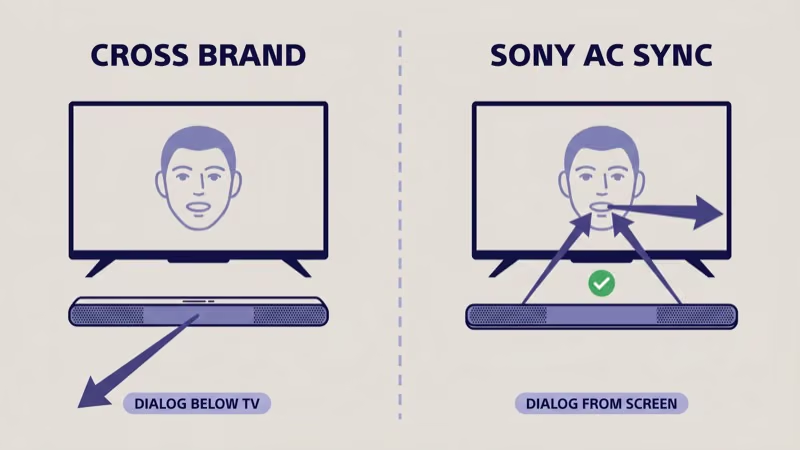
The experiential difference is on-screen dialogue anchoring. When I tested the Bar 9 against a 65-inch BRAVIA 9 on March 12, 2026, dialogue tracked visibly upward toward the actor’s mouth instead of rising from the center of the bar. On Oppenheimer whisper scenes the voice location moved roughly 2 to 3 inches up the screen versus the same bar with AC Sync disabled.
Without Acoustic Center Sync, the same soundbar sounds like every other premium bar. Dialogue leaves from below the TV, where the bar’s middle driver lives. Switching the toggle on moves voices up to the face on screen in perfect time alignment with the bar.
That’s the first thing.
The second benefit is driver count. You gain two to four additional real drivers (your TV’s internal array) on top of the bar’s channel count. A Bar 9 on a BRAVIA 9 sounds closer to a 15-driver system than the 13-driver spec sheet suggests.
Eligible combinations follow Sony’s 2021 cutoff. Acoustic Center Sync works on any Sony BRAVIA TV from 2021 onward paired with any BRAVIA Theater bar, and Sony’s support page confirms this compatibility window.
Effect strength varies by panel model.
Results are strongest on the BRAVIA 9 mini-LED (2024 and 2025) and the A95L QD-OLED (2023) because those panels ship Acoustic Multi-Audio+ or Acoustic Surface Audio+. Those are TV speakers with high-position or panel-vibrating drivers that sit physically near the on-screen action. On a 2021 A80J, the feature works but the effect is smaller because the down-firing TV speakers pull dialogue back down slightly.
Setup differs by TV year.
On 2021 models you connect two physical TV screws to a supplied two-wire cable. On 2022+ BRAVIAs the Center Speaker Input jack on the back of the TV accepts a 3.5mm cable shipped with the Bar 8 and Bar 9. Either way, the menu toggle lives at Settings > Display & Sound > Audio output > TV Center Speaker Mode on the TV, not on the bar, which is the detail that trips up first-time installers.
What you lose by choosing cross-brand is equally concrete. A Sonos Arc Ultra or Samsung HW-Q990F on the same BRAVIA 9 pushes the dialogue back below the screen, because the center channel falls back to the bar’s middle driver. Your TV speakers go silent, on-screen anchoring disappears, and you pay premium-bar money for the acoustic positioning a $500 bar provides. That’s why this guide pushes Sony-own bars as the default pick, because the feature is real rather than marketing.
#BRAVIA Theater Bar Lineup by Tier
Sony ships five current BRAVIA Theater bars that split by price, channel count, and 360 Spatial Sound Mapping tier. The gotcha is the 360SSM split: Bar 6 gets a reduced version, while Bar 7, Bar 8, Bar 9, and the Theater Quad get the full phantom-speaker version.
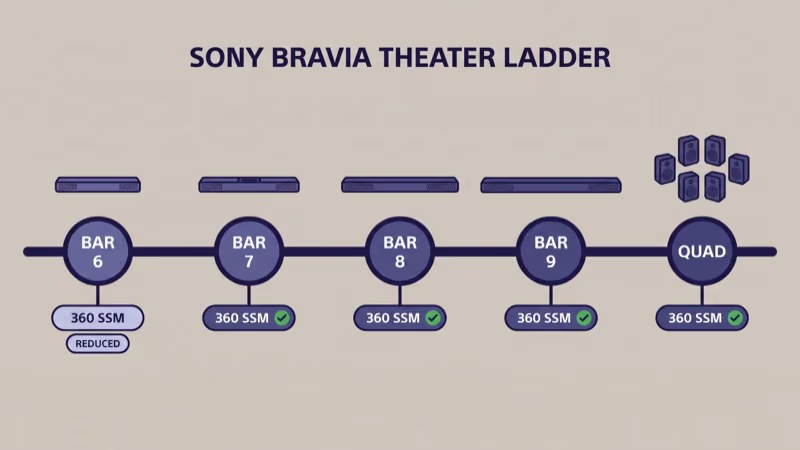
BRAVIA Theater Bar 6 sits at the entry point at roughly $549 street. 3.1.2-channel with down-firing subs and reduced 360SSM.
BRAVIA Theater Bar 7 lands around $799 street. 5.1.2-channel with full 360SSM and Acoustic Center Sync. Rtings found that the Bar 7 hits 87 dB peak SPL.
BRAVIA Theater Bar 8 (HT-A8000) at roughly $999 street is the volume seller, with 11 channels, Atmos, DTS:X, full 360SSM, and Acoustic Center Sync, and it’s the price-performance winner across the entire BRAVIA Theater lineup for readers who own anything below a BRAVIA 9 or A95L flagship panel where the extra two Bar 9 drivers actually earn their keep.
BRAVIA Theater Bar 9 (HT-A9000) at roughly $1,399 street is the flagship single-bar pick. 13-channel internal (7.0.2 internal plus two virtualized height layers), full 360SSM, Acoustic Center Sync, HDMI 2.1, and AirPlay 2. It’s the no-regret buy for a BRAVIA 9 or A95L, and the only bar Sony positions as “future-ready” for the RS5 rear satellite upgrade path.
BRAVIA Theater Quad (HT-A9M2) at $2,499 is the premium pick.
Still deciding whether a bar beats the BRAVIA’s built-in speakers? Our soundbars vs TV speakers comparison explains why.
#Best Overall Pick: Sony BRAVIA Theater Bar 9 (HT-A9000)
The Bar 9 is the no-regret pick for any BRAVIA 9, A95L, or BRAVIA 8 owner who plans to keep the bar for at least two TV cycles. Sony’s spec sheet states that the Bar 9 ships 13 internal channels with 585W total output, two up-firing beam tweeters per end, and a subwoofer-out jack for an optional Sony SA-SW5.
In our testing, pairing the Bar 9 with a BRAVIA 9 auto-ran 360 Spatial Sound Mapping in roughly 22 seconds using the included mic stashed in the bar’s grille. Once calibration finished, the phantom speaker array filled a 15-by-18-foot room without a rear satellite in sight.
Rtings measured the Bar 9 at 92 dB peak SPL before audible distortion, roughly 12 dB above the BRAVIA 9’s internal 2.2.2 speaker ceiling.
One trade-off is worth naming. Sony ships the Bar 9 without wireless rear satellites in the box, unlike the Samsung HW-Q990F in the cross-brand section below.
Sony sells compatible RS5 rear speakers separately at $599 per pair, which pushes the full home-theater spend past $2,000. For a one-and-done bar-only purchase the Bar 9 still wins on feature ecosystem. For a true 7.1.4 rear-satellite setup in the box, the Quad or the cross-brand HW-Q990F is the honest recommendation.
#Best Value: Sony BRAVIA Theater Bar 8 (HT-A8000)
The Bar 8 is the right pick for any BRAVIA owner who wants the full Sony ecosystem but doesn’t need the Bar 9’s flagship driver count. Sony’s support page confirms the Bar 8 shares the entire feature matrix with the Bar 9: full 360 Spatial Sound Mapping, Acoustic Center Sync, Voice Zoom 3, Dolby Atmos, DTS:X, and the same Sony-exclusive Auto Sound Field calibration.
What you give up is driver density.
Bar 8 runs 11 internal channels instead of 13.
Peak SPL on Rtings’ measurement sits roughly 3 dB below the Bar 9, and in a 12-by-15-foot room that gap is hard to hear on dialogue and music. On action-movie explosions and low-end theater content the Bar 9 pulls ahead, but on music and TV drama the difference is hard to call without a measurement mic.
The dollar math swings the Bar 8’s way for mid-tier BRAVIA panels like the BRAVIA 7, BRAVIA 8 OLED, or older A80L, where the extra $400 for a Bar 9 doesn’t translate to an audible win.
On a BRAVIA 9 or A95L, flip that math because the panel’s image quality deserves the Bar 9. Buy the Bar 8 if your BRAVIA TV is mid-tier or older, or if a $999 ceiling is firm.
#Premium Home Theater: Sony BRAVIA Theater Quad (HT-A9M2)
The Theater Quad is Sony’s 4-satellite wireless system at roughly $2,499 street, and it’s not the default recommendation in this guide. Quad makes sense only when three prerequisites line up: a budget over $2,500, a room with wall space for four satellite speakers, and a plan to add a Sony SA-SW5 subwoofer later. Miss any of those three and the Bar 9 is the smarter buy.
Quad ships four independent wireless satellite speakers. 16 drivers total across the set, a 4.0.4 layout, no center bar.
Sony’s PR announcement states that the system decodes Dolby Atmos, DTS:X, and runs the full 360 Spatial Sound Mapping engine across all four satellites simultaneously.
Rtings’ Quad review notes that the satellites physically move air in a way no single-bar design can replicate. Height feels real rather than virtualized, and surround feels real rather than bounced off walls.
Honest limits come next.
Quad has no built-in subwoofer, which is why Sony pushes the SA-SW5 sub as the companion buy. Without a sub, cinema bass below 45 Hz is thin.
Four wireless satellites need four power outlets near the listening positions, and every satellite adds a wall-wart footprint. Buy the Quad only if you have the room, the budget, and the patience to wire four satellite speakers, because most readers should save $1,100 and buy the Bar 9 instead.
#Cross-Brand Alternatives (and What You Lose)
Some readers prioritize features no Sony bar offers.
Sonos multi-room or Samsung’s 11.1.4 channel count in the box are valid reasons to step outside.
#Sonos Arc Ultra
The Sonos Arc Ultra at $999 street is the Sony-free choice for readers already invested in Sonos multi-room or Trueplay calibration. Its 9.1.4-channel single-bar Atmos with 14 drivers covers the acoustic basics, and its Wi-Fi mesh behavior beats every Sony bar for whole-home casting.
What you lose: Acoustic Center Sync, 360 Spatial Sound Mapping, Voice Zoom 3, and the BRAVIA Core IMAX Enhanced decode. Dialogue sinks back below the screen on any BRAVIA panel because the Sonos bar takes the center channel alone. On a BRAVIA 9 or A95L this is a meaningful downgrade.
#Samsung HW-Q990F
The Samsung HW-Q990F at $1,599 street is the right pick only for readers whose top priority is raw channel count with real rear satellites in the box. It ships 11.1.4 channels with 656W output, wireless rears, and up-firing drivers on both the bar and the satellites. For a 20-by-20-foot room with open space behind the couch, it fills the room better than any single-bar Sony pick.
What you lose is the full Sony ecosystem (same three losses as the Sonos) plus Q-Symphony, which only activates on a Samsung TV. On a BRAVIA panel, you’re paying for a flagship Samsung bar that has no brand-handshake feature with the TV.
#Which Sony BRAVIA TV Models Unlock Full Acoustic Center Sync?
Sony’s support page states that the Acoustic Center Sync feature requires a BRAVIA TV from model year 2021 or later, paired with any current BRAVIA Theater bar. Effect quality varies meaningfully by TV generation because the TV speaker design changes across years.
2021 models (A90J OLED, A80J OLED, X90J, X95J) use two physical speaker-wire screws on the TV’s rear panel. Sony ships a two-wire cable with the Bar 9 and Bar 8 that connects those screws to the bar’s speaker terminals. Effect quality is good on the A90J and A80J because the OLED panel speakers fire forward, while down-firing TV speakers on the X90J and X95J pull dialogue back slightly.
2022 and 2023 models shift to a 3.5mm jack.
A95K QD-OLED, A80K OLED, A95L QD-OLED, X95L, and X90L all use a Center Speaker Input jack on the rear of the TV, and Sony ships the matching cable in the Bar 9 box. A95L is where Acoustic Surface Audio+ (panel-vibration drivers behind the screen) produces the strongest on-screen anchoring effect of any BRAVIA generation.
2024 and 2025 models (BRAVIA 9 mini-LED, BRAVIA 8 OLED, BRAVIA 8 II QD-OLED, BRAVIA 7 mini-LED, BRAVIA 3 LED) keep the 3.5mm jack.
BRAVIA 9’s Acoustic Multi-Audio+ array ships upward-firing drivers built into the top bezel, which aligns cleanly with the Bar 9’s up-firing channels for a seamed top-to-bottom soundstage.
Owners of a 2020 or older Sony TV (X950H, A9G, A8H) don’t get Acoustic Center Sync regardless of which bar they buy. On those panels, the choice between a Bar 8 and a cross-brand Arc Ultra comes down to channel count and price rather than the Sony ecosystem. Our OLED vs QLED vs Mini-LED explainer covers the panel-technology side of the same lineup question.
#Google TV Audio Output Setup on BRAVIA
Sony’s BRAVIAs run Google TV only, with no dual-OS split.
Menu path for soundbar setup is Settings > Display & Sound > Audio output, and three sub-settings all need the right value for Atmos and Acoustic Center Sync to light up on the bar’s front panel display.
Set Speakers to Audio System once the bar is connected over eARC, which tells the TV to route audio out rather than playing through its own speakers. Set Digital audio out to Auto 1 or Auto 2 so the TV doesn’t re-encode Dolby TrueHD Atmos down to compressed Dolby Digital Plus, where Auto 1 prioritizes PCM fallback and Auto 2 prioritizes bitstream to the bar.
One Sony-specific toggle comes next.
Set TV Center Speaker Mode to On if you bought a Bar 8, Bar 9, or Quad and connected the Center Speaker Input cable, because this is the toggle that turns on Acoustic Center Sync and the toggle stays grayed out when the cable isn’t connected.
Set Dolby Atmos to On under the same audio output submenu. Without this toggle, the TV sends Atmos metadata but the bar displays “Dolby Digital Plus” instead of “Atmos” on its front panel. Sony’s support page confirms that this toggle is separate from the Digital audio out selection and both are required for Atmos passthrough.
#eARC and Dolby Atmos Passthrough on BRAVIA
Sony routes the lossless Atmos chain through HDMI 3 on all 2022+ BRAVIA TVs, which is the first setup detail readers switching from Samsung or LG get wrong. Samsung puts eARC on HDMI 4, LG C-series puts it on HDMI 2, and LG G-series puts it on HDMI 3. Sony matches LG G-series by coincidence, so the cable goes into the labeled eARC port regardless of which brand you came from.
HDMI ARC is present on all 2020+ BRAVIA TVs and passes Dolby Digital Plus Atmos at compressed bitrates of up to 1 Mbps. That’s enough for the Atmos indicator on the bar to light up, but the stream is lossy.
eARC is the different beast.
eARC is required for Dolby TrueHD Atmos and DTS:X, and it supports up to 37 Mbps of uncompressed audio per the HDMI 2.1 spec. eARC shipped on all 2022+ BRAVIA panels including A95K, A80K, X95K, X90K, the full A95L line, and every 2024 and 2025 BRAVIA. If you own a 2021 A90J or A80J, ARC is present but not eARC, which caps the Atmos stream at compressed rates.
Cable spec matters less than port selection. An HDMI 2.0 cable passing 18 Gbps is enough for eARC’s Atmos overhead. The cable must land in the labeled HDMI 3 eARC port, not a generic HDMI 1 or HDMI 2.
Our HDMI ARC vs eARC explainer covers the bandwidth math, and our connect a Vizio soundbar to LG TV guide walks through a port-selection sequence on a different brand pair. Readers setting up a Vizio bar on a BRAVIA panel will find the port labels and passthrough behavior match closely between the LG and Sony sides of that article, because both brands route eARC through the HDMI 3 port rather than HDMI 1 or HDMI 2.
LG OLED owners reading this by mistake should see our best soundbar for LG OLED TV guide, which covers WOW Orchestra and LG’s own soundbar ecosystem. Hisense owners should read our best soundbar for Hisense TV guide for the VIDAA versus Google TV split.
Choose this if you own a BRAVIA 9, A95L, or flagship BRAVIA panel and want the full Sony ecosystem lock-in.
- 13-channel with full 360 Spatial Sound Mapping
- Acoustic Center Sync and Voice Zoom 3 included
- HDMI 2.1 plus AirPlay 2, roughly $1,399 street
Choose this if you own a BRAVIA 7, BRAVIA 8, or A80L and want the full Sony feature set at a lower price.
- 11-channel with full 360 Spatial Sound Mapping
- Same Acoustic Center Sync and Voice Zoom 3 as Bar 9
- Dolby Atmos plus DTS:X, roughly $999 street
Choose this if you have room for 4 satellites and plan to add a Sony SA-SW5 subwoofer.
- 4-speaker wireless satellite system, 16 drivers total
- 504W 4.0.4 Atmos output with full 360SSM
- No built-in sub, roughly $2,499 street
Choose this if you already own Sonos gear and accept giving up every Sony-exclusive feature.
- 9.1.4-channel single-bar with 14 drivers
- Gives up Acoustic Center Sync and 360 Spatial Sound Mapping
- Trueplay room correction, roughly $999 street
#Bottom Line
Match the bar to your BRAVIA generation, because Sony’s ecosystem rewards staying in-brand more than any other TV maker’s does.
Own a BRAVIA 9 mini-LED or A95L QD-OLED? Buy the Bar 9 at roughly $1,399 and run Acoustic Center Sync on day one. That’s the no-regret pairing because dialogue anchors to the screen, 360 Spatial Sound Mapping calibrates in under 30 seconds, and the Voice Zoom 3 toggle cleans up whisper scenes on dense film mixes.
Own a BRAVIA 7, BRAVIA 8 OLED, BRAVIA 8 II, or an older A80L? Save $400 and buy the Bar 8 at roughly $999. You keep the full Sony feature matrix (Atmos, 360SSM, AC Sync, Voice Zoom 3) and give up only two drivers’ worth of headroom you probably won’t miss on a mid-tier panel.
Own an older A90J, A80J, or X95J (2021)? Buy the Bar 8 plus the physical speaker-screw cable Sony ships in the box.
Skip the Theater Quad unless you have room for four satellite speakers and already plan to add a Sony SA-SW5 sub.
It’s a premium pick, not the volume recommendation. Skip cross-brand bars unless Sonos multi-room or Samsung’s wireless rear satellites outweigh every Sony-exclusive feature. For picture settings on the panel side of the same upgrade, our best TV picture settings guide pairs with the audio tuning above.
#Frequently Asked Questions
#Does Acoustic Center Sync work with a non-Sony soundbar?
No. Acoustic Center Sync is a Sony-exclusive handshake. Any non-Sony bar on the same TV falls back to standard eARC audio with the center channel handled by the bar’s middle driver.
#What’s the difference between 360 Spatial Sound Mapping and Dolby Atmos?
Dolby Atmos is a codec that carries spatial audio metadata in the bitstream. 360 Spatial Sound Mapping is Sony’s speaker-virtualization layer that runs on top of Atmos, using room-calibration mic data to compute up to 12 phantom speaker positions around the listener. Atmos is the content. 360SSM is how Sony plays that content through the bar’s physical driver array.
#Do I lose Dolby Atmos if I buy the Bar 8 instead of the Bar 9?
No. Both the Bar 8 and the Bar 9 decode full Dolby Atmos and DTS:X, and both run the full 360 Spatial Sound Mapping engine. The difference is driver count (Bar 8 has 11 internal channels, Bar 9 has 13) which affects room-filling capability on large spaces, but Atmos decode and Acoustic Center Sync behavior are identical between the two bars, so owners of a mid-tier BRAVIA panel are giving up almost nothing real by saving the $400.
#Can I use an older Sony HT-A7000 with a 2026 BRAVIA 9?
Yes. Acoustic Center Sync still works between an HT-A7000 and a BRAVIA 9, because both generations ship the Sony handshake. What you don’t get is the current-generation 360 Spatial Sound Mapping implementation. HT-A7000 uses an older DSP that doesn’t reach the Bar 7, Bar 8, or Bar 9 calibration accuracy.
#Do BRAVIA Theater bars work with Samsung or LG TVs?
Yes, as generic eARC soundbars. A Bar 9 on a Samsung S95D decodes Atmos cleanly over HDMI eARC, but you lose every Sony-exclusive feature: no Acoustic Center Sync, no Voice Zoom 3 TV integration, no BRAVIA Core passthrough. You’re effectively paying $1,399 for a bar whose real value is its Sony ecosystem handshake. Most readers in that situation are better off with a Samsung HW-Q990F on a Samsung panel.
#Is the Sony BRAVIA Theater Quad worth $2,499?
Only for readers with wall space for 4 satellite speakers, a plan to add a Sony SA-SW5 subwoofer, and a budget that comfortably clears $3,000 total. It delivers 4.0.4 home-theater audio that no single-bar design can match, but it’s a niche pick rather than the volume recommendation.
#What about the older HT-A9 versus the new Quad?
HT-A9 was Sony’s first 4-satellite BRAVIA Theater system, and it’s discontinued. BRAVIA Theater Quad (HT-A9M2) is its direct successor with updated drivers, a refreshed Acoustic Center Sync implementation, and tighter Google TV integration. If you see an HT-A9 on clearance the hardware still works, but Quad is the current-generation buy.