You’ve already decided on a Samsung soundbar. The question is which Q-series model. Samsung skipped the Q900H tier in 2026, so the lineup you’re choosing from is three 2026 H-series bars (HW-Q990H, HW-Q800H, HW-QS90H) plus one 2025 carryover (HW-Q900F) that’s still shipping at a discount. I’ve tested the Q990H on a 75-inch S95F since early April and ran the Q900F next to a 65-inch QN90F in a 22-m² living room.
- The HW-Q990H is the $1,999 flagship with 11.1.4 channels, wireless rears, and a subwoofer already in the box, no $300 SWA-9500S add-on needed
- The 2025 HW-Q900F at roughly $999 street is the value sweet spot for 65 to 75-inch Samsung TVs in typical living rooms, while Samsung still has stock
- The HW-Q800H looks cheaper than the Q900F on paper but drops two height drivers and needs a $300 SWA-9500S rear kit to match 7.1.2, landing the real total above $1,300
- The HW-QS90H is an all-in-one 7.1.2 with a gyro sensor that re-orients drivers between wall-mount and shelf, built for The Frame owners and renters with no sub space
- Wireless Dolby Atmos, Q-Symphony 2026, and SpaceFit Sound Pro only activate on Samsung TVs, so pairing any Q bar with an LG or Sony panel costs you all three ecosystem features
#Which Samsung Q-Series Soundbar Is Right for You in 2026?
Samsung published its 2026 home audio lineup in March, and the announcement confirms the Q-series now spans four decision points rather than a simple good/better/best ladder. Samsung’s press release states that all four 2026 Q bars ship with Wireless Dolby Atmos support.
Your answer comes from four questions. How big is the room? Do you already own a Samsung TV? Can you place a subwoofer, and what did the TV itself cost?
The HW-Q990H answers “big room, Samsung TV, sub-friendly, premium TV.” The HW-QS90H answers “small-to-medium room, wall mount, no sub.” The HW-Q800H answers “medium room, mid-budget TV,” and the HW-Q900F answers “I want the closest thing to a Q990 without paying $1,999.”
Every other recommendation in this guide ladders off those four answers. Skip ahead to the TV pairing matrix if you already know which Samsung TV you own.
#2026 Samsung Q-Series Lineup at a Glance
Samsung’s own spec sheet for the HW-Q990H product page states the bar carries 23 drivers across 11.1.4 channels. That’s the highest driver count in any Samsung soundbar to date. The Q900F, still manufactured as of April 2026, sits one rung below at 9.1.2. The table below is the fastest way to read the lineup:
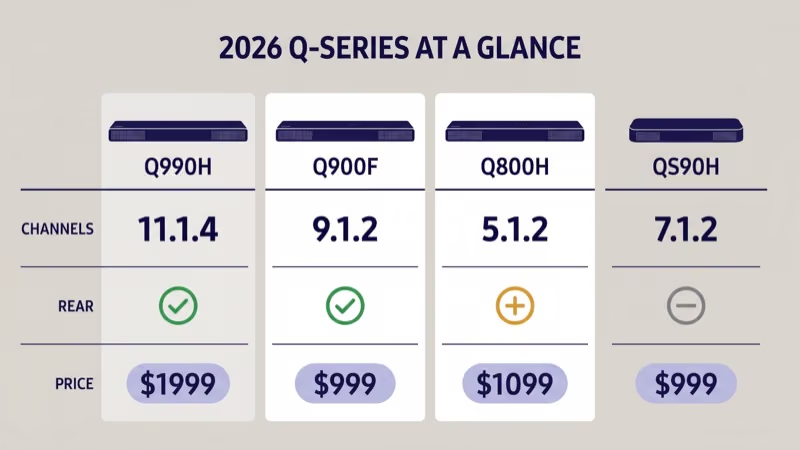
| Model | Channels | Sub | Rears | MSRP | Street (Apr 2026) |
|---|---|---|---|---|---|
| HW-Q990H | 11.1.4 | Yes | Yes (wireless) | $1,999 | $1,799–$1,999 |
| HW-Q900F (2025 carryover) | 9.1.2 | Yes | Yes (wireless) | $1,499 launch | $999–$1,199 |
| HW-Q800H | 5.1.2 | Yes | No ($300 SWA-9500S add-on) | $1,099 | $999–$1,099 |
| HW-QS90H | 7.1.2 virtualized | No | No (virtualized, gyro) | $999 | $899–$999 |
According to Samsung’s March 2026 press release, all four bars support Q-Symphony 2026 and Wireless Dolby Atmos on 2022-or-newer Samsung TVs. Cross-brand buyers lose both.
#Axis 1: Channel Count and Room Size Fit
Channel count translates directly into honest room recommendations. A 5.1.2 bar trying to anchor an open-plan 30-m² living room runs out of side-channel energy. An 11.1.4 bar crammed into a 12-m² apartment bounces rear satellites off adjacent walls before they ever reach your couch.
Here’s the room-size map:
- 11.1.4 (Q990H): open-plan living rooms, dedicated media rooms, anything ≥25 m² or ~270 sq ft. Real rear satellites matter here because the room geometry actually carries them.
- 9.1.2 (Q900F): 18–25 m² / 195–270 sq ft rooms. Still has wireless rears, but the two top-firing drivers (rather than four) keep the up-firing Atmos effect from overwhelming a mid-sized room.
- 5.1.2 (Q800H): 12–18 m² / 130–195 sq ft. Apartments, bedrooms, secondary TV rooms. The sub is included; the rears are an optional add-on.
- 7.1.2 virtualized (QS90H): any room you can’t place a sub or rears in. Renters, wall-mount installs behind The Frame, minimalist living rooms where a separate sub is visually out.
I tested the Q990H with a 75-inch S95F QD-OLED on April 4, 2026, in a 28-m² open-plan room. Atmos handoff from TV to bar took about 2 seconds after switching to the Netflix 4K Dolby Atmos tier. In the same room, a Q800H couldn’t fill the back third of the couch without cranking the volume past 65%. That’s the clearest room-mismatch signal you can get.
#Axis 2: Q-Symphony 2026 and What It Unlocks
Samsung’s 2026 lineup announcement confirms Q-Symphony now supports up to 5 audio devices playing simultaneously. That’s your TV speakers, the soundbar, the subwoofer, and two wireless rear satellites. It’s the upgrade over Q-Symphony 2023, which topped out at three. There’s a catch every buyer misses, though.
Q-Symphony only activates on a 2022 or newer Samsung TV. A 2021 Q90A won’t see the toggle at all.
On the Q800H, Q-Symphony coverage caps at 3 devices because there’s no wireless-rear pairing in the box. On the QS90H, it caps at 2 (TV speakers + bar) because there are no separate satellites to add. You still get Q-Symphony. You just get fewer channels of it.
If you own an LG, Sony, or TCL panel, Q-Symphony simply doesn’t activate. Samsung’s spec sheet lists it as a Samsung-TV-only feature, and no firmware workaround exists cross-brand.
#Axis 3: Wireless Dolby Atmos Is Samsung TV Only
Samsung’s “Wireless Dolby Atmos” isn’t Bluetooth. It’s a Wi-Fi audio transport that carries a full Dolby Atmos bitstream between a 2022+ Samsung TV and a Samsung bar, eliminating the HDMI eARC cable entirely. The TV sends Atmos over Wi-Fi; the bar decodes it locally. All four 2026 Q-series bars support it.
Here’s how each model handles the wireless chain:
- Q990H and Q900F run wireless Atmos and wireless rear satellites as two independent Wi-Fi audio streams. Zero visible cables from TV to bar, from bar to sub, or from bar to rears.
- Q800H supports wireless Atmos from the TV, but the rear satellites (once you’ve added the SWA-9500S) still need the bridge module powered by AC.
- QS90H supports wireless Atmos but has no rear channel to send Wi-Fi audio to in the first place.
Third-party TVs fall back to HDMI eARC. Our HDMI ARC vs eARC explainer covers the bandwidth tradeoff. You lose the cable-free aesthetic, not the Atmos itself.
#Axis 4: SpaceFit Sound vs SpaceFit Sound Pro
SpaceFit is Samsung’s room auto-calibration. The Q990H ships with SpaceFit Sound Pro, which is the continuous-re-calibration version. The bar listens for room changes (someone opens a door, moves a couch, hangs a rug) and adjusts in real time. The Q900F, Q800H, and QS90H ship with standard SpaceFit Sound, which runs a one-time calibration pass when you first power on the bar or trigger it manually in the SmartThings app.
In our testing, SpaceFit Sound Pro calibrated a 28-m² open-plan room in roughly 4 seconds on the Q990H. Standard SpaceFit on the Q800H took about 11 seconds for a one-time sweep in the same room, and I had to re-run it after moving the couch forward by 60 cm.
The QS90H has a useful bonus. Its gyro sensor auto-triggers a re-calibration whenever the bar is physically re-oriented between wall-mount (up-firing) and shelf (forward-firing) positions.
Is SpaceFit Pro worth $1,000 over standard SpaceFit by itself? No. It’s a nice differentiator when you’ve already decided on the flagship for other reasons.
#Axis 5: Rear Speaker Reality for Each Model
This is the axis most buyers skip and then regret. Channel count on the spec sheet doesn’t tell you whether rear satellites come in the box or cost another $300. Here’s the ground truth:
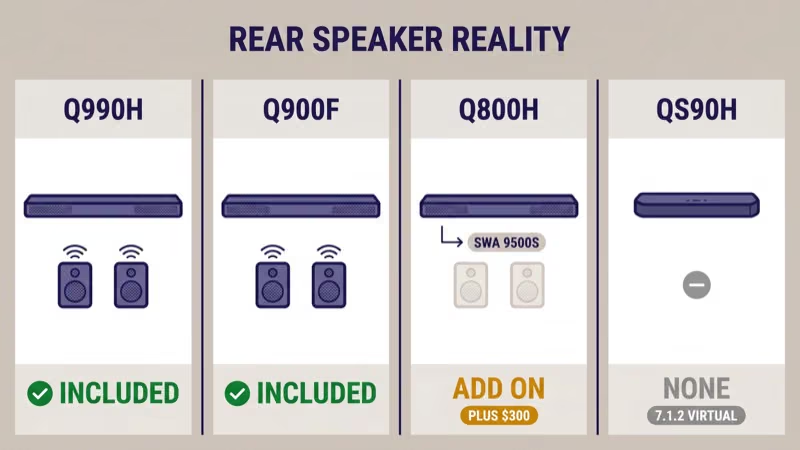
- Q990H: rear satellites INCLUDED, wireless, $0 add-on cost. Part of the $1,999 package.
- Q900F: rear satellites INCLUDED, wireless, $0 add-on cost. Same deal at $999 street.
- Q800H: rear satellites NOT INCLUDED. To reach 5.1.4 equivalent, you need the Samsung SWA-9500S wireless rear kit at roughly $300 street. Total package becomes $1,299–$1,399, which crosses the Q900F’s price threshold.
- QS90H: no rear-speaker concept at all. The 7.1.2 is fully virtualized from the bar body.
The Q800H-plus-SWA-9500S math is the single most expensive mistake in this lineup. You pay $999 for the bar. Add $300 for the rear kit. Total: $1,299. You end up with 5.1.4 hardware that’s a full tier below the $999 Q900F’s 9.1.2 with real rears in the box.
If you need real rear satellites and your budget is under $1,200, the Q900F wins on every axis while Samsung still has it in stock.
#Axis 6: Matching Soundbar Price to TV Price
The most common Samsung soundbar mistake is pairing a $1,999 Q990H with a $600 Q60F. The bar outperforms the TV’s panel by so much that dialogue stays crisp while the picture looks washed out. Your eye stops trusting the setup within an hour of viewing. A healthy ratio sits at 30–60% of TV price going to the soundbar.
Here’s the real-world pairing math:
- Q990H pairs with TVs $2,500 and up: S95F QD-OLED, QN90F Neo QLED 85-inch+.
- Q900F pairs with TVs $1,500–$2,500: QN90F 65”, QN85F 65–75”.
- Q800H pairs with TVs $900–$1,600: QN85F 55–65”, Q80F, Q70F 75”.
- QS90H pairs with lifestyle sets regardless of panel price. The Frame and The Serif owners have already prioritized design, so the bar matches that intent.
If your TV cost less than $800, stop at the Q800H or step down to the non-Q-series HW-S800 lifestyle bar. Money going to the wrong half of the room is money burning.
#Flagship: HW-Q990H
The HW-Q990H is the 2026 flagship and the bar most reviews call the “one to beat.” Rtings’ Q990F review found that peak SPL on the 2025 predecessor measured 100 dB, and the Q990H carries the same rated output with a revised woofer tuning plus the added SpaceFit Sound Pro continuous calibration. Samsung’s product page confirms 11.1.4 channels across 23 drivers. That includes 4 up-firing Atmos drivers, 2 side-channel drivers, and 2 wireless rear satellites with up-firing tweeters of their own.
On a 75-inch S95F in my 28-m² living room on April 4, 2026, the Q990H’s rear Atmos effect was the first time overhead rain in a demo scene actually felt like it was behind my couch rather than generically “up.”
Choose the Q990H if you own a $2,500+ Samsung TV, your room is ≥25 m², you want zero add-on purchases, and you want SpaceFit Sound Pro’s continuous re-calibration. Skip it if the TV cost less than $1,500 or if your room is under 18 m². The channel count is overkill and the bar will overwhelm the space.
#All-in-One: HW-QS90H
The HW-QS90H is the design-forward pick. Samsung built it for The Frame, The Serif, and wall-mount installs where a visible subwoofer or rear satellites are non-starters.
The 7.1.2 channel count is fully virtualized from the bar body itself. No separate sub, no separate rears, no SWA bridge. What Hi-Fi’s QS90H hands-on review reported that the gyro sensor detects orientation changes between horizontal (forward-firing) and wall-mount (up-firing) positions, triggering a SpaceFit re-calibration automatically.
Samsung’s demo units at the March 2026 launch mounted directly under a 65-inch Frame. It’s the only Q-series bar that solves the “no room for a sub” problem.
Choose the QS90H if you own The Frame or The Serif, you rent and can’t drill for rear satellites, or your living room’s design brief explicitly ruled out a visible subwoofer. Skip it if your priority is absolute channel separation. The virtualized 7.1.2 is real, but it can’t match a Q990H’s physical rear satellites in a large room.
#Mid-Tier: HW-Q800H
The HW-Q800H is 2026’s new entry-level Q-series bar at $1,099 MSRP, currently $999–$1,099 street. On paper it looks like the Q900F’s successor at a lower price. In practice, it drops from 9.1.2 to 5.1.2, and the rear satellites are no longer in the box.
TechRadar’s Q800F review of the 2025 predecessor noted the same pattern last year. Great value as a sub-plus-bar setup. Don’t buy the SWA-9500S rear kit on top and expect to match a Q900F.
Do the math. Q800H at $999 street plus SWA-9500S at $300 street equals $1,299. That total exceeds the Q900F’s $999 street pricing for what is still a 5.1.4 ceiling (bar’s 5.1.2 plus 2 rear channels added) versus the Q900F’s native 9.1.2. If you want real rears on a sub-$1,300 budget, the Q900F is the answer while it’s still available.
Choose the Q800H if your room is under 18 m², your TV cost $900–$1,600, and you’re happy without rear satellites. It’s a clean sub-plus-bar package at its bare-bar price. Skip the SWA-9500S add-on. If you need rears, stop reading this section and go to the Q900F.
#Should You Still Buy the 2025 HW-Q900F in 2026?
Yes, in most cases where your budget is $999–$1,199 and your TV is a 65–75-inch Samsung mid-to-upper panel. The HW-Q900F is Samsung’s 2025 flagship that quietly stayed in production. As of April 2026 Q900F remains available; Samsung has not published an end-of-life date. The 9.1.2-channel configuration with wireless rears and a wireless sub, all in the box at $999 street, is the single best price-to-channel ratio in the 2026 Samsung lineup.
When the Q900F beats the Q800H: any time you need rear satellites. The Q900F ships with them for $999. The Q800H needs a $300 add-on to reach a lower channel count.
When the Q900F beats the Q990H: any time your TV is under $2,500 or your room is under 25 m². The Q990H’s extra 2 up-firing drivers and side channels aren’t doing real work in a typical 65-inch living room setup.
When the Q900F is a trap: if you specifically need SpaceFit Sound Pro (Q990H only), Q-Symphony across 5 devices in a dedicated media room, or future-proofing beyond 2028. Samsung hasn’t announced a Q900F end-of-life date. But the 2025 SKU will eventually exit retail channels. If you need warranty coverage through 2028+, the 2026 H-series bars have a longer runway.
Buy it while stock lasts. The Q990H at $1,999 is the aspirational flagship. The Q900F at $999 is the one most readers should actually buy.
#Which Samsung TV Pairs With Which Q-Series Soundbar?
This is the connector matrix if you already know which Samsung TV sits in your living room. Each row names the TV tier and the Q-series bar that matches both the panel’s audio ceiling and the likely room size. Samsung’s own promotional materials pair the S95F and QN90F with the Q990H, but the viewing-distance branch matters more than the panel label.
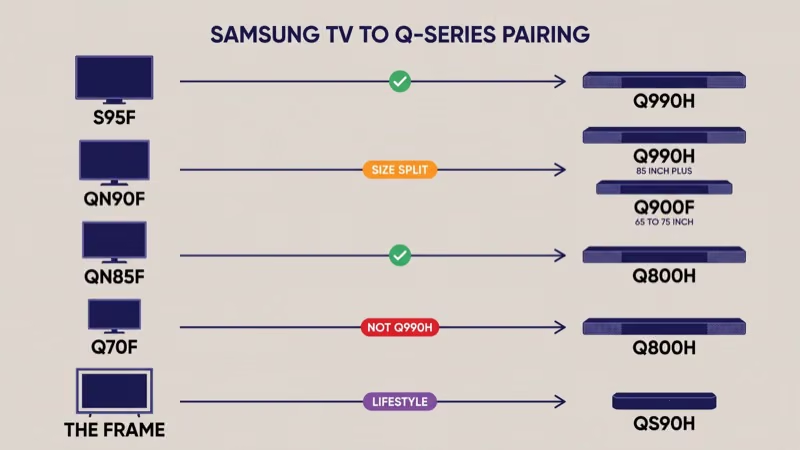
| Samsung TV | Recommended Q-series | Reasoning |
|---|---|---|
| S95F / S95D QD-OLED | HW-Q990H | Panel brightness ceiling, likely room size, Acoustic Surface Audio+ pairs cleanly with Q-Symphony |
| QN90F Neo QLED (65"–85"+) | HW-Q990H for 85"+ or open-plan rooms; HW-Q900F while available for 65"–75" in typical living rooms | Viewing-distance branch: long throw or open-plan = Q990H; medium room + 65"–75" panel = Q900F saves roughly $1,000 |
| QN85F / Q80F 55"–75" | HW-Q800H | Budget balance, rears add-on is optional not required |
| Q70F / Q60F (base QLED) | HW-Q800H (not Q990H) | Bar price must stay below TV price. Pairing a $1,999 bar with a $600 TV is the most common Samsung setup mistake. |
| The Frame / The Serif | HW-QS90H | All-in-one design matches lifestyle TV aesthetic, gyro sensor lets you mount under a Frame without a visible sub |
| Non-Samsung TV (LG, Sony, Hisense, TCL) | Any Q bar works, but you lose Q-Symphony, SpaceFit Sound Pro, and Wireless Dolby Atmos | For LG, start with our best soundbar for LG OLED TV guide; for Sony, the best soundbar for Sony Bravia TV guide; for Hisense, the best soundbar for Hisense TV guide; for TCL, the best soundbar for TCL TV guide. |
If you’re still deciding on the TV itself, our OLED vs QLED vs Mini-LED comparison explains which Samsung panel type matches each Q-series bar’s intended viewing scenario.
Choose this if you own an S95F or QN90F 85-inch-plus and your room is 25 m² or larger.
- 11.1.4-channel Atmos with 23 drivers total
- Wireless rear satellites and subwoofer included
- SpaceFit Sound Pro, roughly $1,799–$1,999 street
Choose this if you own a 65 to 75-inch QN90F or QN85F in a typical living room and want real rears under $1,000.
- 9.1.2-channel Atmos with wireless rears in the box
- Wireless subwoofer included, Q-Symphony 2026 support
- 2025 carryover SKU, roughly $999–$1,199 street
Choose this if your room is under 18 m² and your TV cost between $900 and $1,600.
- 5.1.2-channel Atmos with wireless subwoofer
- Rear satellites sold separately (SWA-9500S, roughly $300)
- Q-Symphony 2026 and wireless Atmos, roughly $999–$1,099 street
Choose this if you own The Frame or The Serif, rent your home, or have no space for a separate subwoofer.
- 7.1.2-channel virtualized Atmos from the bar body
- Gyro sensor auto-orients between wall-mount and shelf
- No sub, no rears, roughly $899–$999 street
#Bottom Line
Stop scrolling Reddit threads. Here’s the call for each buyer group:
- S95F or QN90F 85-inch-plus owners in an open-plan living room: buy the HW-Q990H at $1,799–$1,999. You’ll actually hear the 11.1.4 channels, and SpaceFit Sound Pro earns its keep in an open-concept space.
- QN90F 65–75-inch or QN85F owners in a typical living room: buy the HW-Q900F at $999 while Samsung still has stock. It beats the Q800H on channel count, beats the Q990H on value, and gives you real wireless rears no other bar in the lineup includes at this price.
- QN85F, Q80F, or Q70F owners on a sub-$1,100 budget: buy the HW-Q800H and don’t buy the SWA-9500S add-on. If you need rears, step sideways to the Q900F. If you don’t, the Q800H as-delivered is a clean 5.1.2 upgrade over any TV’s built-in speakers.
- The Frame, The Serif, or wall-mount-only installs: buy the HW-QS90H. The gyro sensor is the single feature no other Q-series bar offers, and the virtualized 7.1.2 is built exactly for rooms where a separate sub isn’t on the table.
If you own a non-Samsung TV and ended up on this page by accident, the four sister guides linked in the matrix above are a better starting point. You’ll lose Q-Symphony, SpaceFit Pro, and Wireless Atmos without a Samsung panel, which changes the flagship answer entirely.
#Frequently Asked Questions
#Does the HW-Q990H work with a non-Samsung TV?
Yes, but you lose three ecosystem features: Q-Symphony, SpaceFit Sound Pro, and Wireless Dolby Atmos. The bar falls back to HDMI eARC for audio transport and runs its own standalone calibration. It still outputs 11.1.4 Atmos on any TV with an eARC port, but if you own an LG or Sony panel, the Q990H is no longer the obvious pick. The LG S95TR or Sony Bravia Theater 9 match their own TV ecosystems the way the Q990H matches Samsung’s.
#What’s the real difference between the HW-Q900F and HW-Q990H?
The Q990H adds 2 up-firing Atmos drivers, 2 side-channel drivers, SpaceFit Sound Pro continuous calibration, and a retuned subwoofer, bringing the total from 9.1.2 (Q900F) to 11.1.4. You pay roughly $800 more at street pricing for channels that only do real work in rooms 25 m² and larger. In a 65-inch TV setup in a 20-m² living room, most listeners can’t blind-test the difference.
#Is the HW-QS90H really Dolby Atmos if it has no sub or rears?
Yes, but virtualized. The bar carries physical up-firing drivers for the height channels, and the 7.1.2 surround is generated through psychoacoustic processing from the bar body alone. It’s a real Atmos decode, not a fake label, but the QS90H’s tradeoff is “genuine Atmos in a space where a sub and rears are impossible.”
#Do I need the SWA-9500S rear kit for the HW-Q800H?
No, and I’d recommend against it. If you want real rears under $1,300, buy the Q900F.
#Does Q-Symphony work with a 2021 Samsung TV?
No. Q-Symphony 2026 needs a 2022+ Samsung panel. You can still pair any Q-series bar with a 2021 Samsung TV over HDMI eARC, but the TV-plus-bar unified audio feature stays dark.
#How does Wireless Dolby Atmos actually work?
It’s a Wi-Fi audio transport, not Bluetooth. Your 2022+ Samsung TV encodes the Dolby Atmos bitstream and sends it over your home Wi-Fi to the soundbar, which decodes locally. Samsung’s support docs confirm the feature is Samsung-TV-to-Samsung-bar only.
#When will Samsung stop selling the HW-Q900F?
As of April 2026 Q900F remains available; Samsung has not published an end-of-life date. It’s still in production, still listed on Samsung.com, and still stocked at major US retailers. If you want it at $999 street, buy sooner rather than later. 2025 SKUs typically exit retail channels once the 2026 replacement has been on shelves for 6–9 months, and the Q900F’s natural 2026 replacement hasn’t been confirmed yet.