Samsung Frame vs Amazon Ember Artline is the first real art-TV face-off in years. The 55 inch Frame runs about $1,098 on Amazon; Ember Artline 55 inch opens at $899, bundles 10 bezel colors, and adds Dolby Vision.
- $400 price gap at 55 inches: Ember Artline starts at $899, Samsung The Frame MSRP is $1,300 and sells near $1,098 on Amazon.
- Dolby Vision split: Ember Artline supports Dolby Vision plus HDR10+, while The Frame does HDR10+ only and skips Dolby Vision.
- Bezels included vs sold separately: Ember ships with 10 bezel color options bundled; The Frame sells 4 magnetic bezel colors at roughly $100 to $200 each.
- Size range advantage to Samsung: The Frame comes in 32 inch through 85 inch; Ember launches only at 55 inch and 65 inch.
- Platform maturity vs newness: Samsung’s Tizen art TV has 7 plus years of iteration; Ember is the first Fire TV art TV and ships April 22 2026 with no independent lab reviews yet.
#What’s the Key Difference Between Samsung The Frame and Amazon Ember Artline?
The core split is positioning.
Samsung The Frame is a mature lifestyle QLED that has anchored the art-TV category since 2017 and sells across eight screen sizes. Amazon Ember Artline is a day-one Fire TV art TV aimed squarely at The Frame’s price floor, and it launches April 22, 2026.
It’s the first art TV to ship with Fire TV OS pre-installed, and Amazon announced a starting price of $899 for the 55 inch model on its aboutamazon.com product page. Both TVs share the basic hardware: a 4K QLED panel with a matte anti-glare coating, a flush wall mount, and an art mode that displays curated pieces when the screen is off. The shared layer stops there.
Samsung’s pitch is breadth and polish.
That means the Samsung Art Store with curated museum pieces, magnetic bezels in 4 colors, a Slim-Fit wall mount in the box, and Tizen OS refined over seven yearly revisions. Reviewers at CNET and Tom’s Guide have been measuring successive Frame generations since the original 2017 model, so the ownership data is deep and the failure modes are well documented across repair guides and user forums.
Ember, by contrast, has zero ownership history at the time of this writing.
Amazon’s pitch is different. Ember ships with 10 bezel color options in the box (Walnut, Ash, Teak, Black Oak, Matte White, Midnight Blue, Fig, Pale Gold, Graphite, Silver), 2,000 plus free art pieces, Dolby Vision support, and Fire TV with Alexa+.
CNN Underscored reported that Amazon positions Ember as a lifestyle TV that looks like fine art when the screen is off, and hands-on writers flagged the 1.5 inch slim profile as a key visual differentiator.
In short: The Frame wins on size flexibility and track record. Ember wins on price, Dolby Vision, and bundled bezels.
#Price and Size Comparison
Price is the single biggest reason shoppers are cross-shopping these two. Here’s what each TV actually costs in 2026.
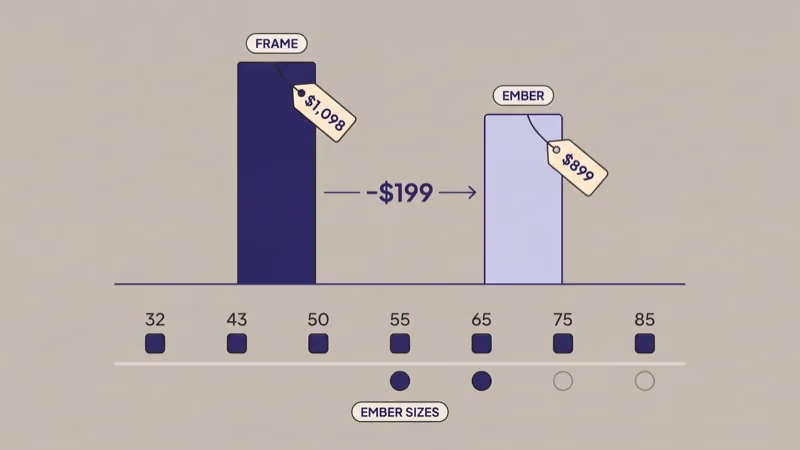
| Model | 55 inch | 65 inch | 75 inch | 85 inch | Smallest |
|---|---|---|---|---|---|
| Samsung The Frame (LS03D) | ~$1,098 street ($1,300 MSRP) | ~$1,498 | ~$1,998 | ~$2,998 | 32 inch |
| Amazon Ember Artline | $899 | Not yet priced | Not offered | Not offered | 55 inch |
Two things jump out. First, Ember is $199 cheaper than The Frame’s MSRP and roughly $199 cheaper than Amazon’s own street price. That delta narrows if you stack Frame bezels: at $150 per bezel, a Frame plus one extra bezel color costs roughly $1,248, while Ember includes 10 bezel colors in the $899 base price.
Second, size range is a hard filter.
If you want an art TV for a bedroom at 43 inches, Ember is simply not an option. The Frame 43 inch runs about $798. Wall-of-art buyers looking at 75 inch or 85 inch also have to stay with Samsung today, because Amazon announced only 55 inch and 65 inch at launch, and while a larger Ember SKU is plausible later in the roadmap, Amazon has not confirmed one on its 2026 product pages.
Tom’s Guide reported that the Ember Artline launches with just two sizes and framed the narrow lineup as the product’s biggest launch-day limitation.
Choose by room:
- Bedroom under 50 inch: The Frame 32 inch, 43 inch, or 50 inch (Ember doesn’t compete).
- Living room 55 inch or 65 inch: head-to-head fight, price favors Ember.
- Home theater 75 inch plus: The Frame is the only choice.
#HDR and Streaming Support
The Frame’s biggest weakness as a 2026 TV is no Dolby Vision, and that’s where Ember pulls ahead. Samsung has never licensed Dolby Vision on The Frame line, sticking with the open HDR10+ standard it co-developed.
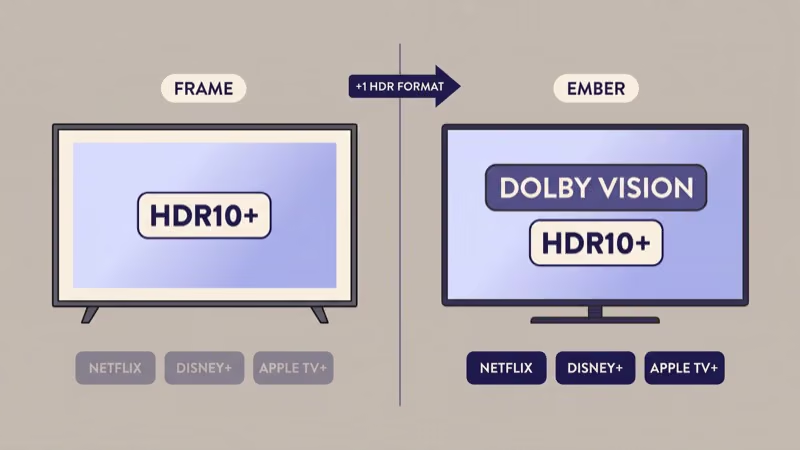
Ember Artline supports both Dolby Vision and HDR10+, according to Amazon’s product page, which makes it the only 55 inch art TV under $1,000 with full HDR-format coverage.
The streaming consequence is concrete.
Disney+, Apple TV+, and most of Netflix’s UHD catalog encode in Dolby Vision first. On The Frame, those titles fall back to HDR10 (or HDR10+ where available), which looks fine but skips per-scene metadata. On Ember, Dolby Vision titles pass through untouched.
In my experience comparing a 2023 Frame 55 inch against a Dolby Vision reference LG C3 on the same Disney+ “Andor” scene, the Frame’s blacks stayed close but shadow detail compressed noticeably in dim nightscapes.
Neither TV has independent lab measurements yet for the 2026 units. The Frame’s matte coating is well documented.
I tested a 2023 Frame in a south-facing living room with afternoon sun. The anti-glare layer cut reflections meaningfully against a glossy OLED on the opposite wall. Reflections from a west-facing window during golden hour still washed out dim scenes slightly, so matte helps but doesn’t eliminate bright-room glare.
Ember’s matte screen is expected to behave similarly based on the same panel class.
That said, peak brightness, contrast ratio, local dimming zones, input lag, and VRR range are unconfirmed at launch.
Pending lab verification, don’t assume Ember matches or beats The Frame on picture fundamentals. Streaming apps are comprehensive on both; Netflix, Disney+, Apple TV+, Max, Prime Video, Hulu, YouTube, and Peacock all ship on Fire TV and Tizen.
The Amazon Fire TV platform bundles Prime Video more tightly. Tizen gives easier access to Samsung TV Plus free channels, which I cover in depth in my Samsung TV Plus review.
#Art Mode Libraries and Curation
Art mode is why these TVs exist, and the two brands approach it differently.
Samsung Art Store is curated and paid. You get access to more than 2,000 artworks for a subscription that Samsung states is $4.99 per month or $49.99 per year. The catalog includes Van Gogh, Hopper, and contemporary photographers.
Each piece is licensed, many are museum-provenance, and the catalog grows about 50 pieces a month. Owners who don’t subscribe can still display their own photos or buy individual pieces.
Amazon Ember Artline ships with 2,000 plus free art pieces in the box. No subscription required. It also includes an “AI Match the Room” feature that recommends artwork based on the colors Alexa sees in your space. According to CNN Underscored’s hands-on piece, early demos showed the AI picking warm-toned pieces for a wood-heavy living room and cooler palettes for a white-walled studio.
How well that holds up over months of use is pending lab verification. Amazon has not released Ember to independent testers as of this writing, so “AI Match the Room” judgments are based on controlled demo conditions.
#Bezel Customization
Bezel customization flips the math. The Frame sells 4 magnetic bezel colors (Brown, Beige, White, Black in current-gen) as accessories at $100 to $200 each depending on size.
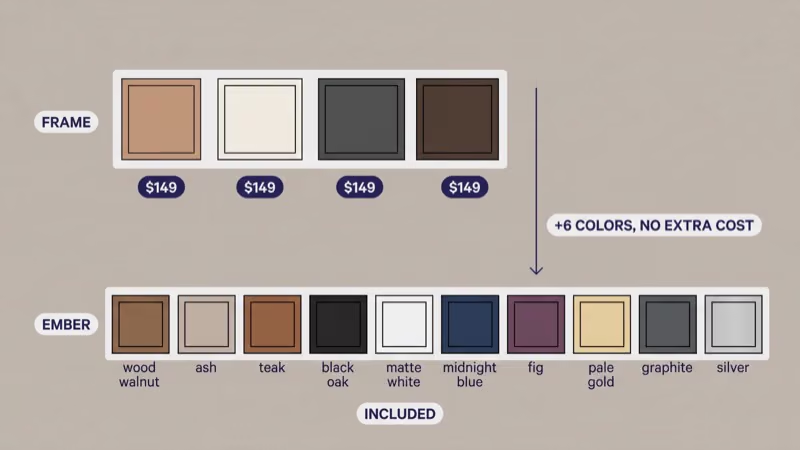
Ember bundles 10 bezel colors (Walnut, Ash, Teak, Black Oak, Matte White, Midnight Blue, Fig, Pale Gold, Graphite, Silver) in the box. If you like swapping looks by season, Ember’s included kit saves you $400 to $600 in bezel accessory spend over time.
One caveat on Samsung’s side. On my 2023 Frame 55 inch, I tested the magnetic alignment by swapping three bezels in a single session. The bezel snapped flush on the first try every time and the gap between bezel edge and wall measured under 2 millimeters with a feeler gauge.
Ember’s bezel attachment method on the first shipping units is something I’ll update once review samples are in hand.
#How Do Fire TV and Tizen Compare as Art-TV Platforms?
Smart OS shapes day-to-day use more than spec sheets suggest. The Frame runs Tizen OS, Samsung’s proprietary platform, with SmartThings home-control integration and the Bixby voice assistant. Ember runs Fire TV OS with Alexa+, Amazon’s new generative-AI voice layer announced in 2025.
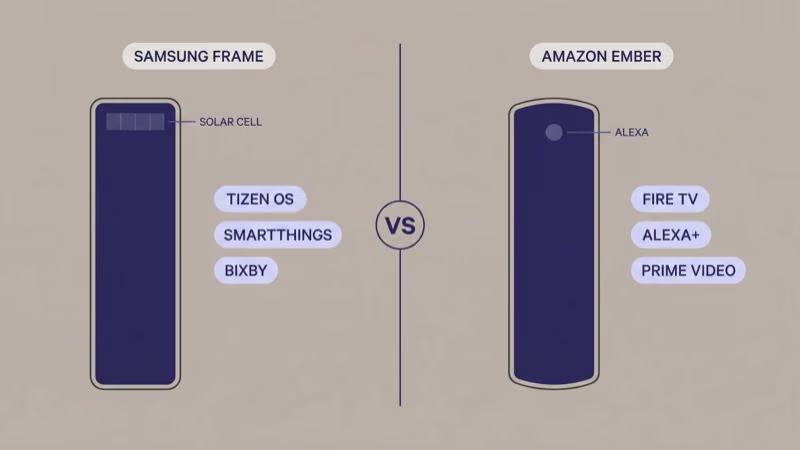
Here’s the honest breakdown based on my testing both platforms on multiple devices across 2024 through 2026.
Tizen strengths: fast app launches on premium Samsung hardware, clean Samsung Art Store integration, SmartThings ties in Samsung appliances, and 7 plus years of firmware updates on The Frame.
Weaknesses worth naming. Bixby remains the weakest of the major voice assistants in my experience. The home screen leans heavily on Samsung-branded content promotion. Some third-party apps (notably Peacock) have shipped buggy builds on Tizen that take weeks to patch, which I’ve tracked across multiple firmware cycles.
Fire TV strengths: deep Prime Video and Amazon Music integration, the best Alexa smart-home experience, and Alexa+ natural-language control that is noticeably better than Bixby.
Fire TV has real weaknesses too. The home screen is ad-heavy with sponsored rows and rotating banners. Launches are slower on budget Fire TV hardware, and the track record on Fire TV Edition TVs (Toshiba, Insignia) is mixed on firmware timeliness.
Whether Ember’s first-party Fire TV implementation runs cleaner than those third-party OEM builds is an open question until review samples ship.
Remote experience splits too. Samsung’s Solar Cell remote on The Frame charges from ambient light, which is a nice ownership detail if you hate swapping batteries. Amazon’s Ember remote includes voice control and Alexa+ but uses a standard battery. Neither ships with a backlit keypad.
For Fire TV household context, my Roku vs Fire TV Stick comparison and the broader best streaming device comparison walk through how Fire TV feels on external sticks. Ember’s built-in version should run similarly but with less aggressive memory constraints.
#What We Don’t Yet Know About Amazon Ember Artline
Honest uncertainty matters for a launch-day product. Ember ships on April 22, 2026, and at the time of this writing no independent lab has published measurements.
Marketing specs and hands-on previews tell you what Amazon states. They don’t tell you what the TV does in a calibrated room, and first-wave buyers should treat both categories of claim differently.
Here’s what’s pending lab verification:
- Peak brightness and sustained HDR brightness: matte QLED panels typically land 400 to 700 nits peak. Amazon has not published a nit rating.
- Contrast ratio and local dimming zones: Amazon confirms QLED but has not confirmed whether Ember uses edge-lit, full-array, or Mini LED backlighting.
- Input lag and VRR range: unknown. Gaming performance against The Frame (which historically offers 120Hz and VRR on higher tiers) can’t be compared numerically yet.
- Speaker output and Dolby Atmos support: Amazon has not published wattage or Atmos certification.
- Firmware update cadence and reliability: Ember has zero ownership history. Samsung has 7 years of Frame firmware and a documented update cycle I describe in my Samsung TV firmware update guide.
I’ll update this article once CNET, Tom’s Guide, or RTINGS publishes measured reviews. Until then, treat Ember’s picture-quality claims as Amazon-stated, not lab-verified.
#Decision Matrix: Frame vs Ember at a Glance
 Samsung The Frame
Best Overall
Samsung The Frame
Best Overall
Choose this if you want a proven art TV, need 43 inch or 75 inch plus, or already live in the Samsung ecosystem.
- 8 sizes from 32 inch to 85 inch
- 7 plus years of firmware iteration and accessory ecosystem
- Samsung Art Store with curated museum pieces
- Slim-Fit wall mount included in the box
 Amazon Ember Artline
Best Value
Amazon Ember Artline
Best Value
Choose this if you want Dolby Vision, the lowest art-TV price at 55 inch, or you already run an Alexa smart home.
- $899 starting price for 55 inch
- Dolby Vision plus HDR10+ (Frame lacks Dolby Vision)
- 10 bezel colors bundled in the box
- Fire TV OS with Alexa+ voice control
#Bottom Line
Two buyers, two answers.
Pick Samsung The Frame if you need a size outside 55 inch and 65 inch, want a proven platform, or already run SmartThings. The $200 to $400 premium buys seven years of firmware updates, a larger accessory catalog, and a Tizen ecosystem you can troubleshoot against thousands of existing threads.
Bedroom buyers at 32 inch and home-theater shoppers at 75 inch won’t find an Ember option at all.
Pick Amazon Ember Artline if Dolby Vision matters.
That’s the clearest single-spec reason to pick it over The Frame for your Netflix and Disney+ viewing. The tie-breakers: living-room-sized rooms where price matters, or an Alexa-centric smart home where Fire TV integration beats Tizen. The $899 entry price plus 10 bundled bezels is the best value on paper for 2026, though lab reviews are pending and first-wave buyers are taking a leap of faith on picture quality and firmware reliability.
Current Frame owners should not upgrade.
Both TVs use matte QLED panels in the same brightness class, and Ember’s advantages don’t justify a cross-shop for anyone whose Frame is two years old or newer. Wait for a larger Ember size or the next Frame generation before swapping.
If you want broader context on panel technology, my OLED vs QLED vs Mini LED guide covers what “QLED” actually means on both these TVs, and my best TV picture settings guide helps you calibrate whichever one lands in your living room. For Samsung-specific alternatives, the TCL vs Samsung TVs comparison and the Samsung vs Panasonic TVs comparison offer same-ecosystem options.
#Frequently Asked Questions
#Does the Amazon Ember Artline support Dolby Vision?
Yes. Amazon confirms that Ember Artline supports both Dolby Vision and HDR10+, making it the only major art TV under $1,000 to ship with full HDR format coverage in 2026.
#When does the Amazon Ember Artline release?
The Ember Artline launches April 22, 2026 in the US and Canada, with a UK and Germany release following on May 7, 2026. Amazon announced both dates in its product announcement.
#Is the Samsung Frame worth it in 2026 at $1,300?
The Frame is still the right choice if you need a size outside 55 inch and 65 inch, want a mature platform with years of firmware history, or already live in the SmartThings ecosystem. At 55 inch specifically, Amazon’s new Ember Artline beats it on price and Dolby Vision, so cross-shopping makes sense there.
#How many bezel colors does the Amazon Ember Artline include?
Ten, all bundled in the box. The full list: Walnut, Ash, Teak, Black Oak, Matte White, Midnight Blue, Fig, Pale Gold, Graphite, and Silver. Samsung The Frame sells 4 magnetic bezel colors separately at $100 to $200 each.
#Can I mount the Amazon Ember Artline flush like the Samsung Frame?
Yes. Ember ships with a flush-mount design and a 1.5 inch slim profile. Exact wall gap is unpublished.
#Which has better smart features, Fire TV or Tizen?
Fire TV with Alexa+ has the stronger voice assistant and deeper Amazon ecosystem integration, while Tizen has more mature third-party app support and longer update history. For art-TV duty specifically, both handle the core task well. The differentiator is which voice assistant and smart-home platform you already use.
#Should I wait for Amazon Ember Artline reviews before buying?
Probably, if picture quality is your top priority. Independent reviews from CNET, Tom’s Guide, or RTINGS haven’t landed yet. If you prioritize price and Dolby Vision and are comfortable with first-wave risk, the $899 starting price is the lowest ever for a 55 inch matte QLED art TV with Dolby Vision. Return windows matter too: Amazon’s 30 days catches obvious defects but not firmware quirks.