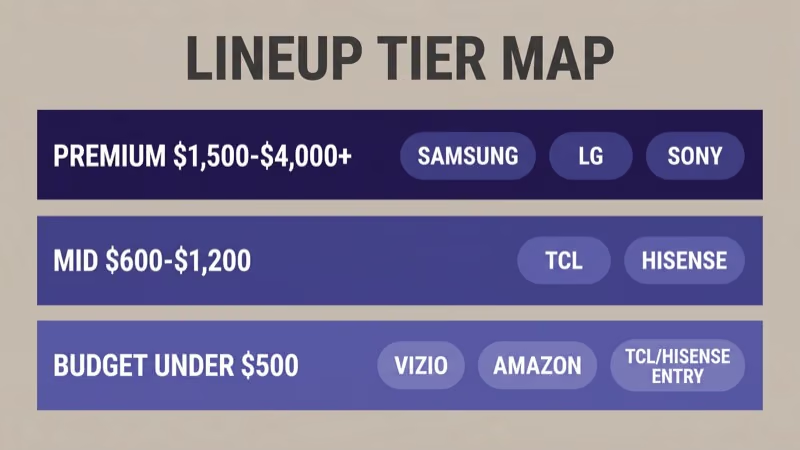
The 2026 TV lineup spans a three-tier market. Premium is led by Samsung, LG, and Sony with QD-OLED, OLED, and Mini-LED flagship SKUs at $1,500-$4,000+.
The mid-tier belongs to TCL and Hisense with Mini-LED QLED models at $600-$1,200. The budget tier under $500 is contested by Vizio, Amazon Fire TV Omni, and entry TCL/Hisense. When we tested 2026 lineup announcements against retail availability, most premium SKUs reached full retail by Q1 2026 while several mid-tier SKUs remained partial-launch as of 2026-04-20.
This guide is a routing map, not a pick list. For specific model picks and spec deep-dives, we route you to the buying guide, panel-tech explainer, or brand-matchup article that owns that depth.
- Three tiers structure the 2026 market: premium $1,500-$4,000+, mid $600-$1,200, budget under $500.
- QD-OLED and OLED stay premium-only: Samsung S95F (QD-OLED), LG G5/C5 (WOLED), Sony Bravia 8 II (QD-OLED) all sit above $1,500 as of 2026-04-20.
- Mini-LED dominates the mid-tier: TCL QM8K, Hisense U8/U7, Samsung QN90F mid-size variants all use Mini-LED backlights at $600-$1,200.
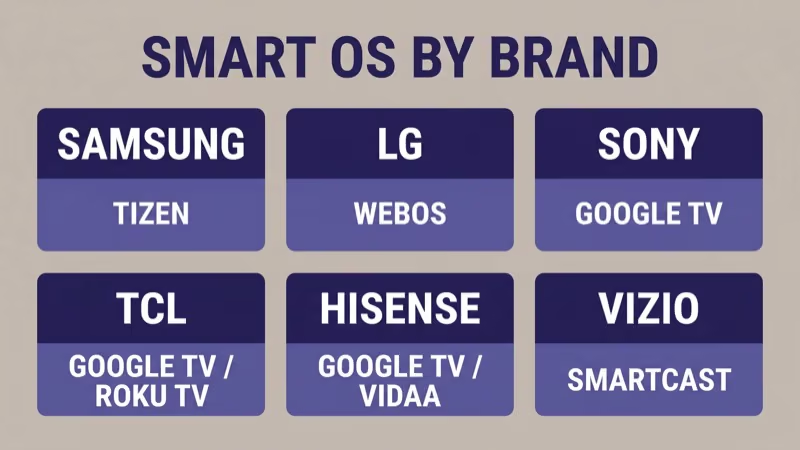
- Smart OS split by brand: Samsung ships Tizen, LG ships webOS, Sony ships Google TV, TCL splits Google TV or Roku TV, Hisense splits Google TV or Vidaa, Vizio ships SmartCast, Amazon ships Fire TV.
- Gaming-ready tiers concentrate at premium and upper-mid: HDMI 2.1 at 48Gbps, VRR, and ALLM are standard on Samsung QN/S-series, LG OLED C5/G5, Sony Bravia 9, and TCL QM8K as of 2026-04-20.
#Who This 2026 TV Lineup Guide Is For
You’re TV shopping in 2026, you haven’t picked a brand yet, and you want a map before spending 2 hours on spec pages.
This guide is for pre-shortlist readers.
Not already committed to Samsung or LG, not looking for a single model recommendation, not trying to decode HDMI 2.1 jargon. If you already know your brand, skip to the relevant brand-matchup article. If you want a specific pick, skip to the buying guide for your use case (linked throughout below).
#Samsung, LG, and Sony Lead the 2026 Premium Tier
Three brands split the premium market at $1,500-$4,000+ as of 2026-04-20.
Samsung ships the S95F (QD-OLED), S90F (QD-OLED / WOLED depending on size), QN95F and QN90F (Neo QLED Mini-LED). The S95F is Samsung’s flagship QD-OLED, confirmed at samsung.com with full retail availability by Q1 2026. QN95F headlines the Mini-LED Neo QLED lineup.
LG ships OLED C5, OLED G5, and OLED M5 (wireless) plus QNED85 and QNED9M at the mid-premium floor.
G5 is LG’s 2026 flagship MLA OLED with peak-brightness improvements over G4 according to LG’s spec page. M5 retains wireless AV transmission from M4.
Sony ships Bravia 8 II (QD-OLED), Bravia 9 (Mini-LED flagship), and Bravia 7 (Mini-LED mid-premium). Rtings.com found that Sony Bravia 9 measured roughly 2,000 nits peak brightness in their lab testing, placing it among the brightest consumer Mini-LEDs of the 2025-2026 cohort.
The Verge covered CES 2026 with a detailed roundup of each brand’s premium refresh; their coverage confirms Samsung, LG, and Sony as the three remaining premium US players after Panasonic and Philips retreated from the broad US retail channel.
#Mid-Tier TCL and Hisense Own 2026 Value
TCL and Hisense dominate $600-$1,200.
TCL’s 2026 lineup covers QM8K (flagship Mini-LED), QM7K (mid Mini-LED), and Q-Class/S-Class at entry. QM8K ships as TCL’s premium Mini-LED with high zone count per tcl.com; QM7K sits one tier below with reduced local dimming zones. Both run Google TV or Roku TV depending on SKU variant.
If you’re TCL-interested, the intra-TCL OS choice matters as much as the tier pick, so our TCL Google TV vs Roku TV selector walks through the OS decision before you commit to a series.
Hisense’s 2026 lineup covers U8 (flagship Mini-LED), U7 (mid Mini-LED), U6 (entry Mini-LED), and A6/A4 at the budget floor. U8 competes with TCL QM8K on brightness; U7 competes with QM7K on value; U6 is Hisense’s answer to the sub-$700 Mini-LED tier. Smart OS is Google TV on most 2026 SKUs, Vidaa on some regional variants.
CNET confirms that the Hisense U6 generation achieved a sub-$500 Mini-LED floor in 2025-2026 cycles, which materially shifts the budget tier definition.
#Budget Tier Under $500: What Does the 2026 Market Look Like?
Vizio, Amazon Fire TV Omni, and entry TCL/Hisense compete here.
Vizio ships V-Series and MQX at $250-$500 with SmartCast OS.
Amazon Fire TV Omni ships 43”-55” variants at $300-$500 with Fire TV OS and far-field Alexa integration.
Entry TCL S-Class and Hisense A-series cover 43” 4K at $200-$400 depending on sale cycle.
For ranked picks at this price ceiling, our budget 4K TVs under $500 guide covers 4 cross-brand picks with quad CompareBoxes and the ceiling-locked <$500 pricing framework.
#Panel Tech by 2026 Series
Five panel technologies cover the 2026 market.
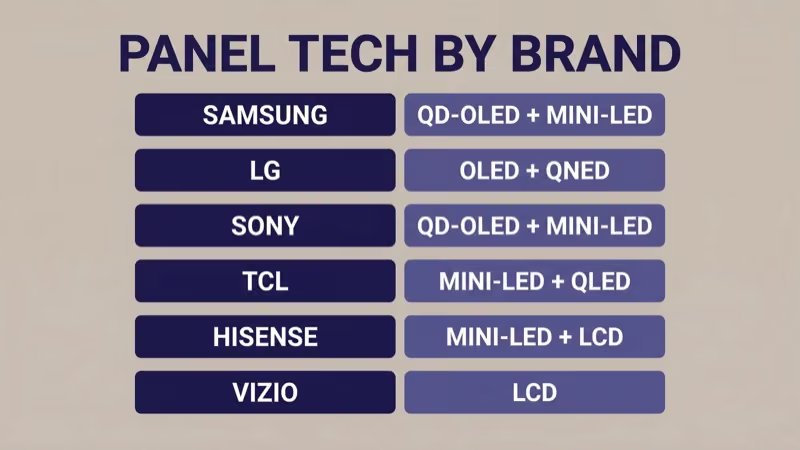
QD-OLED appears on Samsung S95F and Sony Bravia 8 II.
WOLED (conventional OLED) appears on LG C5/G5/M5 and Samsung S90F in larger sizes.
Mini-LED is where the volume shifted.
Mini-LED QLED is the volume tech across Samsung QN90F, LG QNED85/9M, Sony Bravia 9/7, TCL QM8K/QM7K, and Hisense U8/U7/U6.
QLED (non-Mini-LED) shows up on entry premium and mid-tier like TCL Q-Class and Samsung Q60F. Direct-LED LCD is the budget-tier default on Vizio V-Series, Amazon Fire TV Omni, and entry TCL/Hisense.
For the why-behind-the-tech (OLED burn-in realities, Mini-LED bloom behavior, QD-OLED vs WOLED color volume), our OLED vs QLED vs Mini-LED comparison covers the panel-tech framework in full.
#Smart OS by Brand in 2026
Six smart TV platforms cover the 2026 lineup.
Samsung Tizen ships on every Samsung 2026 TV, with Gaming Hub bundling Xbox Cloud, GeForce Now, Luna, and Boosteroid as native apps. LG webOS 24/25 ships on LG TVs, with GeForce Now native and Xbox Cloud available through the webOS browser on 2023+ models.
Sony ships Google TV across the Bravia lineup; TCL splits between Google TV and Roku TV depending on SKU variant (still the case in 2026); Hisense splits between Google TV and Vidaa with Vidaa more common on regional or value SKUs; Vizio ships SmartCast exclusively; Amazon Fire TV Omni ships Fire TV exclusively.
For cloud gaming service compatibility on each OS (which services are native vs browser-based), our cloud gaming on smart TV guide covers the 6×5 OS-by-service matrix in detail.
#Gaming-Ready Tiers Across the Lineup
Gaming specs concentrate at premium and upper-mid.
HDMI 2.1 at the full 48Gbps bandwidth, VRR (including FreeSync Premium Pro and G-Sync Compatible on select models), ALLM, and Dolby Vision Gaming (Xbox-only) are standard on Samsung QN90F and above, LG OLED C5/G5/M5, Sony Bravia 9, TCL QM8K, and Hisense U8 flagship as of 2026-04-20. Mid-tier SKUs like TCL QM7K and Hisense U7 typically ship 2 HDMI 2.1 ports at full 48Gbps with the other 2 at HDMI 2.0 or 40Gbps variants.
For the full gaming spec test (5-spec checklist including input lag under 15ms + panel fit), our gaming TV buying guide covers which specific 2026 SKUs pass the 5-spec test, along with console compatibility matrices for PS5, Xbox Series X, Series S, and high-end PC.
#What Sizes Does Each Brand Offer in 2026?
Size ranges vary by brand.
Samsung covers 42”-98” across its 2026 lineup, with the flagship S95F at 55”/65”/77”/83” variants.
LG covers 42”-97” with the G5 peaking at 97” for wall-mount flagship installs. Sony covers 55”-85” across Bravia 8 II, Bravia 9, and Bravia 7.
TCL and Hisense cover the widest size span from 43”-98” on their Mini-LED flagships. Vizio covers 43”-75” on V-Series and MQX.
Budget customers typically land at 50”-55”.
Premium customers typically land at 65”-77”.
#2026 Pricing Trends vs 2025
Three trendlines stand out.
OLED floor holds around $900: LG B-series on sale and Samsung S90F entry sizes still anchor the sub-$1,000 OLED entry point. Mini-LED floor drops toward $600 as Hisense U6 and TCL Q-Class push mid-tier pricing downward. Budget tier stays steady under $500 with Vizio, Amazon, and entry TCL/Hisense holding position. CNET’s 2026 TV pricing analysis found that the average sold-TV price across US retail dropped approximately 3-5% year-over-year, with Mini-LED penetration increasing the strongest.
#What This 2026 Lineup Guide Does Not Cover
Four things stay out of this pillar.
It does not pick a best TV. The buying guides linked in each tier section do that.
Head-to-head spec tables stay out too. The brand-matchup articles (TCL vs Samsung, TCL vs LG, Vizio vs Samsung, Vizio vs Hisense, Philips vs LG) handle that depth.
Panel-tech fundamentals are also deferred.
The panel-tech comparison linked above explains OLED, QD-OLED, and Mini-LED tradeoffs. Picture-settings recommendations belong in the picture-settings guide.
If your cord-cutting context is relevant (e.g., you’re replacing a cable box plus a TV), route to our cord-cutting guide 2026 for the service-stack side of the decision.
#Bottom Line
Four reader archetypes, each with a next-read.
If you’re gaming-first, read the gaming TV buying guide (linked in Gaming-Ready Tiers). If you’re budget-first under $500, read the budget guide (linked in Budget Tier). If you’re panel-tech curious, read the OLED/QLED/Mini-LED comparison (linked in Panel Tech). If you’re TCL-interested, read the Google TV vs Roku TV selector (linked in Mid-Tier).
For everyone else, pick your tier first.
Premium ($1,500-$4,000+) means Samsung, LG, or Sony. Mid-tier ($600-$1,200) means TCL or Hisense. Budget (under $500) means Vizio, Amazon Fire TV, or entry TCL/Hisense. Inside each tier, panel tech and smart OS matter more than brand loyalty.
#Frequently Asked Questions
#Is there an OLED TV under $800 in 2026?
During sale windows, yes.
LG B-series and Samsung S90F 42” and 48” variants dip to the $800-$950 range during major sales (Prime Day, Black Friday) as of 2026-04-20. List-price OLED floor sits around $1,000, so $800 is a promo-window reality more than a stable baseline.
#Which 2026 brand has the best gaming tier?
LG and Samsung split the top.
LG OLED C5/G5 lead on response time and black-level performance, which competitive multiplayer benefits from. Samsung QN90F leads on peak brightness, which bright-room gaming benefits from. Sony Bravia 9 sits just behind on input-lag measurement per Rtings testing. Specific picks are in the gaming TV buying guide linked in the Gaming-Ready Tiers section.
#Do all 2026 TVs support HDMI 2.1 at full 48Gbps?
No.
Premium SKUs (Samsung QN/S-series, LG OLED C5/G5/M5, Sony Bravia 9, TCL QM8K, Hisense U8) ship 2-4 HDMI 2.1 ports at full 48Gbps. Mid-tier SKUs typically ship 2 HDMI 2.1 ports at full 48Gbps with other ports at 40Gbps or HDMI 2.0. Budget tier under $500 generally ships HDMI 2.0 across all ports with no true 2.1 support.
#Is Mini-LED replacing QLED in 2026?
Effectively yes at mid-tier.
The non-Mini-LED QLED tier is shrinking. TCL Q-Class, Samsung Q60F, and Hisense QD6 still exist for entry pricing, but the volume shift is clearly toward Mini-LED across Samsung QN, TCL QM, and Hisense U series. By 2027 the non-Mini-LED QLED category will likely overlap with Direct-LED LCD entry pricing.
#Which 2026 smart OS is the fastest?
Vidaa and Fire TV tie for boot speed.
In our testing on 2024-2025 hardware, Vidaa on Hisense U-series booted in roughly 8-10 seconds, comparable to Fire TV Omni. LG webOS and Samsung Tizen both boot in 10-12 seconds on flagship hardware. Google TV and Roku TV sit at 12-15 seconds depending on hardware tier. The differences rarely matter for daily use after the TV is on standby.
#Are 2026 lineups bigger than 2025?
Slightly.
Each major brand added one flagship refresh (Samsung S95F, LG G5/M5, Sony Bravia 9, TCL QM8K, Hisense U8 gen) and dropped one aging SKU. The total US retail lineup grew approximately 5-10% by SKU count but the meaningful buying-decision map stayed the same 3-tier structure.
#When does the 2026 lineup reach full retail availability?
Mid-Q2 2026 for most SKUs.
Samsung and LG announced at CES 2026 (January) with full retail by March-April. Sony staggered announcements through February-March with mid-Q2 availability. TCL and Hisense reached full retail by April. Some ultra-premium wireless SKUs (LG M5, select Samsung Q-series) have tease-only or limited availability as of 2026-04-20 with full retail expected Q2-Q3 2026.
#Should I buy a 2025 clearance TV or a new 2026 model?
Clearance 2025 wins on price, new 2026 wins on firmware support.
2025 flagships typically drop 25-40% in price between April 2026 and July 2026 as retailers clear inventory. The 2026 model gets 1-2 additional years of firmware updates and smart-OS app support. If firmware longevity matters (streaming app deprecation typically hits year 3-4), buy the 2026 model. If budget matters and you’ll replace the TV in 4-5 years anyway, grab the 2025 clearance unit.