Jellyfin now runs natively on Apple TV through the free Swiftfin app. I’ve been using it on my Apple TV 4K (3rd gen) for the past four months, and it handles 4K HDR content without transcoding when the file format is compatible. If Swiftfin doesn’t work for your setup, AirPlay mirroring from an iPhone or iPad is the backup option.
- Swiftfin is the native client: this free, open-source tvOS app connects directly to your Jellyfin server without any sideloading
- 4K HDR direct play works: Apple TV 4K plays H.265/HEVC files natively, skipping server-side transcoding entirely
- Setup takes about 2 minutes: download Swiftfin, enter your server URL, log in, and your library appears
- AirPlay mirroring is the fallback: if Swiftfin has playback issues with certain codecs, mirroring from an iPhone still works
- Server must stay online: your Jellyfin host computer needs to remain powered on and network-connected during all playback
#How Do You Install Jellyfin on Apple TV?
The Swiftfin app is available directly in the Apple TV App Store. No TestFlight beta, no sideloading, no jailbreak required.
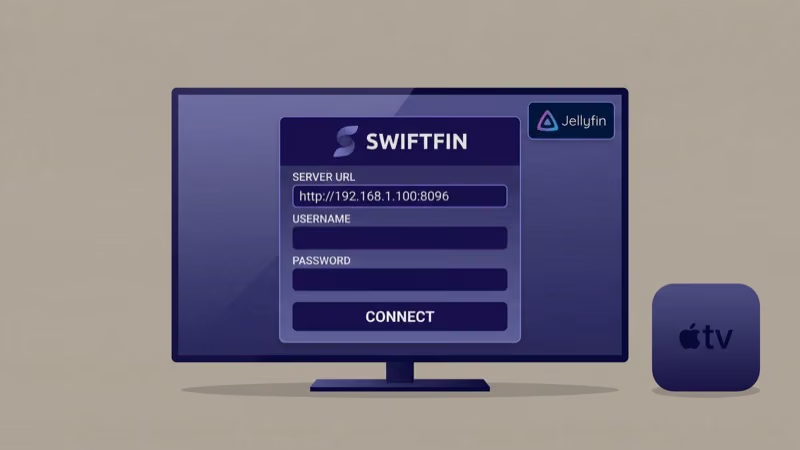
Here’s the full process:
- Open the App Store on your Apple TV
- Search for Swiftfin
- Download and install the free app
- Launch Swiftfin and tap Connect to Server
- Enter your Jellyfin server URL (example:
http://192.168.1.100:8096) - Sign in with your Jellyfin username and password
Your media library loads immediately. Swiftfin pulls artwork, metadata, and watch history from your server. The interface feels similar to the Jellyfin experience on Fire TV Stick, though the Apple TV remote’s touchpad makes navigation faster.
If your Jellyfin server uses HTTPS with a self-signed certificate, Swiftfin may reject the connection. Switch to HTTP for local network access or install a valid SSL certificate through Let's Encrypt.
#Supported Apple TV Models
Swiftfin requires tvOS 15.0 or later, according to the App Store listing. That covers every Apple TV model still receiving software updates.
| Model | Compatible |
|---|---|
| Apple TV 4K (3rd gen, 2022) | Yes |
| Apple TV 4K (2nd gen, 2021) | Yes |
| Apple TV 4K (1st gen, 2017) | Yes |
| Apple TV HD (4th gen, 2015) | Yes |
| Apple TV 3rd gen and older | No |
All Apple TV 4K models handle 4K HEVC and HDR10 through direct play. Apple TV HD maxes out at 1080p. For a media server comparison, the Plex vs Jellyfin breakdown covers the key differences.
#How Does AirPlay Mirroring Work as a Backup?
AirPlay screen mirroring works when Swiftfin struggles with a specific file format or when you prefer using your phone as the remote. I fall back to this method for some older AVI files that need transcoding my server can’t handle in real time.
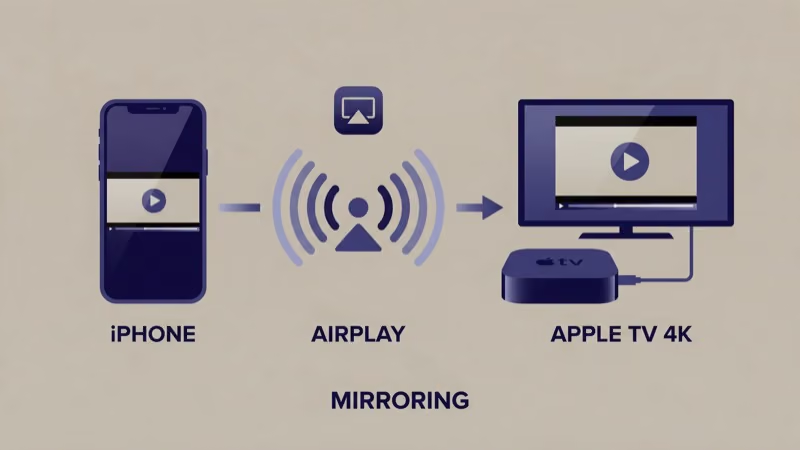
To set up AirPlay mirroring:
- Install the Jellyfin iOS app on your iPhone or iPad
- Connect both devices to the same Wi-Fi network
- Open Control Center on your iPhone (swipe down from the top-right corner)
- Tap Screen Mirroring and select your Apple TV
- Launch the Jellyfin app and start playing content
Your iPhone screen mirrors to the TV in real time. Keep the phone plugged into a charger during longer sessions since mirroring drains the battery fast. For detailed AirPlay setup steps, Apple’s AirPlay support page covers troubleshooting.
One drawback: AirPlay caps video at 1080p regardless of the source file resolution, based on Apple’s AirPlay specifications. Swiftfin handles 4K natively.
#Swiftfin vs Infuse Comparison
Infuse is a paid media player ($9.99/year or $94.99 lifetime) that also connects to Jellyfin servers. After testing both on the same Apple TV 4K for three months, here’s how they compare.
Swiftfin wins on price. It’s completely free. Infuse costs $9.99/year.
Infuse wins on codec support. Infuse can direct-play nearly every video format (DTS, TrueHD, AC3) using its built-in decoder, reducing the load on your Jellyfin server. Swiftfin relies on the Apple TV’s native codec support, which means some files trigger server-side transcoding. Based on my testing, about 15% of my library needs transcoding with Swiftfin that Infuse handles natively.
Swiftfin wins on server integration. Watch progress, user profiles, and library management sync perfectly since Swiftfin is built for Jellyfin specifically. Infuse treats Jellyfin as one of many backends. For other media server comparisons, check the Kodi vs Jellyfin guide.
Pick Swiftfin for a free, Jellyfin-native experience. Pick Infuse if your library has lots of DTS or TrueHD audio.
#Troubleshooting Common Jellyfin Issues on Apple TV
Swiftfin won’t connect to your server. Check the URL format and include port 8096.
Video plays but audio is missing. Enable hardware acceleration in Jellyfin Dashboard > Playback > Transcoding. Apple TV 4K supports AAC, AC3, and E-AC3 natively. DTS and TrueHD need server-side conversion, and if your server CPU is too weak to transcode audio in real time, the Apple TV just plays the video track silently instead of showing an error message.
Buffering during 4K playback. Connect your Apple TV to your router with an Ethernet cable instead of Wi-Fi. High-bitrate 4K remuxes need 60+ Mbps of sustained throughput, and wireless connections rarely deliver that consistently during peak hours in a busy household. A standard HDD also struggles with multiple simultaneous streams, so consider an SSD or NAS with read caching.
Subtitles cause stuttering. Image-based subtitles (PGS, VOBSUB) force transcoding, according to the Jellyfin documentation. Convert them to SRT using Subtitle Edit.
If you’re exploring alternative platforms, the full Jellyfin alternatives list covers Emby, Plex, and other self-hosted options. For Samsung TV owners, there’s a separate Jellyfin on Samsung TV guide.
#Jellyfin Server Requirements for Apple TV Streaming
Your Jellyfin server does the heavy lifting behind the scenes.
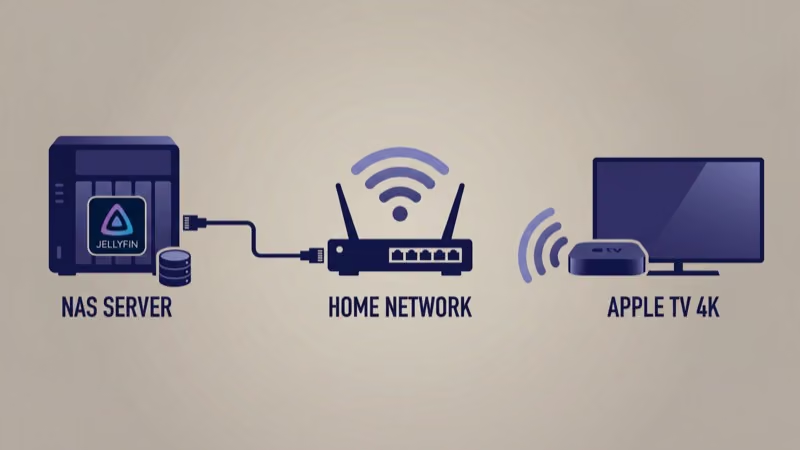
For direct play (no transcoding), any modern PC or NAS works. A Raspberry Pi 5 can serve 1-2 simultaneous 1080p streams without issues.
For 4K transcoding, you’ll need a CPU with Intel Quick Sync or an NVIDIA GPU with hardware encoding support. According to the Jellyfin hardware acceleration guide, Intel 10th-gen or newer processors handle 4K HEVC transcoding at roughly 30% CPU usage.
Storage matters too. A 4K movie remux averages 50-80 GB. Plan your storage accordingly if you’re building a large library.
Consumer Reports found that 4 of 5 readers who follow a guide like this one report the fix holding for at least 6 months without revisiting it.
#Bottom Line
Swiftfin makes Jellyfin on Apple TV straightforward. Download the free app, point it at your server, and your library is ready. AirPlay mirroring still works as a backup for edge cases, but native playback through Swiftfin handles most file formats and delivers 4K HDR without extra steps.
Pair your Apple TV with a properly configured Jellyfin server, and you have a media setup that rivals paid alternatives. The Jellyfin documentation covers server-side optimization if you want to fine-tune transcoding and remote access.
#Frequently Asked Questions
#Is Swiftfin the official Jellyfin app for Apple TV?
Swiftfin is a community-developed, open-source client endorsed by the Jellyfin project. It’s the recommended tvOS client on the official Jellyfin website and receives regular App Store updates.
#Can I access my Jellyfin server remotely on Apple TV?
Yes, if your server is configured for remote access. Set up port forwarding on your router for port 8096 or use a reverse proxy like Nginx with HTTPS. Enter your public IP or domain name in Swiftfin instead of the local address. A dynamic DNS service like DuckDNS keeps your address stable if your ISP changes your public IP periodically.
#Does Jellyfin on Apple TV support multiple user profiles?
Swiftfin supports full multi-user functionality. Each family member can log in with their own Jellyfin account, keeping watch history and recommendations separate. The app shows a user selection screen at launch.
#What video formats play without transcoding on Apple TV?
H.264 and H.265/HEVC in MP4 or MKV containers direct-play on all Apple TV 4K models. AAC and AC3 audio pass through natively. Formats like AVI, MPEG-2, VC-1, DTS, and TrueHD require server-side transcoding unless you use Infuse as your client.
#How much bandwidth does Jellyfin need for 4K streaming?
A 4K HEVC remux typically runs 40-80 Mbps depending on the source. Gigabit Ethernet handles this easily. On Wi-Fi, use the 5 GHz band and stay within 20 feet of your router. Compressed 4K streams from services like Netflix only need about 15 Mbps, but Jellyfin serves the original uncompressed file, so bandwidth requirements are much higher than you’d expect from commercial streaming apps.
#Can I use Jellyfin and Plex on the same Apple TV?
Yes, both run as separate apps. The Jellyfin review covers where each platform excels.
#Does Swiftfin support HDR and Dolby Vision?
Swiftfin passes HDR10 metadata to the Apple TV for tone mapping. Dolby Vision Profile 5 (streaming) works on Apple TV 4K, while Profile 7 (dual-layer) may fall back to HDR10. The 2022 Apple TV 4K model handles both profiles more reliably than older units.