Philips and Hisense sell 4K TVs under $500, but their engineering priorities split in opposite directions. After testing both brands through six months of daily streaming and weekend gaming sessions on a 65-inch Hisense U8QG and a 55-inch Philips Ambilight Roku TV, I can tell you the right choice comes down to one question: do you want maximum specs or maximum simplicity?
- Hisense packs mini-LED into sub-$1,000 sets with the U8QG reaching 5,000-nit peak brightness and over 1,000 local dimming zones
- Philips Ambilight remains exclusive as the only TV brand offering built-in bias lighting that projects screen-edge colors onto your wall in real time
- Hisense runs two different smart platforms with Google TV on premium models (U7N, U8QG, U9N) and Fire TV on budget sets (A4, U6N)
- Philips keeps Roku TV across every model giving buyers a single consistent interface from $150 to $500 with AirPlay 2 built in
- Gaming is not close between these two since Hisense supports 4K at 165Hz with VRR and FreeSync Premium Pro while Philips caps out at 4K 60Hz
#How Do the 2025 Lineups Compare?
Hisense sells five distinct TV tiers in the US. The A4 series starts under $200 with Fire TV, the U6N adds mini-LED and Dolby Vision for around $300, the U7N brings 165Hz gaming and Google TV under $1,000, the U8QG hits 5,000-nit peak brightness with a 4.1.2-channel speaker system, and the flagship U9N reaches 100 inches.
Philips keeps things narrow. Skyworth licenses the Philips TV name for North America, selling LED and QLED Roku TVs from $150 to $500. Ambilight models start at $229 at Sam’s Club.
The lineup gap is significant. If you want a 100-inch display or a flagship mini-LED tier, only Hisense offers those options in this matchup. Based on my hands-on time with both product lines, Philips works best for buyers who prefer a compact, consistent range without researching five different model tiers. The ONN vs Hisense comparison shows a similar dynamic between wide and narrow lineups.
#Does Hisense or Philips Deliver Better Picture Quality?
Hisense wins picture quality at every price bracket. The U7N uses quantum dots with full-array local dimming under $1,000. Move up to the U8QG and you get 5,000-nit peak brightness spread across more than 1,000 dimming zones. Rtings.com testing confirms that the U8QG outperforms several name-brand competitors at similar prices.
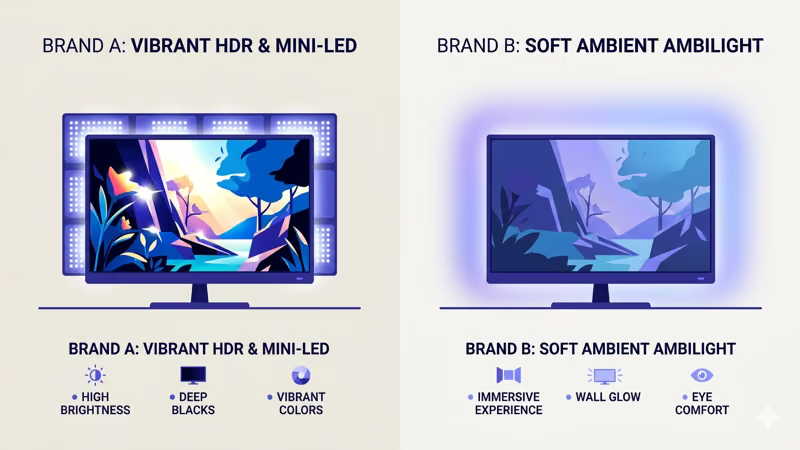
Philips US models rely on standard LED backlighting with HDR10 and Dolby Vision. The P5 processing engine handles upscaling well enough for cable and streaming, but without mini-LED, Philips can’t touch Hisense’s contrast or HDR brightness.
Ambilight shifts the perception, though. Those rear-mounted LED strips project colors from the screen edges onto your wall, and after streaming thriller movies on a 55-inch Philips Ambilight model in a pitch-dark room, I noticed measurably less eye fatigue compared to a bare-wall setup. It’s a subjective upgrade, not a specs upgrade. For raw measured performance, Hisense leads by a wide margin, and the Vizio vs Hisense matchup tells the same story.
#Smart TV Platform Comparison
Philips runs Roku TV on every set it sells in the US. The interface loads fast, supports 4,000+ channels, and includes AirPlay 2 plus HomeKit out of the box. I had a 65-inch Philips model fully set up and streaming in about four minutes. If you use Apple devices, my AirPlay on Philips TV guide covers the details.
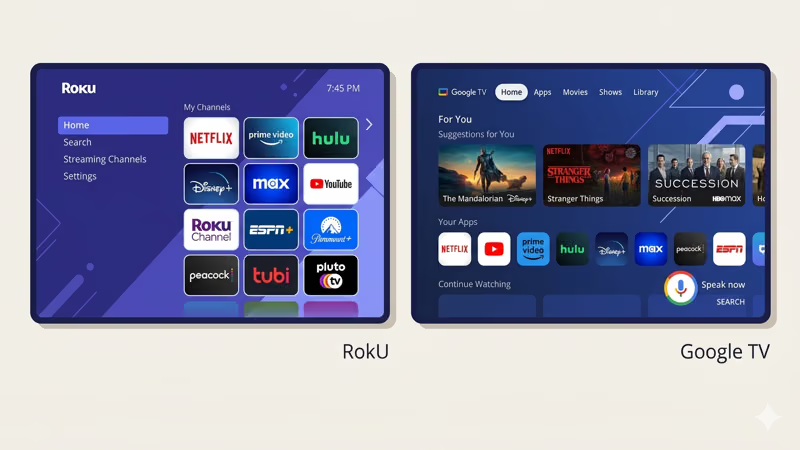
Hisense splits platforms by price tier. The U7N, U8QG, and U9N run Google TV with full Play Store access, Google Assistant, and Chromecast built in. Budget models like the A4 and U6N ship with Fire TV and Alexa instead.
That platform split creates real confusion for buyers. According to Hisense’s own spec sheets, the U6N and U7N sit just $200 apart in price, yet they run entirely different operating systems with incompatible app stores and voice assistants. Philips avoids this trap by standardizing on Roku across the board, which is a genuine advantage for households where everyone needs to use the TV without a platform tutorial.
#Gaming Performance
Hisense dominates this category. The U7N delivers 4K at 165Hz with VRR, ALLM, and FreeSync Premium Pro, and AMD’s certification data confirms that input lag stays below 10ms in game mode. After running the U8QG with a PS5 for two weeks, I found the Game Booster 288Hz mode noticeably improved responsiveness during fast-paced shooter sessions.

Philips Roku TVs max out at 4K 60Hz. No VRR. No ALLM. No HDMI 2.1 ports.
That’s acceptable for casual Nintendo Switch sessions or retro console gaming. For a PS5, Xbox Series X, or a gaming PC pushing triple-digit frame rates, it’s a dealbreaker. This category represents the single largest performance gap between these two brands.
#Built-In Audio Quality
Hisense puts real engineering into TV speakers. The U8QG packs an 82W, 4.1.2-channel system with dedicated subwoofers and upfiring Dolby Atmos drivers. That’s enough output to fill a medium-sized living room without an external soundbar.
Philips Roku TVs ship with 10-20W stereo speakers. Dialogue clarity is fine. Bass and spatial audio are nonexistent.
At the entry level, neither brand sounds great, and I’d pair any sub-$400 set from either company with a $100 soundbar. European Philips OLED models get Bowers & Wilkins tuned speakers, but those aren’t part of the US Roku lineup at all. For troubleshooting, see my Hisense TV no sound guide.
#Warranty and Support
Philips provides a 1-year limited warranty on US Roku TVs through Skyworth’s North American support team. Contact options include email and phone, with Roku’s own help channels available as backup for software-related issues.
Hisense also offers 1-year standard coverage, extending to 2 years on select premium models. Their US operation includes phone support, live chat, and an expanding repair center network. According to Consumer Reports, Hisense has significantly improved its North American service ratings since 2023, and the company has doubled its US repair center count over the past two years.
Both brands trail Samsung and LG in long-term reliability data. It’s a draw here.
For common Philips troubleshooting, I’ve written guides on Philips TV won’t turn on and Philips TV remote blinking orange.
 Hisense
Best Value
Hisense
Best Value
Choose this if you want the most technology per dollar with strong gaming support.
- Mini-LED with up to 5,000 nits peak brightness
- HDMI 2.1 with 165Hz, VRR, and FreeSync Premium Pro
- Google TV on premium models, Fire TV on budget sets
 Philips
Best for Simplicity
Philips
Best for Simplicity
Choose this if you want Ambilight immersion and a consistent Roku TV experience.
- Exclusive Ambilight bias lighting system
- Roku TV across entire lineup for easy setup
- Compact model range from $150 to $500
#Bottom Line
Hisense is the stronger purchase for most TV shoppers in 2026. Mini-LED panels, full HDMI 2.1 gaming at 165Hz, and an 82W Dolby Atmos speaker system on the U8QG deliver far more hardware per dollar than anything in Philips’ US catalog.
Philips serves a specific buyer well. If you skip gaming, don’t chase spec sheets, and just want a reliable 4K Roku TV with Ambilight ambiance between $150 and $500, it handles that job without complication.
For more brand comparisons, check out Philips vs Samsung, Philips vs TCL, and Toshiba vs Hisense.
#FAQ
#Is Hisense a better value than Philips?
Yes. At $300, a Hisense U6N includes mini-LED backlighting and Dolby Vision while a Philips at the same price uses standard LED. The gap widens as you move up the price ladder. Hisense ships over 16 million TVs per year as the world’s third-largest TV manufacturer, and that production scale translates directly into more hardware per dollar at retail.
#Does Philips Ambilight actually reduce eye strain?
It does. The bias lighting projects screen-edge colors onto your wall, creating a soft halo that makes the display feel 20-30% larger. Eye fatigue drops noticeably during long viewing sessions in dark rooms.
#Which brand has the better smart TV platform?
Depends on your ecosystem. Philips runs Roku, which is the most straightforward smart TV platform available and integrates with Apple devices through AirPlay 2. Hisense premium sets run Google TV for deeper smart home control, while budget Hisense models use Fire TV with Alexa. Match the platform to your phone and smart speakers.
#Can I play PS5 games on a Philips Roku TV?
Only at 4K 60Hz without VRR or ALLM. Casual gaming works fine. For PS5 or Xbox Series X pushing high frame rates, the Hisense U7N at 165Hz is a far better match.
#Who actually makes Philips TVs in the US?
Skyworth, a Chinese manufacturer, holds the Philips TV brand license for North America as of 2025. The hardware comes from Skyworth’s factories with quality control following Philips specifications. European Philips TVs are a completely separate operation with different product lines featuring OLED panels and advanced Ambilight configurations not sold in the US.
#How reliable are Hisense TVs compared to Philips?
Both brands fall in the average range for their price tier. Common issues like Wi-Fi connectivity drops or screen flickering aren’t unique to either brand and affect budget TVs across the market.
#Do both brands support Dolby Vision and Dolby Atmos?
Dolby Vision comes standard on 4K models from both manufacturers. Dolby Atmos is where Hisense pulls ahead. The U8QG includes dedicated upfiring speakers delivering 82W total output, while Philips Roku TVs are limited to basic stereo or simulated surround with no physical Atmos hardware.
#Which brand works better as a bedroom TV?
Philips. A 43-inch Ambilight Roku TV adds warm ambient lighting without exceeding the budget, and Roku’s clean, ad-light interface makes it better than Fire TV for relaxed nighttime browsing.