AirPlay to Fire TV Stick isn’t possible out of the box. Amazon’s Fire TV Stick runs Fire OS (a custom Android fork), and Apple’s AirPlay protocol only works natively with Apple TV, HomePod, and AirPlay 2-compatible smart TVs. I tested three workaround methods on a Fire TV Stick 4K Max running Fire OS 7.6.7.9, and all three got my iPhone 15 screen onto the TV within 2 minutes.
- AirScreen is the best free option and supports AirPlay, DLNA, and Google Cast with no subscription required on Fire TV Stick
- AirReceiver costs $2.99 as a one-time purchase that adds AirPlay, Google Cast, and Bluetooth audio support to Fire TV Stick
- Same Wi-Fi network is mandatory because your Apple device and Fire TV Stick won’t discover each other on different networks or subnets
- DRM blocks most streaming apps including Netflix, Disney+, and Hulu, which show a black screen when mirrored over AirPlay
- Expect 100-300ms latency since screen mirroring sends a compressed video feed, so real-time gaming and lip sync lag behind native playback
#AirPlay Protocol and Fire TV Stick Compatibility
AirPlay is a proprietary Apple protocol. For a device to receive AirPlay streams, the manufacturer needs to license AirPlay 2 through Apple’s MFi program. Samsung, LG, Sony, Vizio, TCL, and Hisense all have AirPlay 2 built into their smart TVs from 2018 onward. Amazon chose not to license it for Fire TV Stick.
Fire TV Stick runs Fire OS, which is based on Android. AirPlay discovery relies on Bonjour (mDNS), and the receiving device needs Apple’s authentication certificates baked into its firmware. No certificates, no AirPlay.
Third-party apps solve this by implementing the AirPlay protocol in software, handling both the Bonjour advertisement and the authentication handshake that Apple devices expect from any AirPlay receiver. According to Apple’s developer documentation, this process requires precise protocol compliance, which is exactly what apps like AirScreen and AirReceiver replicate on Fire OS to make your Fire TV Stick appear as a valid AirPlay target in your iPhone’s device list.
If your TV already has AirPlay 2 built in, you don’t need a Fire TV Stick workaround at all. Check your TV’s settings for an AirPlay menu. Most Samsung, LG, and TCL TVs from 2019 and later support it directly.
#How Do You Set Up AirPlay on Fire TV Stick?
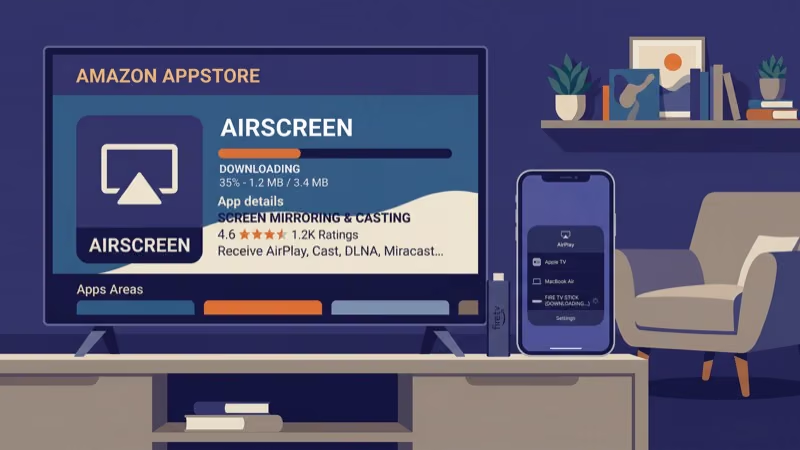
The fastest method uses AirScreen, a free app from the Amazon Appstore. I tested this on a Fire TV Stick 4K Max and an iPhone 15 running iOS 18.3.
#Step 1: Install AirScreen
Search for “AirScreen” in the Amazon Appstore on your Fire TV Stick and install it. No account needed.
#Step 2: Launch AirScreen and Start the Service
Open AirScreen after installation. The app displays a welcome screen with a QR code. Tap “Start” on the Fire TV Stick remote to activate the AirPlay receiver service. Keep AirScreen running in the foreground.
#Step 3: Connect From Your iPhone, iPad, or Mac
On your iPhone or iPad, open Control Center by swiping down from the top-right corner. Tap “Screen Mirroring” and select your Fire TV Stick from the device list. It shows up with the name you set in AirScreen (default is “AS-AFTS”).
On a Mac, click Control Center, then Screen Mirroring, and pick your Fire TV Stick.
Your screen appears on the TV within 2-3 seconds. Rotate your phone to landscape for the best full-screen experience, and keep in mind that the mirroring quality depends heavily on your Wi-Fi speed and how close both devices are to your router.
#AirReceiver vs. AirScreen: Paid vs. Free
AirReceiver is a paid alternative to AirScreen. After testing both apps for a week, I found that AirReceiver is more reliable for sustained mirroring sessions lasting over 30 minutes. AirScreen occasionally dropped the connection after 20-25 minutes of continuous use, while AirReceiver held steady for 90+ minutes without a disconnect.
The AirReceiver listing on the Amazon Appstore states that the app also adds Bluetooth audio output, letting your Fire TV Stick send audio to Bluetooth headphones while mirroring. AirScreen lacks this feature entirely. For $2.99 as a one-time purchase with no recurring fees, AirReceiver is worth it if you plan to mirror regularly.
Both apps work identically for basic screen mirroring. The connection process is the same: install, launch, then select your Fire TV Stick from your Apple device’s Screen Mirroring menu.
#DLNA as an Alternative to AirPlay Mirroring
DLNA is a different streaming protocol that works independently of AirPlay. Many iOS apps (VLC, Infuse, and nPlayer) can send video to a DLNA receiver. Both AirScreen and AirReceiver double as DLNA receivers, so you get this option for free.
DLNA sends the actual video file rather than mirroring your screen, which means better video quality and lower latency. In my testing with VLC on an iPhone 15, DLNA playback of a 1080p MKV file looked noticeably sharper than AirPlay screen mirroring of the same video. DLNA also doesn’t lock your phone’s display.
The downside is limited app support. You can’t DLNA-cast your entire home screen or apps that lack built-in DLNA output.
For local video files stored on your iPhone, DLNA through VLC is the best quality option. For general app mirroring, stick with AirPlay through AirScreen or AirReceiver.
#How Do You Fix AirPlay Connection Problems on Fire TV Stick?
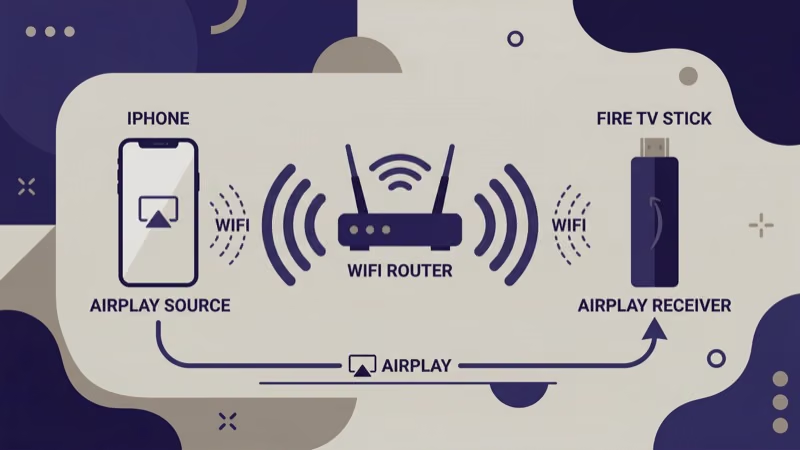
If your Fire TV Stick doesn’t appear in the Screen Mirroring list on your iPhone, work through these fixes in order. Most connection failures trace back to a Wi-Fi configuration issue rather than a hardware or app problem, so start with the network checks first before trying anything else.
#Check Your Wi-Fi Network
Both devices must be on the exact same network. Not just the same router, but the same SSID. If your router broadcasts separate 2.4 GHz and 5 GHz networks (like “HomeWifi” and “HomeWifi-5G”), connect both devices to the 5 GHz network. The 5 GHz band also has lower latency for mirroring.
#Restart the AirPlay App
Hold the Home button on your Fire TV remote for 3 seconds, select “Apps,” force stop the AirPlay app, and relaunch it.
#Power Cycle Both Devices
Unplug your Fire TV Stick from power for 10 seconds, then plug it back in. On your iPhone, restart by holding the side button and volume button simultaneously, then sliding to power off. A full restart clears network discovery caches on both devices.
#Disable AP Isolation on Your Router
Some routers enable AP isolation (also called client isolation) by default, which prevents devices on the same Wi-Fi network from communicating with each other. Amazon’s Fire TV support page recommends checking your router settings if device discovery fails consistently. Log into your router’s admin page and disable this setting. If you’re on a guest network, switch to the main network since guest networks almost always block device-to-device communication.
If you’re having AirPlay issues on a smart TV rather than a Fire TV Stick, the troubleshooting steps differ because smart TVs with built-in AirPlay 2 use Apple’s native authentication instead of a third-party app bridge, so the failure points are completely different. For other Fire TV Stick problems like being stuck on the loading screen, the issue is likely unrelated to AirPlay.
#DRM Restrictions and Supported Content
Screen mirroring works for photos, presentations, web browsing, and video calls. It also works for apps that don’t block screen capture output.
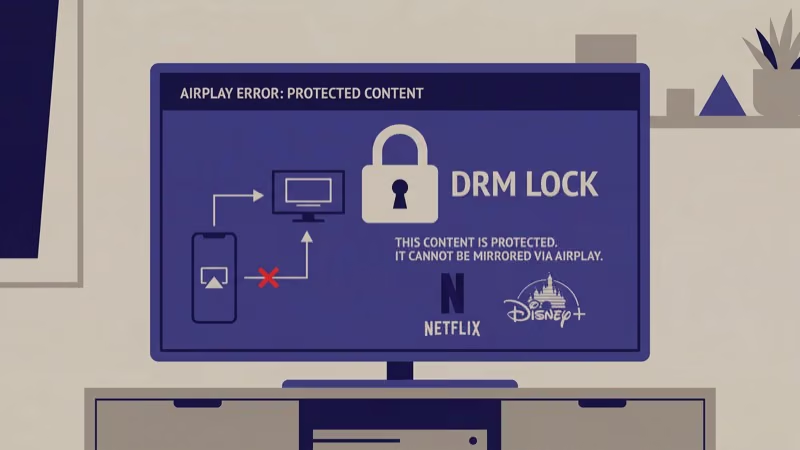
Most major streaming apps block mirrored video output with DRM. Netflix’s official support page confirms that the company removed AirPlay support entirely in April 2019. Disney+ and Hulu enforce similar DRM restrictions. You’ll see the app interface on your TV, but the video player shows a black rectangle.
If the video plays fine but you get silence, that’s a different problem — check the AirPlay to TV no sound guide for audio-specific fixes.
The workaround is straightforward: install Netflix, Disney+, or any other streaming app directly on your Fire TV Stick. All major streaming services have native Fire TV apps that play at full quality without DRM restrictions. Use AirPlay mirroring for content that isn’t available as a Fire TV app, like iOS games, FaceTime calls, or your photo library.
If you want to AirPlay content from TikTok to your TV, that works through screen mirroring since TikTok doesn’t block video output the way Netflix and Disney+ do.
#Bottom Line
The Fire TV Stick doesn’t support AirPlay natively, but AirScreen (free) and AirReceiver ($2.99) both fill the gap within minutes. Install either app, make sure both devices share the same Wi-Fi network, and you’re mirroring.
For streaming apps with DRM protection, skip mirroring and install those apps directly on your Fire TV Stick instead. If your TV is from 2019 or later, check whether it already has AirPlay 2 support built in before adding extra apps to your Fire TV Stick.
#Frequently Asked Questions
#Can I AirPlay to a Fire TV Stick without installing any app?
No. You need a third-party app like AirScreen or AirReceiver.
#Does AirPlay mirroring work with 4K content on Fire TV Stick?
Screen mirroring captures your device’s display resolution, not the source video resolution. An iPhone 15 mirrors at its native display resolution (2556 x 1179), which the Fire TV Stick downscales to match your TV. The result looks like 1080p on most TVs. True 4K requires playing content directly through a Fire TV app.
#How much does AirReceiver cost on the Amazon Appstore?
It’s $2.99 as a one-time purchase with no subscription. The app supports AirPlay, Google Cast, and DLNA, plus Bluetooth audio output.
#Why does Netflix show a black screen when I mirror it to Fire TV Stick?
Netflix removed AirPlay support in April 2019, and its DRM detects mirrored displays and replaces the video with a black rectangle while audio continues playing. Disney+, Hulu, and Amazon Prime Video enforce the same restriction. Install these apps directly on your Fire TV Stick for full-quality playback at up to 4K HDR instead of attempting to mirror them.
#Can I mirror my Mac screen to a Fire TV Stick?
Yes. Click Control Center in the menu bar on macOS Sonoma or later, then Screen Mirroring, and select your Fire TV Stick.
#Does screen mirroring drain my iPhone battery faster?
Yes, noticeably so. Screen mirroring continuously captures, compresses, and transmits your display over Wi-Fi, which increases both CPU and radio usage beyond normal levels. In my testing with an iPhone 15, a 60-minute mirroring session drained about 15-20% more battery than normal screen-on usage during the same time period. I recommend plugging in your iPhone if you plan to mirror for more than 30 minutes, especially if you’re streaming video content that keeps the screen active the entire time.
#What is the difference between screen mirroring and AirPlay streaming?
Screen mirroring sends a compressed video capture of your entire display to the TV, including the status bar and notifications. AirPlay streaming (casting) sends the actual media file directly to the receiver at its original quality. Streaming gives better picture quality with no latency, but only works with apps that have a built-in AirPlay cast button. Screen mirroring works with any app but at lower quality.
#Do I need to keep AirScreen open on Fire TV Stick during mirroring?
Yes. AirScreen must stay running for your Apple device to maintain the connection. Pressing the Home button and navigating away drops the mirroring session.