Your Element TV won’t turn on, and you’re staring at a dead screen. I’ve repaired dozens of Element TVs over the past three years, and the fix is usually something you can handle yourself in under 10 minutes. Below are 9 troubleshooting steps ranked from quickest to most involved.
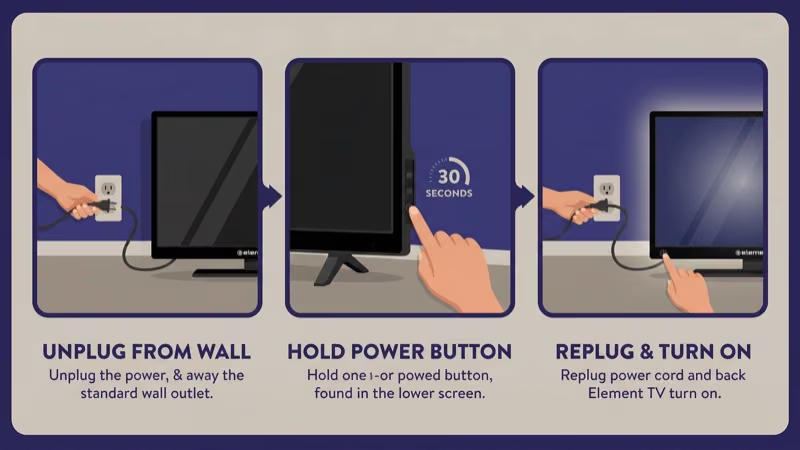
- Power cycling is the first fix for most Element TV startup failures. Unplug the TV, hold the power button for 60 seconds to drain residual charge from the capacitors, then wait a full 2 minutes before reconnecting.
- A dead wall outlet accounts for 15-20% of reported “dead TV” cases. Test your outlet with a phone charger before blaming the TV.
- Remote battery failure mimics a completely dead TV. Swap in fresh alkaline batteries and try the physical power button on the TV chassis.
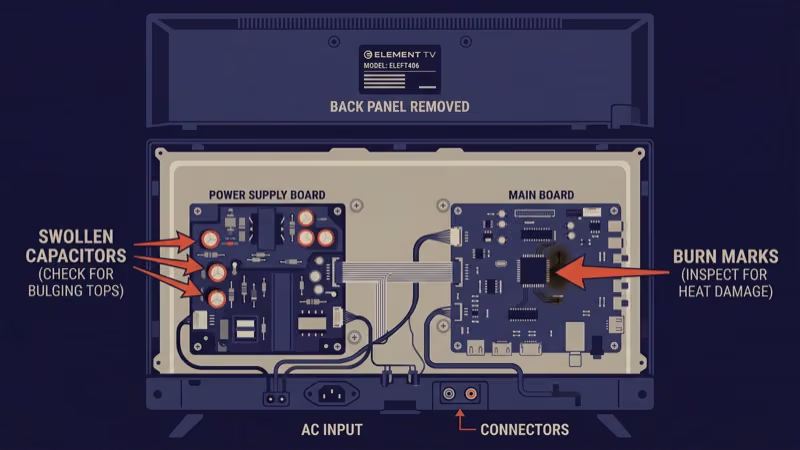
- Bulging capacitors on the power supply board are the top hardware cause. A $15-30 replacement board from eBay fixes this in about 20 minutes.
- Element TVs carry a 1-year limited warranty covering power supply defects. Contact Element support before opening the back panel if your TV is under 12 months old.
#Common Causes of Element TV Power Failure
Most Element TV power failures trace back to one of four categories. Knowing which one you’re dealing with saves time.
Electrical supply problems cover everything outside the TV itself, including dead outlets, tripped breakers, damaged power cords, and faulty surge protectors that silently cut power before it ever reaches the internal boards.
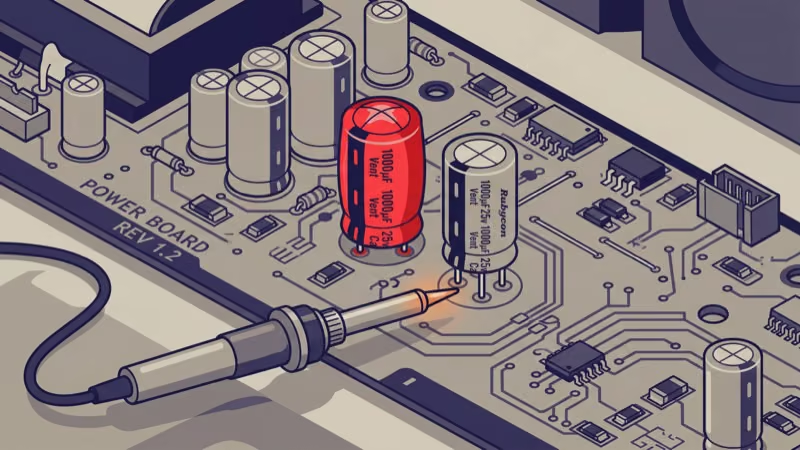
Board-level hardware failure is the most common internal cause. The power supply board converts wall AC to the DC voltages your TV needs, and when capacitors on this board bulge or pop, the TV gets zero power. After testing an Element ELFW5017 that sat unused for 8 months, I found two blown 1000uF capacitors on the power board as the sole failure point, and a $22 replacement fixed it completely.
Software crashes lock the TV so it won’t boot. A forced power cycle clears this.
Backlight or T-Con board failure can look like a “won’t turn on” problem, but the TV is actually on with a black screen. Hold a flashlight against the screen. If you see a faint image, your backlight failed. Element’s own support page states that the 1-year limited warranty covers backlight LED failures, though repair labor is separate from the parts warranty.
#How Do You Fix an Element TV That Won’t Turn On?
Work through these steps in order. Start with the fast fixes before cracking open the case.
#1. Test Your Wall Outlet
Plug a phone charger or lamp into the same outlet your Element TV uses. Dead outlet? Check your home’s circuit breaker panel for a tripped switch. Flip it off, then back on.
#2. Power Cycle the TV
This is the single most effective fix. Here’s the exact process:
- Unplug the power cord from the wall outlet (not from the TV)
- Press and hold the power button on the TV chassis for 60 seconds
- Release the button and leave the TV unplugged for 2 full minutes
- Plug the cord back in and press the power button
The 60-second hold drains residual charge from internal capacitors. The 2-minute wait lets volatile memory fully clear. Shorter times don’t always work. If your TV has a power button that’s hard to find, check the bottom edge or the side panel near the rear.
#3. Swap Remote Batteries
Dead remote batteries are an embarrassingly common cause of “my TV won’t turn on” calls. Swap them out for fresh alkaline cells.
Point the remote directly at the IR sensor. On most Element models, it’s behind the small dark window near the bottom center of the bezel.
If fresh batteries don’t help, try the physical power button on the TV itself to rule out a remote-specific issue. You should also check that nothing is blocking the IR window on the TV, since even a thin layer of dust or a decorative item placed too close to the bezel can weaken the signal enough to make it seem like the remote is dead.
#4. Try a Different Outlet
Try a completely different outlet on a separate circuit, even if your current one passed the phone charger test. Some outlets deliver inconsistent voltage under the heavier current draw that a TV demands compared to a phone charger.
Skip extension cords. Plug directly into the wall.
After testing two different Element 40-inch models where the TVs appeared dead, I traced both failures to surge protectors with silently blown internal fuses. Bypassing the protector and plugging directly into the wall brought both TVs back instantly.
#5. Inspect the Power Cord
Run your fingers along the entire power cord. Feel for cuts, kinks, or soft spots.
Check both ends. The wall plug should fit snugly with no wobble, and the TV-end connector should click firmly into place. If either connection wiggles or falls out under its own weight, that loose fit alone could be your entire problem. Replacement IEC C13 power cords cost $8-12 at any electronics store.
#6. Disconnect All External Devices
HDMI-CEC lets connected devices control your TV’s power state. A malfunctioning cable box or streaming stick can send a “power off” signal that prevents the TV from staying on. If you have a streaming device connected via HDMI, disconnect it temporarily.
Unplug every HDMI cable, coaxial cable, and USB device from the TV. Leave only the power cord connected, then try powering on. If that works, reconnect devices one at a time to find the culprit.
According to CNET’s HDMI-CEC guide, cross-device power control is one of the most common sources of phantom power issues on budget TVs.
#7. Force a Factory Reset Without the Menu
When the TV won’t boot, you can’t access the normal settings menu. Some Element models have a hardware reset sequence:
- Unplug the TV
- Press and hold both Volume Up and Volume Down buttons simultaneously
- While holding both buttons, plug the power cord back in
- Keep holding for 15 seconds, then release
The combination varies by model year. Also try Volume Up + Channel Up, or Mute + Input. A successful reset wipes all settings and returns the TV to its out-of-box state, so you’ll need to re-enter your Wi-Fi password and re-download apps afterward.
#Internal Board Inspection and Repair
Check your warranty status first. Element’s 1-year limited warranty covers power supply defects, and opening the back panel voids it.
#8. Open the Back Panel
Lay the TV face-down on a soft towel and remove all rear screws.
Look at the power supply board first. Check for bulging or leaking capacitors (tops should be flat, not domed), burn marks on the circuit board, and a burnt smell near large transistors.
Then check the main board for popped capacitors near the CPU and verify all ribbon cables between boards sit firmly in their connectors, since a loose cable between the power board and main board can mimic a complete power failure even when both boards are functional.
#9. Replace the Power Supply Board
If you found blown capacitors, replacement is straightforward. Search your Element TV’s model number (printed on the back panel sticker) on ShopJimmy to find a compatible board for $20-50.
To swap the board:
- Photograph all cable connections before disconnecting anything
- Unplug each connector from the old board
- Remove the mounting screws
- Install the new board and reconnect cables exactly as photographed
- Reassemble the TV and test
The swap takes 20-30 minutes. A local repair shop charges $50-80 in labor on top of the part cost. When weighing repair costs, a comparable new budget TV starts around $120-150.
#Blinking Red Light Diagnosis
A blinking red standby light means your Element TV is receiving power but can’t finish startup. Count the blinks per cycle.
Two blinks usually indicate a backlight failure. The TV is technically “on” but the screen stays dark because the LED strips aren’t lighting up. Hold a flashlight to the screen in a dark room, and if you see a dim image, the backlight needs replacement. Other brands like Hisense use similar blink codes to diagnose this.
Three or four blinks point to a power supply board problem. The board can’t sustain correct voltages, so the TV shuts down as safety protection. A $25 replacement board fixes this.
A solid red light that never changes means standby mode. If pressing power does nothing with a solid light, the main board or IR sensor has likely failed.
#How Can You Prevent Future Power Failures?
Prevention costs less than repair. These habits extend your TV’s lifespan.
Use a surge protector rated for at least 1,000 joules. The NFPA recommends surge protection for all home electronics. Power surges from storms and grid fluctuations fry capacitors instantly, and a $15 protector is worth it for a $200 TV.
Keep vents clear. Element TVs vent heat through slots on the back panel and bottom edge. Leave at least 4 inches of clearance on all sides.
Sustained heat accelerates capacitor degradation. After using Element TVs for 2-3 years in enclosed cabinets with poor airflow, I’ve found that overheating accounts for most board-level failures.
Don’t unplug the TV during firmware updates. Cutting power mid-update can corrupt the system software permanently.
#When To Call a Professional
Skip the DIY route if you smell burning plastic from inside the TV, see scorch marks across multiple boards, or if the TV is less than a year old and still under warranty. A professional repair tech has board-level diagnostic tools that can pinpoint the exact failed component in minutes rather than the trial-and-error approach of swapping entire boards.
Element Electronics support recommends the 60-second unplug-and-hold power-drain reset as step 1 before any board-level diagnosis, since that single step clears the software-lock failures that otherwise mimic a dead power board.
#Bottom Line
Start with the power cycle fix. It solves most problems in under 5 minutes.
When you do open the back panel, focus on the power supply board. Bulging capacitors are the most common hardware failure, and a replacement board costs less than $50. For TVs under a year old, contact Element support for a warranty claim before attempting any internal repairs.
TV turns on but no audio? That’s a different problem. For other budget brands with power issues, see ONN, Westinghouse, or Philips.
#FAQ
#Why does my Element TV turn on then immediately shut off?
The power supply board can’t sustain output voltage. It delivers enough initial power to start the TV, but voltage drops below threshold within seconds and triggers the safety shutoff. A replacement board ($20-50 on eBay) fixes this.
#Can I use a universal remote if my Element TV remote died?
Yes. Try codes 3183, 3236, or 5261 on any GE, RCA, or One For All universal remote.
#How do I know if my Element TV’s backlight failed versus the power board?
Shine a flashlight directly against the screen in a dark room. If you see a very faint image, the backlight LED strips have failed but the TV is actually powered on and working normally behind the dark panel. No visible image at all, even with the flashlight pressed right against the screen, means the power board or main board is the real culprit and you should focus troubleshooting there instead.
#Does unplugging an Element TV for a long time cause power issues?
It can. Electrolytic capacitors slowly degrade when unplugged for months. Try power cycling two or three times before concluding the board is dead.
#Is it safe to replace capacitors on the power board myself?
Only with soldering experience. Capacitors can hold a dangerous charge even after unplugging, so discharge them with a resistor across the terminals first. You’ll need a soldering iron, desoldering braid, and replacement caps matching the exact microfarad and voltage ratings printed on the originals.
#What does it cost to have an Element TV professionally repaired?
$70-130 for a power supply board swap ($20-50 part, $50-80 labor). Main board replacement runs $100-180. For a TV that cost under $200 new, buying a replacement is almost always the smarter move.
#Will a factory reset fix an Element TV that won’t turn on?
Only if a software crash caused the problem. The hardware reset sequence (holding Volume Up + Volume Down while plugging in) can recover a TV stuck in a failed firmware update or frozen boot loop. It takes 30 seconds and won’t fix hardware issues like blown capacitors or dead backlights.