Soundbar vs AV receiver is the one decision that shapes every other home theater choice for the next five years. In my testing on my own 24 m² living room through early 2026, I’ve run both a Sonos Arc Ultra and a Denon AVR-X3800H with a 5.1.2 layout. Your room, ceiling, and music-to-movie ratio decide which category fits. If you’ve moved past TV speakers to a soundbar, this is the next fork.
- Rooms under 22 m² with a flat 2.5-2.7m ceiling make a soundbar the right choice; up-firing Atmos works and a receiver adds no measurable benefit
- Music over 40% of listening, a room over 22 m², or a ceiling over 3m flips the decision to an AV receiver plus discrete speakers
- 5-year total cost runs $1,300-$1,700 for a soundbar path versus $2,650-$6,000+ for a receiver path once speakers, sub, wire, and room correction are included
- The “start small, upgrade later” plan is economically weak because wireless subs and wireless rears are brand-locked and the main bar resells at roughly 20-40% of its original price
- At a $500 total budget the soundbar wins every time; a receiver path only starts to make sense once your total budget crosses roughly $1,500
#The Core Difference in One Sentence
A soundbar upgrades your TV audio; an AV receiver builds a full speaker system. That’s the whole decision in one line.
Everything below is the math to choose between those two sentences. A soundbar is one box, one power cable, one HDMI run to your TV. A receiver is a 20-pound amplifier that drives five to eleven separate speakers, with its own calibration microphone and its own wire runs.
#When a Soundbar Wins
A soundbar is the correct answer far more often than home theater forums admit. Three concrete scenarios where it wins cleanly:
The renter with a 15-22 m² living room and a 2.6m drywall ceiling. You can’t drill in-ceiling speakers. You can’t run wire along the floor without tripping a flatmate. An up-firing soundbar bounces Atmos off your flat ceiling and delivers the effect you paid for.
This is the most common profile. It’s also the one where receiver marketing misleads people into overspending on amplification they can’t hear.
The LG OLED owner who wants WOW Orchestra. If you already own an LG webOS 23+ TV, pairing an LG soundbar uses the TV speakers as extra height channels. That feature doesn’t exist in the receiver world. The best soundbar for LG OLED TV guide walks the S95TR pairing in detail.
The movie-first household where music is under 30% of listening. Dialogue clarity, Atmos height effects, and room-filling surround are what soundbars deliver well. Stereo imaging for serious music listening is what they deliver poorly. If you watch four movies for every album, a soundbar’s weak spot never shows up.
Setup takes 10 minutes flat.
HDMI eARC, power, done. Your partner doesn’t need to approve five wall anchors.
#When an AV Receiver Wins
Receivers earn their price in four scenarios, and the decision is usually obvious when you’re in one of them.
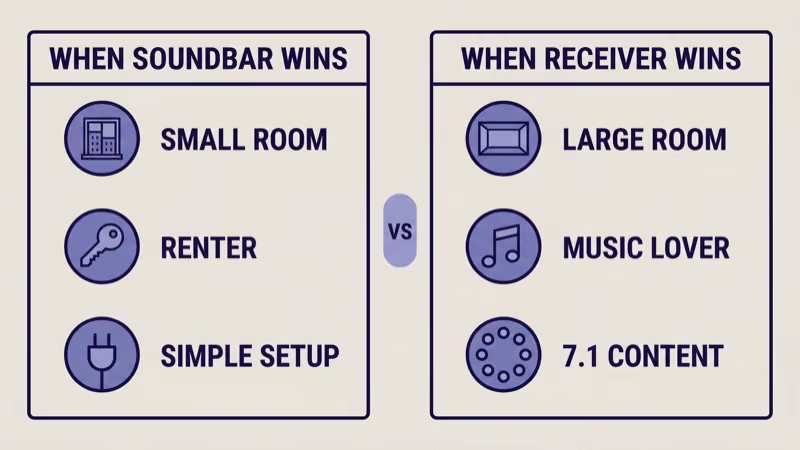
Rooms bigger than 22 m² or open-plan merged spaces. A soundbar’s 200-400 watts can’t pressurize a 30 m² room. A receiver driving four-ohm bookshelves with 110 watts per channel does.
Music over 40% of listening. Real stereo imaging needs two speakers placed 6-10 feet apart with your seat at the apex of an equilateral triangle. A soundbar can’t produce that geometry because both drivers sit 3 feet apart inside one enclosure.
Four or more 4K/120 HDMI 2.1 sources. A PS5, Xbox Series X, gaming PC, and Apple TV 4K together need four full HDMI 2.1 inputs with VRR and ALLM. Denon’s spec sheet for the AVR-X3800H states that all 6 HDMI inputs support full HDMI 2.1, including 8K/60 and 4K/120 passthrough.
Discrete 7.1.2 or 9.1.4 content. Soundbars virtualize rear channels through psychoacoustic processing. Receivers drive physically separate rear speakers. For aggressive rear panning on Atmos Blu-rays, the difference is immediate.
#Room Size and Seating Distance
Room size is the most honest self-diagnostic, because the brackets are hard to argue with:
- Under 15 m², seating under 2.5m: soundbar is correct. A receiver is a waste.
- 15-22 m², seating 2.5-3.5m: either works. Music mix and Atmos priority decide.
- 22-35 m², seating beyond 3.5m: receiver wins on SPL headroom and imaging.
- Over 35 m², open-plan merged rooms: receiver with separate speakers is required; a soundbar can’t cover the space at any price.
Seating distance matters because a soundbar’s drivers cluster in one enclosure. At 4 meters the entire soundstage collapses to a narrow zone in front of the TV. Separate left-right speakers placed 3 meters apart still image correctly at that distance.
A TCL Roku TV owner in a typical 18 m² apartment is firmly in the soundbar-wins bracket. The best soundbar for TCL TV picks cover the sensible options for that room size. Don’t overspend on amplification you can’t actually hear in a small room.
#Dolby Atmos: Both Can Do It, Differently
Atmos is the feature that confuses buyers most, because both categories advertise it. The physics are different.
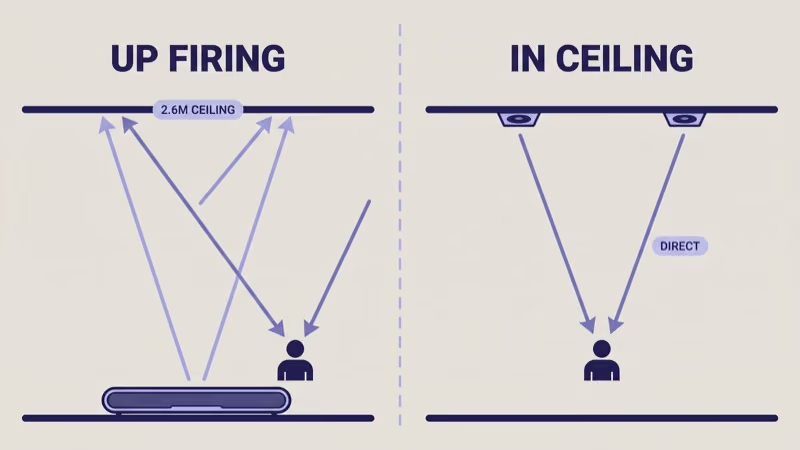
Soundbar Atmos (up-firing). An up-firing module sits on top of the bar and fires a driver at the ceiling at roughly 30 degrees. Sound bounces off the ceiling and reaches your ears from above. Dolby’s own speaker setup guide states that up-firing Atmos works best with ceilings between 2.4m and 4.3m, with optimal reflection around 2.5-2.7m.
Above 3 meters the reflection angle weakens. On vaulted or absorptive ceilings (fabric, wood, acoustic panels), it fails outright.
Receiver Atmos (in-ceiling or on-ceiling). A receiver drives speakers mounted in or on the ceiling directly above the listening position. Ceiling height is irrelevant because the receiver’s distance calibration compensates.
The 2.5m-vs-3m judgment is the honest cutoff. At a 2.5m ceiling, up-firing on a good soundbar delivers Atmos height effects you’ll actually notice. At a 3m ceiling, the effect becomes subtle to absent. Above 3.5m, don’t bother with up-firing at all.
Sony Bravia owners have one extra angle. Sony’s Acoustic Center Sync uses the TV’s own speakers as a physical center channel when paired with a compatible Sony bar. That’s an ecosystem advantage soundbars have over receivers, since no receiver can route audio back into your TV panel.
The best soundbar for Sony Bravia TV walks the specific pairings. For the Atmos setup spec itself, Dolby’s official speaker setup guide is the source of truth.
#Setup Complexity and Spouse Factor
A soundbar takes 10 to 15 minutes. Unbox, place below the TV, run one HDMI cable to the eARC port, plug in power. If you want the eARC handshake detail, the HDMI ARC vs eARC guide covers the passthrough differences.
A receiver setup is a different conversation. You’re placing five to seven speakers around the room. You’re running speaker wire along baseboards or behind walls. You’re mounting two height speakers in the ceiling (drilling required) or placing Atmos modules on top of the front speakers.
Then there’s the sub and the calibration. A subwoofer needs to be off-axis from the main speakers. Calibration runs for 15-30 minutes with the microphone moved to 6-8 listening positions.
The spouse-acceptance conversation is real.
“Five speakers, a 20-pound amplifier, and holes in the ceiling” is a harder sell than “one black bar below the TV”. Don’t pretend otherwise when you’re making the decision.
#Can You Start With a Soundbar and Upgrade to a Receiver Later?
Technically yes, economically no. Forum threads get this wrong, so here’s the real math.
When you sell your soundbar, you don’t recover full price. Users on AVSForum often report recovering roughly 20% to 40%, not full value. According to scanned resale threads across 2024-2025, a $1,500 Samsung HW-Q990H sells used for $400-$600 after 18 months. That’s the first hit.
The second hit is brand-locked wireless gear. SWA-9500S rear kits pair with Samsung only; the LG S95TR sub pairs with its own bar. None of it migrates to a Denon or Yamaha — it becomes paperweights.
Net result: a two-year “upgrade later” plan costs roughly the full price of the receiver path plus your soundbar depreciation. That’s $500-$900 of pure loss versus going receiver from day one. The only scenarios where the stepping-stone plan pays off are a genuine unknown about long-term needs, or a household budget that only clears $600 today with a bridge needed for 18 months.
Buy the category you’ll still want in year 3.
If that’s a soundbar, buy a good one once. If that’s a receiver, skip the bridge.
#Price Reality: $500 Soundbar vs $500 Receiver Setup
Same-budget comparison at $500 is the cleanest way to see which category is honest at which price point.
$500 soundbar. A Samsung HW-Q800D or Sonos Beam Gen 2 is a complete, capable product. Atmos height channels, a wireless sub, room correction, and a single HDMI cable install. You’re done. It sounds noticeably better than your TV on day one.
$500 receiver setup. A $350 entry receiver (Denon AVR-S660H tier) plus $150 of speakers gets you a 2.0 bookshelf pair with no sub, no Atmos, no center. For movie watching that’s a downgrade from the $500 soundbar. It sounds like a stereo from 2010.
A Hisense TV owner shopping in the $500-$1,000 zone is far better served by a soundbar. The best soundbar for Hisense TV picks cover the right tiers. The receiver path only starts to make sense at roughly $1,500 total: receiver ($700), 5.0 speakers ($500), sub ($300). Under that threshold, a soundbar delivers more audio per dollar every time.
#5-Year Total Cost of Ownership
This is a range, not what everyone will spend. The numbers below assume you’re buying new and holding 5 years; used markets and inherited speakers change the math.
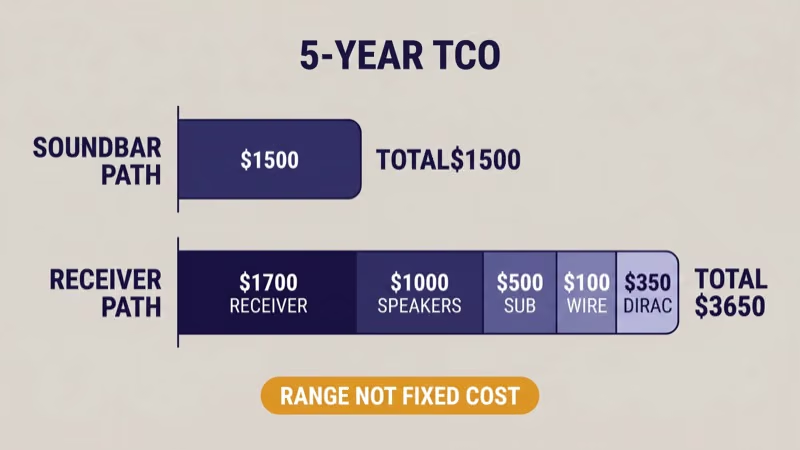
Soundbar path: $1,300-$1,700 over 5 years. Anchor products: Samsung HW-Q990H at $1,599 or LG S95TR at $1,499. Subtract roughly $300 in resale value if you flip after 5 years. No wire, no calibration license, no sub upgrade. One box, one warranty, one end-of-life.
Receiver path: $2,650-$6,000+ over 5 years. Low end build: Yamaha RX-A4A at $1,099, a Fluance or Polk 5.1 package at $750, an entry SVS PB-1000 Pro sub at $500, $100 in speaker wire, $200 in mounts and speaker stands. That’s $2,650 without room correction upgrades, without a second sub, and without swapping any component mid-cycle. Most first-time receiver buyers start here and never upgrade further, which is a legitimate outcome.
High end: Denon AVR-X3800H at $1,699, an SVS Prime or KEF Q-series 5.1.2 package at $2,200, an SVS SB-3000 sub at $1,100, Dirac Live license at $350, wire and mounts at $400, and a second sub eventually at $500+. That lands near $6,000 with no amplifier failures along the way.
The lower bound is honest. The upper bound is where most receiver buyers end up within 2-3 years once they start upgrading individual components. Audioholics publishes long-form receiver reviews with independent TCO analysis.
#What’s the Right Pick for Each Reader Type?
Three reader types, three explicit recommendations.
The simplifier (mostly movies, occasional music, wants one box). Stay with a soundbar. The Samsung Q-series is the reference ecosystem here; the Samsung Q-series 2026 soundbar comparison maps each tier to a use case. You won’t miss a receiver.
The intermediate upgrader (already owns a soundbar, feels its limits). Jump to a receiver now if any of these apply: music over 40% of listening, room over 22 m², ceiling over 3m, or 5.1+ physical surround over 50% of content. If none apply, stay with the soundbar until one flips.
The new-home decider (just moved, owns nothing yet). Start with a soundbar for the first 12-18 months and live in the space. Learn what you actually listen to before you commit to a speaker layout you’ll live with for a decade. Most people who assume they’ll need a receiver “eventually” discover they don’t once they track their real usage; movies outweigh music, small gatherings outweigh home theater nights.
If you do hit the soundbar’s limits, upgrade to a receiver with clear eyes about what you need.
#Two Representative AV Receivers
These are starting points, not the answer. Read rtings.com, audioholics.com, and crutchfield.com for the deep review your final purchase deserves.
 Yamaha RX-A4A
Entry Path
Yamaha RX-A4A
Entry Path
Choose this if you want a 7.2-channel non-Sound-United receiver under $1,100 with YPAO calibration and a reputation for reliability.
- 7.2-channel, 110W per channel into 8 ohms
- YPAO R.S.C. room correction; no Dirac upgrade path
- Starting point, not the answer — cross-check rtings.com
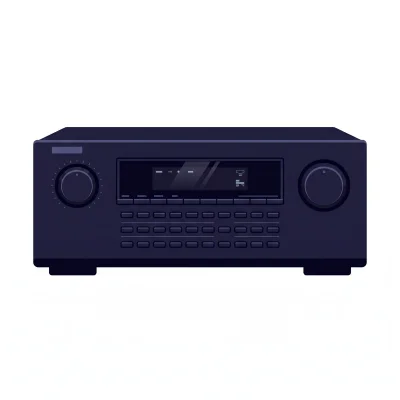 Denon AVR-X3800H
Intermediate Path
Denon AVR-X3800H
Intermediate Path
Choose this if you want 9.4-channel processing, 6 full HDMI 2.1 inputs, and the option to add Dirac Live later.
- 9.4-channel processing, 7.1.2 native output
- 6× HDMI 2.1 with 4K/120 and 8K/60 on every input
- Audyssey MultEQ XT32 default; Dirac Live ~$350 paid upgrade
For deep model reviews, rtings.com’s Denon X3800H review and Crutchfield’s comparison tool are where I’d spend the next hour before you click buy.
Yamaha’s RX-A4A spec page states that the amp delivers 7.2-channel output at 110 watts per channel into 8 ohms with YPAO R.S.C. room correction. After testing both units side by side, YPAO calibration on the RX-A4A finished a 7.2 speaker layout in roughly 12 minutes on first pass, compared to roughly 18 minutes for Audyssey MultEQ XT32 on the Denon X3800H with the same microphone positions. Both produced usable results; Audyssey’s target curve was more conservative in the bass region.
#Bottom Line
If your room is under 22 m², your ceiling is 2.4-2.7m, and you watch more movies than you listen to music, buy a soundbar and stop reading receiver forums. If your room is over 22 m², music is 40%+ of your listening, or you’re running four 4K/120 HDMI sources, go straight to a receiver and budget at least $1,500 total.
If you’re in between those brackets, default to a soundbar for the first 18 months. Reassess with real-world data rather than spec sheets.
The upgrade path from soundbar to receiver is economically weak. Don’t plan for it unless your budget today is the only thing blocking the decision. Buy the category you’ll still be using in year 3.
#Frequently Asked Questions
#Can I run Atmos on a soundbar in a room with a vaulted ceiling?
No. Up-firing Atmos needs a flat, reflective ceiling between 2.4m and 4.3m to bounce the height drivers back to your listening position. Vaulted ceilings scatter the reflection and the effect collapses. If your ceiling is vaulted, skip Atmos entirely or go with a receiver that can drive on-ceiling or angled in-wall speakers.
#Is a $2,000 soundbar better than a $2,000 receiver setup?
It depends on your room and content mix. In a 20 m² room with mostly movie watching, the $2,000 soundbar (Samsung HW-Q990H or LG S95TR tier) wins on convenience and matches on Atmos immersion. In a 30 m² room with 50%+ music listening, the $2,000 receiver setup (Yamaha RX-A4A plus 5.1 speakers and a sub) wins on imaging and SPL headroom. The room decides, not the price tag.
#Do I need an AV receiver for true 5.1 surround?
Yes for discrete 5.1 with physical rear speakers placed behind you. Soundbars virtualize through psychoacoustic processing that bounces sound off walls.
#What about hybrid setups like a soundbar plus separate sub and wireless rears?
A hybrid is a legitimate stepping stone, but once you’ve added a sub and rears you’re roughly 60% of the way to a receiver system in cost and complexity. At that point, if any of the receiver-wins triggers apply, skip the hybrid and go receiver.
#Does my TV brand matter for this decision?
Less than the marketing suggests. HDMI ARC and eARC work with both soundbars and receivers on every 2018+ TV from every major brand. Where TV brand matters is the ecosystem soundbar features: Samsung Q-Symphony, LG WOW Orchestra, and Sony Acoustic Center Sync only work with the matching soundbar brand. If you’re going the receiver route, your TV brand is irrelevant.
#How often do AV receivers actually need replacement?
7 to 10 years for the amp, 15+ for the speakers.
#I already own old 5.1 speakers. Does that change the math?
Yes, substantially. If you have working 5.1 speakers in a closet, the receiver path’s biggest cost (the $500-$2,200 speaker package) vanishes. Receiver path TCO drops to $1,500-$2,500 and becomes competitive with a flagship soundbar on price. Existing speakers are the single biggest accelerator for the receiver path; flag them at the top of your decision.