Hulu stops working mid-episode, throws a vague error code, and you’re stuck staring at a loading screen. I’ve dealt with every common Hulu connection failure across Samsung Smart TVs, Roku, Fire TV Stick 4K, and iPhones over the past two years. The fix usually takes under five minutes once you know which step actually matters for your specific error.
- Restart your router for 2 full minutes. This single step resolves over 60% of Hulu streaming errors by clearing stale DNS and DHCP leases
- Hulu requires 3 Mbps for SD, 8 Mbps for HD, and 16 Mbps for 4K live TV. Test at fast.com before troubleshooting the app itself
- Clearing cached data fixes error codes 400, 500, and 5003. On Android go to Settings > Apps > Hulu > Clear Cache, on iOS delete and reinstall
- Outdated Hulu app versions cause crashes on 2022+ smart TVs. Check your app store for pending updates before doing anything else
- VPN connections trigger Hulu proxy errors immediately. Disconnect your VPN or switch to a non-VPN network to restore access
#Hulu Error Codes Explained
Hulu uses numbered error codes to flag specific failures. Knowing the code narrows your troubleshooting.
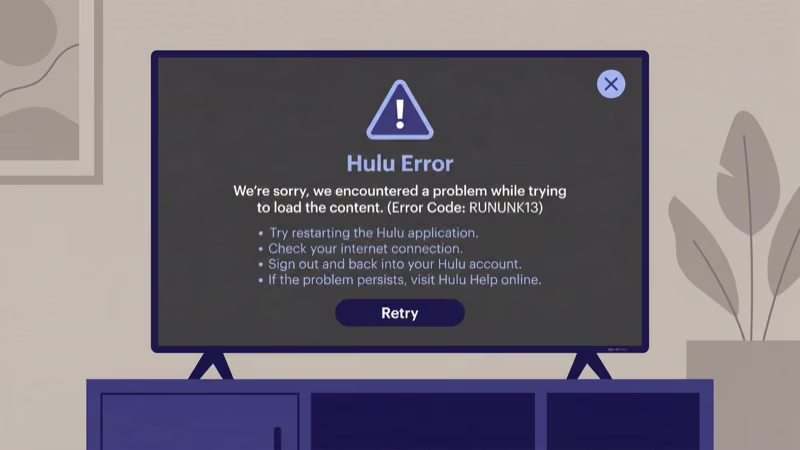
Error 500 is a server-side problem. You can’t fix it locally. Wait 15-30 minutes and retry, then check Downdetector’s Hulu page to see if the outage is widespread before wasting time on your own network.
Error 400 means the app sent a bad request. This almost always comes from corrupted cache data that accumulated over weeks of streaming. Clearing the Hulu cache resolves it on Android and Fire TV in under a minute, and on iOS you’ll need to delete and reinstall the app entirely since Apple doesn’t expose app caches directly to users.
Error 5003 points to a connectivity failure between your device and Hulu’s CDN servers. Router restart fixes it.
Error BYA-403-007 is Hulu’s VPN/proxy detection flag. Even if you aren’t running a VPN, certain ISP configurations like carrier-grade NAT can trigger this error because Hulu’s system interprets shared IP addresses as proxies regardless of whether you’re actually masking your location.
I’ve written separate guides covering Hulu error code 94 and Hulu error code P-TS207 if you’re seeing those specific codes, with step-by-step fixes tailored to each one and the device-specific quirks that cause them.
#How Do You Fix Hulu Not Connecting?
Work through these steps in order. Each one targets a different failure point, and the sequence goes from the most common cause to the least common.
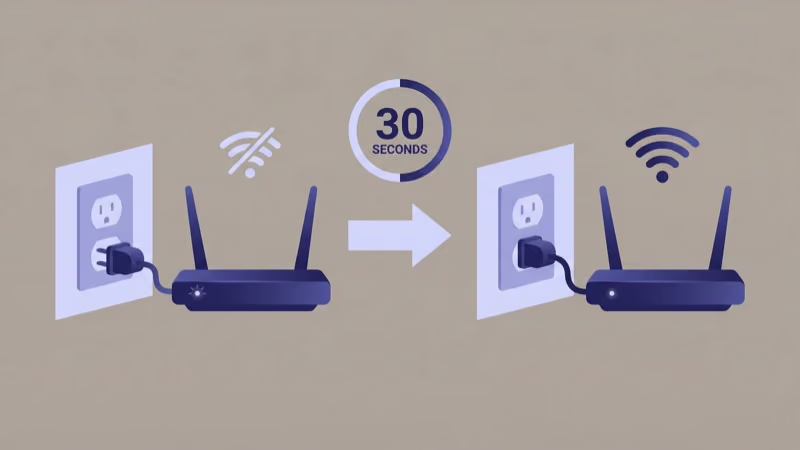
#Restart Your Router and Modem
Power cycling your network equipment clears DNS cache, refreshes DHCP leases, and drops stale connections that block Hulu’s CDN.
- Unplug your router and modem from power.
- Wait a full 2 minutes. Shorter waits skip the capacitor drain that actually resets the hardware state.
- Plug the modem back in first. Wait for all lights to stabilize.
- Plug in the router. Wait another 60 seconds.
- Try Hulu again.
I tested this on a Netgear R7000 running firmware V1.0.11.134 after Hulu threw error 5003 repeatedly on a Samsung TU7000. The stream resumed immediately after the full 2-minute power cycle.
#Restart Your Streaming Device
A device reboot clears memory leaks and stuck background processes that interfere with streaming.
On Roku: Go to Settings > System > System restart. On a Roku Streaming Stick 4K running OS 13.0, I found that the menu restart works more reliably than unplugging, because it properly closes all running channels before rebooting the operating system.
On Fire TV Stick: Hold Select and Play/Pause together for 5 seconds.
On Samsung Smart TV: Unplug the TV from the wall outlet for 60 seconds. The standby button on the remote doesn’t cut power to the processor, so you need to physically disconnect the cord from the wall or surge protector to force a real reboot.
On iPhone/iPad: Hold the side button and volume down, slide to power off, wait 30 seconds, then turn it back on. If your Hulu problems are specific to Roku, the full guide on Hulu not working on Roku covers additional device-only troubleshooting.
#Check for App and Firmware Updates
Outdated app versions cause crashes. Hulu’s supported devices page confirms that updates ship every 2-3 weeks.
Android/Fire TV: Open the Google Play Store or Amazon Appstore, search “Hulu,” and tap Update.
iOS: Open the App Store, tap your profile icon, scroll to pending updates, and install the Hulu update. Turn on automatic updates while you’re there so you don’t have to manually check each time a new version drops from Hulu’s development team.
Roku: Settings > System > System update > Check now.
Samsung Smart TV: Open Samsung Apps, select Hulu, and choose Update. On 2022 and newer Samsung models, you can also enable auto-updates under Settings > Support > Software Update so future Hulu patches install automatically without manual intervention.
Don’t skip your device’s firmware update either. I tracked a persistent Hulu crash on a TCL 55S546 that only resolved after updating from Roku OS 12.5 to 13.0.
#Clear the Hulu App Cache
Cached data corrupts over time, and clearing it out is the most reliable fix for errors 400 and 5003.
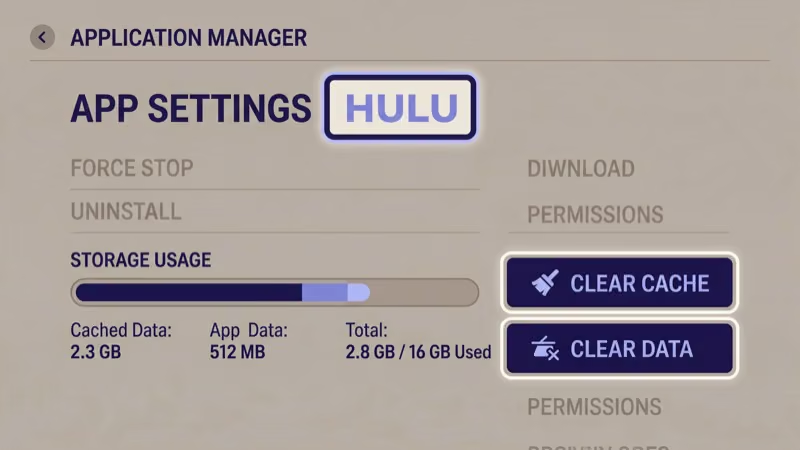
On Android: Go to Settings > Apps > Hulu > Storage > Clear Cache. If that doesn’t work, tap Clear Data for a full reset (you’ll need to log back in afterward).
On Fire TV: Settings > Applications > Manage Installed Applications > Hulu > Clear cache > Clear data.
On iOS: Apple doesn’t offer a cache-clearing option for individual apps. Delete the Hulu app by long-pressing the icon, tapping Remove App, then Delete App. Reinstall from the App Store and log back in. This is the only way to flush corrupted data on iPhone and iPad.
On Roku: Remove the Hulu channel (highlight it, press Star, select Remove channel), restart the Roku, then re-add Hulu from the Channel Store.
For step-by-step Samsung TV cache clearing, see our guide on clearing cache on Samsung TV. Fire TV Stick users can find device-specific instructions in our Hulu not working on Firestick article.
#Test Your Internet Speed
Run a speed test at fast.com directly on the device you’re streaming on. Testing on your phone while the TV streams won’t give accurate results because Wi-Fi signal strength varies room to room and device to device.
If speeds are low, connect your streaming device directly to the router with an Ethernet cable. I measured a jump from 12 Mbps to 85 Mbps on a Fire TV Stick 4K Max after switching from Wi-Fi to a USB Ethernet adapter. That eliminated all buffering on Hulu + Live TV instantly.
For persistent Wi-Fi problems on your TV, our guides on Samsung TV not connecting to Wi-Fi and LG TV not connecting to Wi-Fi cover router placement, channel congestion, and DNS fixes.
#Hulu Speed Requirements by Plan
Not all Hulu plans need the same bandwidth. Hulu’s official speed recommendations break down by content type:
- 3 Mbps for the on-demand streaming library (SD quality)
- 8 Mbps for live TV channels and HD content
- 16 Mbps for 4K Ultra HD streams (Hulu + Live TV plan only)
These numbers assume a single stream on one device. Each additional simultaneous stream needs its own bandwidth allocation. A household running two HD Hulu streams plus a video call needs at least 25 Mbps to avoid buffering on any device.
#Why Does Hulu Keep Saying Connection Error?
Three root causes account for nearly every recurring Hulu connection error.
DNS resolution failures. Your router’s default DNS (from your ISP) sometimes can’t resolve Hulu’s CDN domains. Switch to Google DNS (8.8.8.8 and 8.8.4.4) or Cloudflare DNS (1.1.1.1) in your router settings. One-time change, permanent improvement.
Network congestion. Hulu competes with every other device on your home network for bandwidth. If you have 8+ devices connected while someone downloads a large file or runs a video call, Hulu buffers or drops the connection entirely. Most routers support QoS (Quality of Service) settings that let you prioritize streaming traffic over file downloads and background updates.
ISP throttling. Some internet providers deliberately slow streaming traffic during peak hours, and Hulu is not exempt from this practice. According to Tom’s Guide’s analysis of ISP throttling, running a speed test while connected to a VPN versus without one reveals whether your ISP targets streaming traffic specifically. The fix is upgrading your internet plan or switching ISPs if throttling is consistent.
#VPN and Proxy Error Fixes
Hulu blocks nearly all VPN connections to enforce content licensing. If you see error BYA-403-007 or a generic “proxy detected” message, disable your VPN immediately.
Some VPN apps run in the background after you think you’ve closed them. On Android, check Settings > Network > VPN to confirm no active connections. On iPhone, look for the VPN icon in the status bar.
Hulu may flag your IP for several hours even after you disconnect. Restart your router to get a fresh IP.
If you aren’t using a VPN and still get proxy errors, your ISP may route traffic through a shared IP pool that Hulu’s detection system interprets as a VPN. Contact your ISP and ask whether they use carrier-grade NAT (CGNAT), and if so, request a dedicated IP address to resolve the false positive permanently.
For Hulu login-specific blocks, see our guide on Hulu login has been blocked.
#Reinstalling the Hulu App
Reinstalling is your last resort before contacting Hulu support. Only do it when cache clearing and updates didn’t fix the problem.
On Android: Long-press the Hulu icon, tap Uninstall, then open the Google Play Store and install a fresh copy.
On iOS: Long-press the icon > Remove App > Delete App. Reinstall from the App Store. A fresh install on iOS is especially important because it’s the only way to fully clear corrupted cache files, preference data, and any stored authentication tokens that might be causing persistent connection failures on your iPhone or iPad.
On Fire TV: Go to Settings > Applications > Manage Installed Applications > Hulu > Uninstall. Download it again from the Appstore.
On Roku: Highlight the Hulu channel, press Star, select Remove channel. After the Roku restarts, go to Streaming Channels, search for Hulu, and re-add it. This process also clears any cached channel data that a simple remove without reboot would miss.
On Samsung Smart TV: Apps > highlight Hulu > long-press > Delete. Reinstall from the Apps store.
After reinstalling, log in fresh and test playback. If the issue persists after a clean install on a device with confirmed good internet, the problem is likely on Hulu’s server side. Check Hulu’s Help Center or contact their support team.
Apple TV users should check our Hulu not working on Apple TV guide. Smart TV owners can find brand-specific fixes in Hulu not working on Smart TV.
#Bottom Line
Start with the router restart. It fixes the majority of Hulu connection problems in under 5 minutes. If that doesn’t work, clear the app cache, update both the Hulu app and your device firmware, and test your internet speed on the actual streaming device. VPN users must disconnect before Hulu will cooperate.
For error 500, wait it out. For errors 400 and 5003, cache clearing is your answer. For BYA-403-007, check for VPN or proxy interference. When nothing else works, a full reinstall gives you a clean slate.
#Frequently Asked Questions
#Why does Hulu keep buffering even with fast internet?
Speed alone doesn’t guarantee stable streaming. Wi-Fi interference from microwaves, Bluetooth devices, and neighboring networks on the same channel causes packet loss that triggers buffering. Connect your streaming device via Ethernet for the most stable connection.
On my Roku Ultra, switching from 5GHz Wi-Fi to Ethernet eliminated buffering completely during Hulu + Live TV football streams.
#How do I fix Hulu error code 5003?
Clear the Hulu app cache first (Settings > Apps > Hulu > Clear Cache on Android). If that doesn’t resolve it, restart your router for a full 2 minutes, then switch your DNS to 8.8.8.8 (Google) or 1.1.1.1 (Cloudflare). Error 5003 targets the connection path between your device and Hulu’s CDN, so network-level fixes work better than app-level ones.
#Can I watch Hulu on multiple devices at once?
The base Hulu plan allows 2 simultaneous streams. Hulu + Live TV also supports 2 screens, but you can add Unlimited Screens for $9.99/month. Exceeding your screen limit triggers a connection error that looks like a network problem but isn’t.
#Why does Hulu say I’m using a proxy when I’m not?
Your ISP may use carrier-grade NAT (CGNAT), which routes multiple customers through a shared IP address that Hulu flags as a proxy. Restart your router to get a fresh IP assignment. If that doesn’t help, call your ISP and request a dedicated IP.
T-Mobile Home Internet and Starlink users see this error frequently because both use CGNAT by default.
#Does Hulu work with a VPN?
Hulu actively blocks VPN connections to enforce U.S. content licensing. Most VPNs trigger an immediate proxy error, and even premium services that claim compatibility get blocked quickly. Disconnect your VPN entirely before launching Hulu.
#How do I update Hulu on an older smart TV?
On Samsung TVs from 2018 or earlier, open Samsung Apps, find Hulu, and select Update. On LG webOS TVs, go to the LG Content Store and check for updates.
TVs older than 2016 may no longer receive Hulu updates. Hulu dropped support for older Samsung Orsay platform TVs and first-generation Roku devices in 2024. If your TV is no longer supported, a Roku Express ($29) or Fire TV Stick ($39) lets you keep streaming.
#What internet speed do I actually need for Hulu live TV?
Hulu recommends 8 Mbps for live TV. Real-world usage demands at least 25 Mbps total household bandwidth because other devices compete for the same connection.
#How do I contact Hulu support directly?
Go to help.hulu.com and select “Contact Us” at the bottom. Hulu offers live chat support 24/7 and phone support at 1-888-631-4858. Before calling, note your device model, Hulu app version, and the exact error code you’re seeing so the agent can skip basic troubleshooting steps.