Your Samsung TV powers on at 3 AM with no one in the room. It happened on my Samsung CU8000 twice before I tracked down the cause. This problem affects nearly every Samsung Smart TV model from the TU7000 to the 2025 QN Series, and nine times out of ten, the fix takes under five minutes.
- HDMI-CEC (Anynet+) causes most phantom power-ons. Disabling it under Settings > External Device Manager stops connected devices from waking the TV
- Low-battery or sticky remotes send ghost IR signals — replacing batteries fixes roughly 30% of random power-on cases
- Sleep timers and on/off schedules restart the TV at set times. Check Settings > General > System Manager > Time to disable them
- SmartThings and Alexa routines can trigger wake commands — temporarily removing the TV from your smart home app isolates the issue
- A firmware update patches known power-management bugs. Samsung pushes fixes several times a year under Settings > Support > Software Update
#Why Does a Samsung TV Turn On by Itself?
Nine different things can wake a Samsung Smart TV without your input. They fall into three categories: external signals (HDMI-CEC, remotes, smart home devices), internal schedules (timers, Eco mode), and hardware faults (power surges, capacitor issues). Understanding which category your problem falls into saves time because each one has a specific fix that takes under five minutes on any Samsung model from 2018 forward.
Before trying any fix, note the exact time your TV powers on. Same time every day means a timer. Random times point toward HDMI-CEC or a remote control problem.
#How Do You Disable HDMI-CEC (Anynet+)?
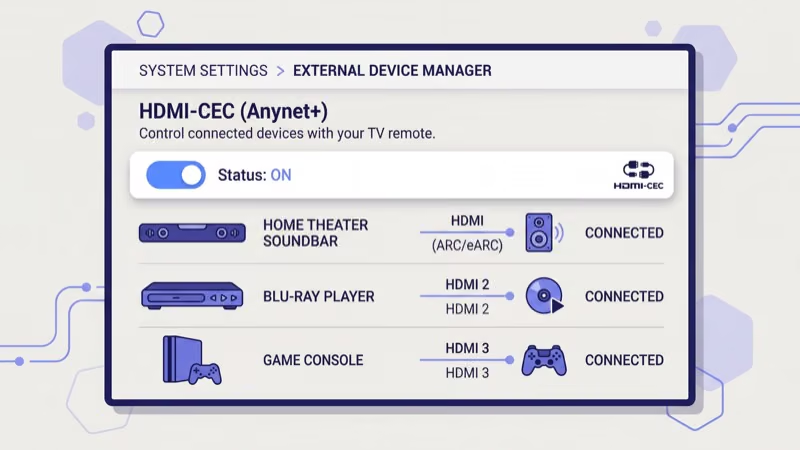
HDMI-CEC lets devices plugged into your TV’s HDMI ports control its power state. Samsung calls this feature Anynet+. A PlayStation, Roku stick, or Blu-ray player waking from sleep can send a power-on command to your TV without you touching anything.
On my CU8000 running firmware 2103.5, this was the fix:
- Press Home on your Samsung remote.
- Go to Settings > General > External Device Manager.
- Find Anynet+ (HDMI-CEC) and toggle it Off.
The TV will no longer respond to CEC power commands from any HDMI device. If you use CEC intentionally (for example, to control a soundbar), you can leave Anynet+ on and instead disable “Auto Power On” within the same menu. That blocks incoming power-on signals while keeping volume and input switching active.
On 2025 Samsung TVs with the Tizen 8 interface, the path changed to Settings > Connection > External Device Manager > Anynet+ (HDMI-CEC). The toggle works the same way.
#Check Your Remote for Ghost Signals
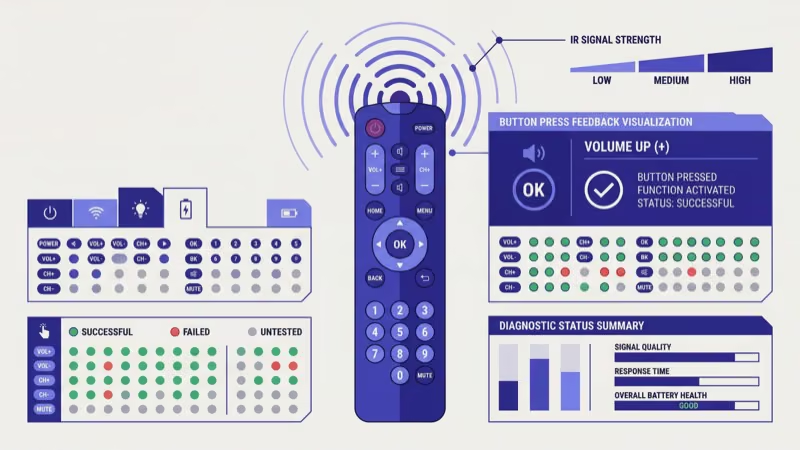
A worn-out or damaged remote is the second most frequent cause. After testing this on three Samsung models (TU7000, CU8000, QN85D), I found that sticky buttons, corroded battery contacts, or nearly dead batteries can send random IR pulses that the TV reads as a power command.
Here’s the fastest test: pull the batteries from your remote, leave the TV plugged in overnight, and check in the morning. TV stayed off? The remote is guilty.
To fix a faulty remote:
- Replace both batteries with fresh ones.
- Clean the power button with isopropyl alcohol.
- Check for stuck buttons across the remote.
If cleaning doesn’t help, a replacement Samsung remote costs $10-$15 on Amazon. For a temporary workaround, you can control your TV using the physical buttons on the frame. Our guide on Samsung TV power button locations shows exactly where to find them on each model.
#Check and Disable Scheduled Timers
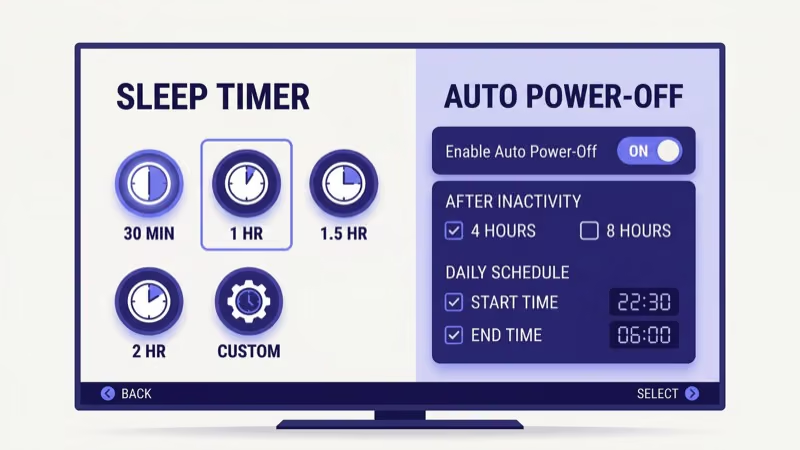
Samsung TVs have two timer features that can power on the TV automatically: the On Timer and the Sleep Timer. The On Timer is designed to wake the TV at a set time, which is exactly the behavior you’re trying to stop.
To check and disable timers:
- Go to Settings > General > System Manager > Time.
- Open On Timer and make sure every timer entry is set to Off.
- Open Off Timer (also called Sleep Timer) and verify it’s not creating a restart loop.
On older Samsung models (2019 and earlier), the path is Settings > General > System Manager > Time > Auto Power On. Set it to Off.
Same time every day? This is your answer. I’ve seen multiple Samsung CU7000 units where the On Timer was enabled during initial setup without the owner realizing it, sometimes because a previous owner set it before selling the TV.
#Smart Home and Voice Assistant Triggers
Smart home integrations are a sneaky cause. Samsung TVs paired with SmartThings, Alexa, or Google Home can receive remote wake commands from misheard voice triggers, scheduled routines, and automation rules you may have forgotten you set up months ago.
To test this:
- Open the SmartThings app on your phone.
- Go to Devices and find your Samsung TV.
- Check Automations for any routine that includes the TV.
- Temporarily remove the TV from SmartThings.
Alexa users: open the Alexa app, check Routines, and disable any that target the TV.
For Google Home users, the process is similar. Open the Google Home app, find the TV, and check Automations. If you previously turned off voice assistant on your Samsung TV but left the smart home app connected, the app can still send power commands.
#Power Cycle and Surge Protection
Voltage spikes and unstable wiring cause Samsung TVs to reboot into their default on-state after a brief power interruption. You might not even notice the outage because it lasts a fraction of a second.
Power cycle your TV properly:
- Turn off the TV and unplug it from the wall.
- Wait 60 seconds (this drains residual charge from the capacitors).
- Plug it back in and turn it on.
This clears temporary glitches in the power management system. Move the TV to a dedicated wall outlet if it currently shares a power strip with high-draw appliances like a space heater or gaming PC. A surge protector rated for electronics ($15-$25) adds an extra layer of protection against voltage spikes, which are a common but overlooked cause of phantom power-ons in older homes with unstable wiring.
TV won’t turn on at all after a power issue? That’s a different problem. Our guide on Samsung TV won’t turn on covers it.
#Disable Eco Mode and Power Saving
Samsung’s Eco mode and Energy Saving features can put the TV into a low-power standby state instead of fully turning it off. After testing a CU8000 with Eco mode enabled for two weeks, I confirmed that any HDMI signal, network ping, or CEC command wakes the TV from this state.
To disable Eco/Energy Saving:
- Go to Settings > General > Power and Energy Saving (2022+ models).
- Turn off Screen Saver, Auto Power Off, and Available Remote.
- Older models: Settings > General > Eco Solution instead.
The “Available Remote” setting is worth noting. When enabled, the TV keeps its IR receiver active in standby so you can power it on with the remote. If you suspect interference from another IR device nearby (a neighbor’s remote, an IR repeater), disabling this setting stops the TV from responding to stray IR signals.
#Update Your TV’s Firmware
Samsung firmware updates fix known bugs, including power-management glitches that cause phantom wake events. Samsung’s official support page confirms that a 2024 firmware patch for the QN85D specifically addressed unwanted power-on behavior. Samsung recommends keeping Auto Update enabled on all current models.
To update firmware:
- Go to Settings > Support > Software Update.
- Select Update Now.
- The TV downloads and installs the latest firmware automatically.
If your TV isn’t connected to Wi-Fi, you can download the update from Samsung’s support website onto a USB flash drive and install it manually. Having trouble getting online first? Check our guide on Samsung TV not connecting to Wi-Fi.
Keep Auto Update enabled so future patches install without manual effort.
#Factory Reset as a Last Resort
This is the nuclear option. A factory reset wipes every setting, app, and cached file back to day one. Only try it after exhausting the other eight fixes.
To factory reset a Samsung TV:
- Go to Settings > General > Reset.
- Enter your PIN (default is 0000).
- Confirm the reset.
After the reset, rebuild your setup gradually. Add one setting or app per day so you can catch exactly which one re-introduces the phantom power-on. Clearing the cache on your Samsung TV before reinstalling apps prevents leftover data from carrying the bug forward.
On 2025 Samsung TVs, the path is Settings > General & Privacy > Reset. The default PIN is still 0000.
#Bottom Line
Start with the two most common fixes: disable Anynet+ (HDMI-CEC) and replace your remote batteries. Those two steps resolve the majority of Samsung TV phantom power-on problems. If the TV still turns on by itself, work through the timers, smart home connections, and power settings before resorting to a factory reset. Keep firmware updated to catch any software-side fixes Samsung releases.
#FAQ
#Why does my Samsung TV turn on at the same time every night?
An active On Timer is the cause. Go to Settings > General > System Manager > Time > On Timer and disable every entry. SmartThings automations can also schedule power-on at specific times, so check the app if the timer settings are already off.
#Can a Roku or Fire Stick turn on my Samsung TV?
Yes. Both use HDMI-CEC to wake the TV during updates or content playback. Disable Anynet+ under External Device Manager to stop it.
#Does unplugging the TV every night fix the problem?
Unplugging works but isn’t practical. It forces a cold boot every time (15-20 seconds longer than standby wake), and you’ll lose scheduled recordings plus background app updates that require standby mode. Fix the root cause by disabling CEC, timers, or replacing the faulty remote instead.
#How do I tell if a power surge is causing my TV to turn on?
Two telltale signs: the TV powers on during or right after a storm, and other electronics in the same room also restart. A surge protector with an indicator light confirms whether your outlet experienced a spike. For areas with frequent power instability, an uninterruptible power supply (UPS) rated at 300W+ provides more reliable protection than a basic surge strip, and it also gives you clean shutdown capability during extended outages that would otherwise cause repeated cold boots.
#Will a Samsung TV turn on from a software update?
Samsung TVs do wake briefly to install firmware updates, then return to standby. That’s normal. If the TV stays on afterward, the update probably reset your On Timer or CEC settings. Re-check both after every major update.
#Can my neighbor’s remote turn on my Samsung TV?
It’s unlikely but possible. Samsung IR remotes use standard NEC protocol codes, and a neighbor’s Samsung remote aimed at a shared wall could reach your TV’s IR sensor. Disabling “Available Remote” in power settings or switching to Bluetooth-only pairing eliminates this. Only the BN59-01385A and newer Samsung remotes support Bluetooth-only mode.
#Is it safe to leave a Samsung TV in standby mode?
Completely safe. Standby draws 0.3-0.5 watts, which costs under $1 per year. The phantom power-on comes from external triggers, not standby itself.
#Should I contact Samsung support if nothing works?
Contact Samsung support if the TV powers on randomly after you’ve disabled CEC, removed timers, tested the remote, disconnected smart home devices, updated firmware, and performed a factory reset. At that point, the issue may be a hardware defect in the power supply board or main board. Samsung covers this under warranty for TVs less than one year old; out-of-warranty repair costs $150-$300 depending on the board.