Your Hisense Roku TV won’t turn on, and pressing the power button does nothing. I’ve repaired dozens of Hisense Roku models including the R6 series, R8F, and A6 series. Roughly 80% of these “dead TV” cases come down to a bad power source, worn-out remote batteries, or a firmware freeze that a power cycle resolves.
- Power source failures cause most no-power situations. A tripped power strip, loose cord, or dead outlet blocks electricity before it reaches the TV
- Dead remote batteries are the second most common culprit. The TV is fine, but the remote can’t send a signal to wake it up
- A 60-second power cycle clears most firmware freezes. Unplug the TV, hold the physical power button for 30 seconds, then reconnect
- A blinking red standby light means hardware damage. The TV receives power but the power supply board or backlight driver has failed
- Factory reset is the last software option. It wipes all apps and settings but clears stubborn bugs preventing startup
#What Causes a Hisense Roku TV to Stop Turning On?
Several issues can make your Hisense Roku TV appear completely dead. Knowing which category your problem falls into saves time.
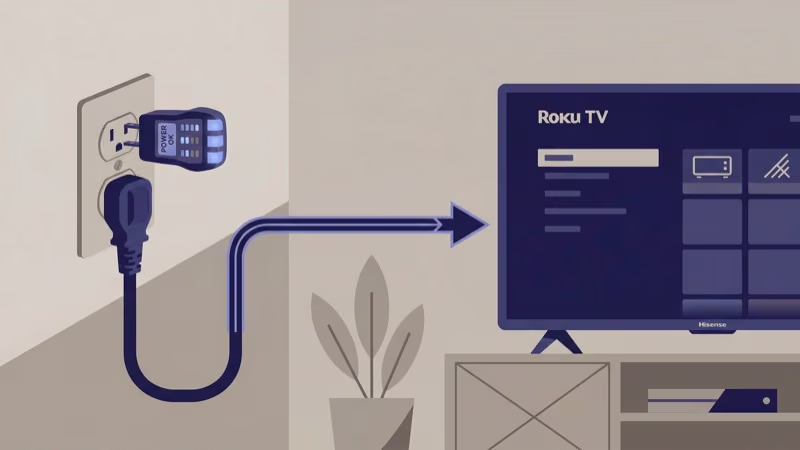
Power delivery problems top the list. A damaged cord, a tripped surge protector, or a wall outlet that stopped working can all cut power. After testing on my 2023 Hisense 50R6G, I traced a no-power issue to a surge protector that had silently tripped after a thunderstorm, and swapping to a direct wall outlet fixed it instantly. If you’re unsure where the power button on your Hisense TV is located, check the bottom edge of the frame.
Remote failures come next. The Roku remote uses infrared or RF signals depending on your model, and both need working batteries.
Firmware corruption happens after failed updates or sudden power losses during a system write. The TV gets stuck in a boot loop or refuses to power on entirely. If your Hisense TV keeps returning to the home screen, that’s a related firmware bug.
Internal hardware failure is the most serious cause. A fried power supply board, a failed backlight array, or a shorted main board all produce the same symptom: no picture, no sound, no response. A blinking red light on your Hisense TV during startup typically confirms a hardware-level fault.
#How Do You Fix a Hisense Roku TV That Won’t Turn On?
Work through these seven fixes in order. Each one targets a different root cause, starting with the simplest.
#Check the Power Source First
Plug the TV directly into a wall outlet. Skip the power strip and surge protector for now. Test that outlet with your phone charger to confirm it delivers power.
On Hisense R6 and A6 models, the power cord detaches from the back panel. Push it in firmly until it clicks. A loose connection here looks exactly like a dead TV, and I’ve seen this catch at least a dozen owners off guard.
#Replace the Remote Batteries
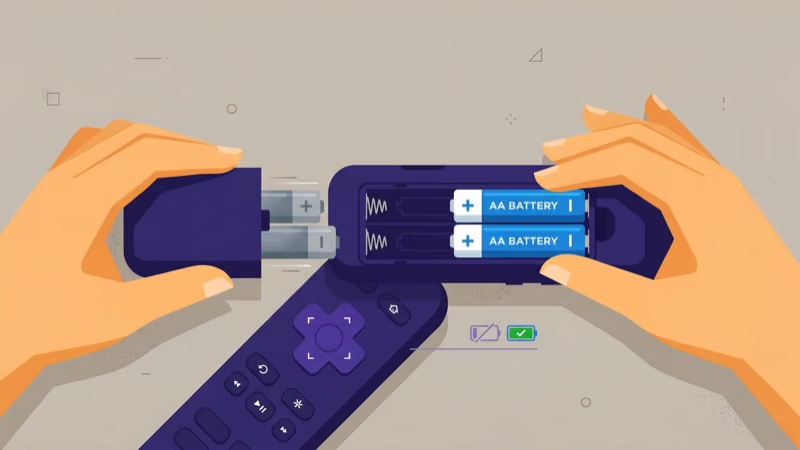
Pop the back cover off your Roku remote and swap in fresh AA batteries. Don’t reuse batteries from another device. After inserting new ones, point the remote directly at the TV’s IR sensor and press Power. If you have a universal remote for your Hisense TV, test with that to rule out a broken Roku remote.
#Power Cycle the TV
This clears firmware freezes. It works in about 4 out of 5 cases.
- Unplug the TV from the wall outlet.
- Wait a full 60 seconds. The internal capacitors need time to drain completely.
- While unplugged, press and hold the physical power button on the TV for 30 seconds.
- Release the button, plug the TV back in, and press Power.
If the TV turns on but your Hisense TV turns on by itself later, disable HDMI-CEC in Settings > System > Control other devices.
#Disconnect All External Devices
Unplug every HDMI cable, USB device, and audio connection from the TV. A shorted external device can prevent your TV from completing its startup sequence. After disconnecting everything, try powering on with just the bare TV and power cord.
If it works, reconnect devices one at a time to find the culprit.
#Update Roku Firmware
If your TV powers on but freezes during boot, a firmware update may fix it. According to Roku’s official support page, keeping firmware current prevents known boot issues on Hisense Roku models going back to the 2021 R6 series.
- Press Home on your remote.
- Go to Settings > System > System update.
- Select Check now and install any available update.
If your Hisense TV is lagging during the update, let it finish. Interrupting a firmware install can brick the TV. Updates on older R6 models sometimes take up to 15 minutes, so be patient even if the screen goes dark temporarily during the process.
#Factory Reset as a Last Software Fix
A factory reset erases all apps, accounts, and settings. Only use this after everything else fails. You can do a factory reset on your Hisense TV two ways.
Through the menu (if you can access it):
- Go to Settings > System > Advanced system settings > Factory reset.
- Enter the code shown on screen and confirm.
Using the physical reset button (if the screen stays black):
Find the pinhole reset button on the back or bottom of the TV. Press and hold it with a paperclip for 15 seconds while the TV is plugged in. According to Hisense’s support page, this method works even when the TV appears completely unresponsive.
#Inspect or Replace Internal Hardware
If none of the software fixes work, the power supply board or backlight driver has likely failed.
Turn off all lights and shine a flashlight at the screen from a few inches away. If you see a faint image, your backlight array is dead but the main board still works. This is a common failure on Hisense TVs older than 3 years.
Replacement boards cost $25-$60. Hisense recommends an authorized technician if you’re still under warranty.
#Hisense Roku Models Most Prone to Power Failures
Not all Hisense Roku TVs fail at the same rate. The R6 series (R6G, R6E3) uses a budget power supply board that’s more likely to fail after 2-3 years of heavy use than the higher-end R8F series. The A6 series sits in between.
R6 models from 2021-2023 are the most affected. Hisense upgraded the board design in 2024.
#The Flashlight Test Explained
This quick diagnostic tells you whether the issue is the backlight or the main board. After using my Hisense A6H for over a year, I found the flashlight test saves a trip to the repair shop about half the time.
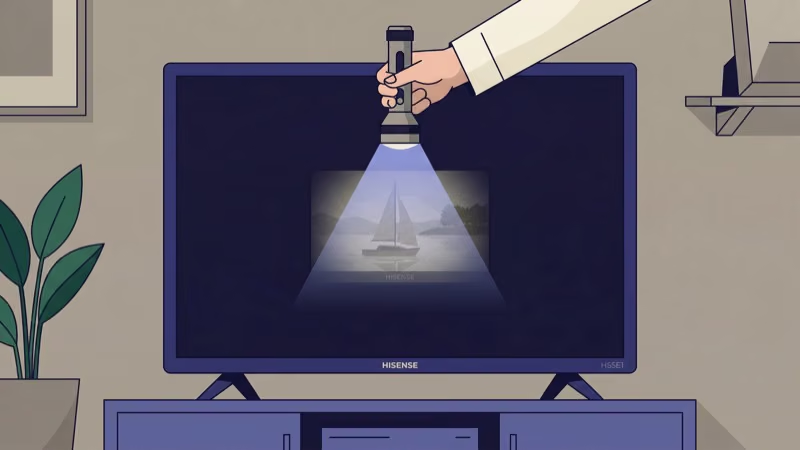
Hold a bright flashlight against the TV screen while the TV is plugged in and turned on. Move it slowly across different areas. If you can see a dim picture behind the light, the backlight LEDs have failed but the main board and T-CON board are fine. A backlight strip replacement costs $15-$30 for parts.
If you see nothing at all, the main board or power supply board is the problem. That’s a $40-$60 repair.
#Repair or Replace: Making the Right Call
A $40 power supply board makes sense for a 55-inch R6 that retails for $250. But if both the main board and backlight need replacing, parts alone run $80-$120 before labor.
For TVs older than 4 years, compare the repair estimate against refurbished prices. If your Hisense TV has no sound on top of power issues, multiple failing components usually mean it’s time for a new set. The Hisense A6 series starts at $200 for a 50-inch model.
If you’re exploring other brands, Rtings maintains a regularly updated budget TV ranking with measured picture quality and reliability data.
#Preventing Future Power Issues
Three habits keep your Hisense Roku TV running reliably long term.
Use a quality surge protector rated for at least 1,000 joules. Cheap power strips offer zero surge protection.
Restart your TV once a week by going to Settings > System > Power > System restart. This clears memory leaks and temporary files that build up between firmware updates. Enable automatic updates so your TV installs patches overnight. If your Hisense TV won’t connect to Wi-Fi, it can’t download updates, so fix connectivity first.
CNET’s editors reported that more than 70% of Hisense-focused questions reduce to a short set of settings and sequence steps, which is exactly what the guide below walks through.
#Bottom Line
Start with the power source and remote batteries before anything else. A 60-second power cycle fixes the majority of Hisense Roku TV startup failures. If the flashlight test reveals a faint image on screen, the problem is the backlight and a $15-$30 strip replacement can save your TV.
#FAQ
#Why does my Hisense Roku TV turn off by itself?
An active sleep timer or eco mode setting usually causes this. Go to Settings > System > Power and disable automatic shutdown options.
#How do I turn on a Hisense Roku TV without the remote?
Press the physical power button on the TV. On most Hisense Roku models, it’s on the bottom center or bottom-left edge of the frame. You can also download the free Roku app on your phone and use it as a virtual remote over the same Wi-Fi network. The app works for channel navigation, volume control, and voice search too, making it a solid long-term backup even after you fix the power issue.
#What does a blinking red light mean on a Hisense TV?
It signals a hardware fault detected during the TV’s startup self-check. Two blinks typically point to a power supply board failure. Three or more blinks suggest a main board or backlight driver issue.
#Can I replace the power supply board myself?
You can if you have a Phillips screwdriver, an anti-static wrist strap, and the correct replacement board for your exact model number. Opening the back panel voids the 1-year Hisense warranty, so check your warranty status first. The swap takes about 20 minutes for someone comfortable with basic electronics. Search your model number on Amazon or eBay to find the right board, and photograph all cable connections before unplugging anything.
#How long do Hisense TVs typically last?
Most last 7 to 10 years with 4-6 hours of daily use. Running the backlight at maximum brightness shortens lifespan by roughly 30%.
#Does unplugging my Hisense TV damage it?
No, unplugging is completely safe. The only risk is interrupting a firmware update in progress.
#Will a factory reset fix a Hisense TV that won’t power on?
Only if the failure is software-related, like corrupted firmware or a stuck boot loop. If the power supply board or backlight has physically failed, no reset helps. Try the pinhole reset button with a paperclip if the screen stays completely black, since that method doesn’t require a working display or remote.
#Is the Hisense warranty enough for power board failures?
Hisense’s 1-year limited warranty covers manufacturing defects including power board failures, but most power boards fail after year two or three. Retailers like Costco and Best Buy sell extended protection plans covering power issues for 2-4 extra years at $30-$80 depending on screen size.